Merchant of Venice."
And he may come before us as a political idealist in the character of Brutus in the tragedy of Julius Caesar, or a cultural idealist in Hamlet; and at last the great Shakespeare appears, the dramatist beyond the bounds of description, in King Lear and Macbeth.
As for his poetry, it compels us, like his theater, to doubt the truth of what history tells us of the poverty of his culture, for it stands upon a lofty summit; and I — as I said in the introduction to al-Mawa'id by Salah Labaki — hold that poetry, like every human creation, comes into being only after humanity has grown complete in the gifted soul, and it does not grow complete without culture. For that edifice — the edifice of civilization, which has been man's concern ever since man existed — is built by the inspired, those whose souls have accompanied all the stages of humanity and then summed up, through themselves, nations and ages, so that if they suffer, a people suffers, and if they yearn, a generation yearns!
The edifice, meanwhile, is one: it rises and grows complete and remains one through all the difference of ages and the multiplicity of the modes of expression — poetry, painting, and music; science, philosophy, and conduct. Whatever of all this belongs to the core of truth is a stone of that edifice.
As for the stamp of the individual gift, the difference of age and region, and the change of the expressive genre — these may affect the luster of the stone, its measure, or its position, but they do not take it out of being a stone, and a stone in that self-same edifice.
We hear of schools in poetry — realist, symbolist, impressionist — and of doctrines in philosophy that demolish one another; we hear of one age of literature that differs from another age, and of one climate of thought that stands far from another; then we wait patiently upon time, and behold, all of it, rightly seen, is summed up in a single human treasure, which we usually call the classical, or the edifice of civilization as I have called it here — in it every art has a wing and every thought a corner, every age a course of masonry and every genius a stone.
The design, however, is one, created by the genius of humanity, not the genius of a man; and its building takes the whole lifetime of history, which is not generous even with the lifespans of geniuses. And how many are the stones the generations have cast down far from that edifice, because their bearer could not reach the topmost course, or because they came from outside the design! For a builder who has no ladder adds nothing to the edifice — nor does one who has reached the top of the ladder with no new stones in his hands.
Culture and talent are both necessary in the building of civilization.
How, then, can we doubt the culture of one who has in the
edifice, like William Shakespeare, corners of alabaster and courses of marble!
And if I have tried to clothe this brief study in the simplest possible dress, it is for the sake of ease for the listeners. But I do not claim to have introduced anyone to Shakespeare, or to have known him myself. The trifling problems around him — how the scholars have studied them to satiety: the spelling of his name, the reality of his existence, the date of his birth, his errors of orthography, the authenticity of his portraits — on all these, volumes have been written; how much more, then, on his age, his life, his plays, and his poetry, which are what matter most?
Therefore I advise whoever wishes to enjoy what this great master has offered to the culture of man, and to its province of beauty in particular — I advise him to turn away from everything that has been and is being written about him, including this talk, and to read him calmly and attentively, time after time, and times after times, until he finds his way to the keys of his genius; then he will be assured a constructive delight, renewed every day to the end of his life, though his life should rival eternity!
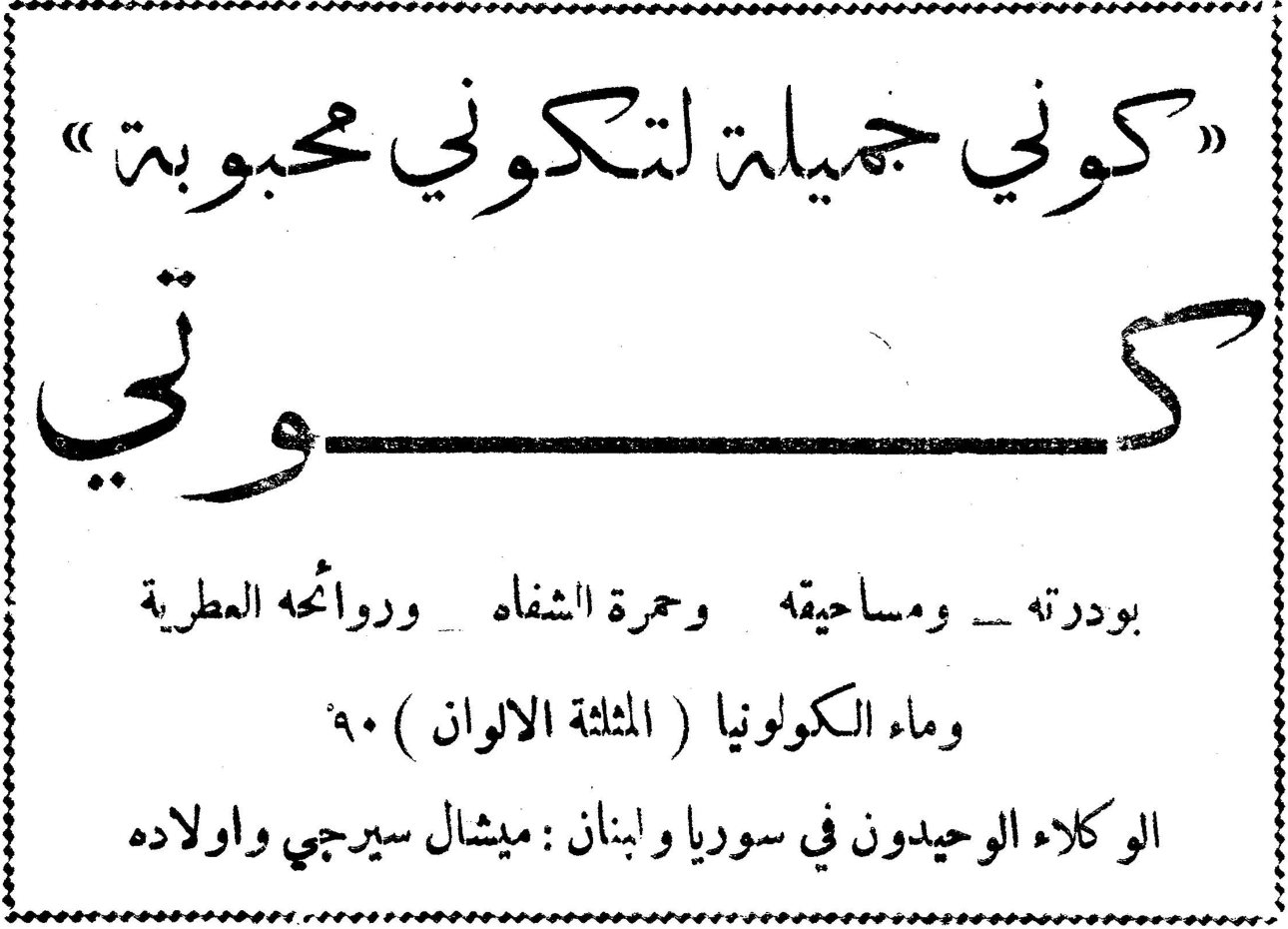
Coty
"Be beautiful, that you may be loved"
Coty
Its powder — its cosmetics, its lipstick, its perfumes, and its eau de Cologne (in the three colors) 90
Sole agents in Syria and Lebanon: Michel Sergi and Sons