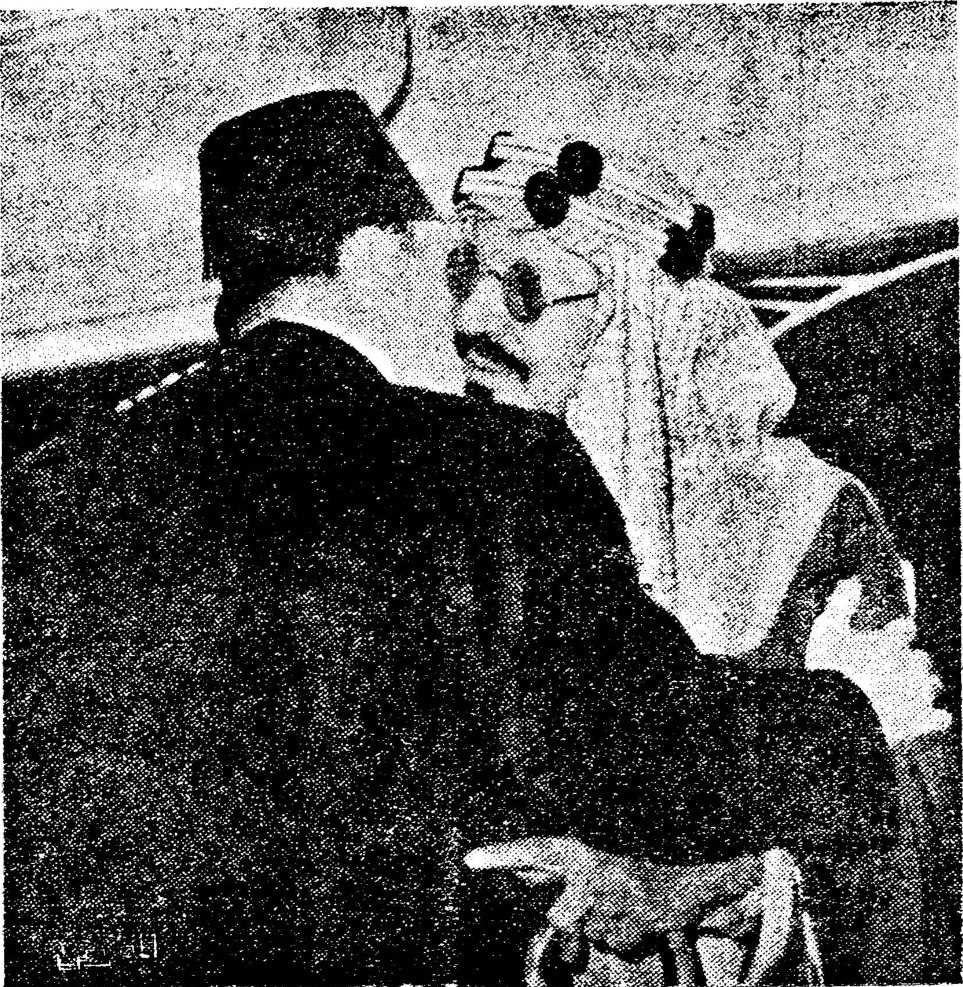
Before His Majesty King Al Saud left the capital of Egypt, he embraced His Majesty King Farouk with the embrace of a brother for a brother, as the reader sees them above these words.
1 – Which European king remained at the helm of government the longest?
2 – Who was the orchestra conductor who appeared with Deanna Durbin in the film "One Hundred Men and a Girl"?
3 – What causes the wind to blow?
4 – How long does the earth take to make one rotation?
5 – Who was Napoleon's second wife?
6 – Who was the one called the mad Queen of Sweden? And what is the name of the famous film star who played her part?
7 – Does the driest desert in the world lie in Africa or in Asia?
8 – What is the name of the country known as the land of "a thousand lakes"?
9 – Where is Adelaide?
10 – Two of these three things — the Pyramids, the Leaning Tower of Pisa, and the Temple of Diana at Ephesus — share a certain fame. Which two are they? And what is that fame?
1 – Louis XIV, King of France, who ascended the throne in 1643
By the nature of their land and the makeup of their temperaments, the Arabs saw in woman their happiness and the repose of their souls; so they loved her and all but worshiped her. Yet by the nature of their society and the system of raids and captive-taking customary among them, they saw in woman a cause of their humiliation and of the disgrace that might attach to them; so they took her for an ill omen, to the point of burying her alive. Thus the Arabs were caught between two pulls: the pull of their region's nature and their temperaments drawing them toward woman, and the pull of their social order and their wars driving them away from her.
Muhammad (peace be upon him) was born in the Arabian Peninsula while its people were in the two conditions we have described. He confirmed the first condition — the condition of loving woman — and blessed it, proclaiming among His signs: "that He created for you, from yourselves, mates that you might find repose in them, and He set between you affection and mercy." And he condemned the second condition — the condition of seeing an ill omen in woman: he raised her worth, restored her to the throne of her sovereignty, and called out that woman is mistress of her house. ("The woman is mistress in her husband's house, and she is responsible for her flock.")
The purpose of Muhammad's prophethood, then, was not the proclamation of God's oneness alone, but glad tidings concerning woman, and the celebration of her restoration to the throne of her sovereignty.
Umar ibn al-Khattab said: "By God, in the Jahiliyya we counted women as nothing, until God revealed concerning them what He revealed and apportioned to them what He apportioned." Whoever follows the Prophet's biography through the stages of his life will perceive the causes that made his noble soul ready to receive the revelation concerning women.