technical terms required to express the various shades of modern thought. And because the students of science and theology in all parts of India
are now flocking to the learning of Arabic, most of its words and phrases have become familiar to a large body of the population. Add to this that the use of Arabic words lends a splendor and fluency to speech and an economy to expression — qualities that would not have existed in the Urdu language had it borrowed words from any language other than Arabic. And notwithstanding the fertility of Urdu literature, resting as it does upon the literatures of the two languages, Persian and Arabic, it contains a great quantity of Arabic words. One may easily cast one's eye over passages of elevated Urdu poetry and prose by some of the master poets and writers, in which they have used the adjectives, the nouns derived from verbs, and the forms known in Arabic.
The Hindi language, whose basic grammar is the same basic grammar as that of Urdu, and which is written in the Sanskrit characters and contains a vast quantity of Sanskrit words and words of the Indo-Aryan dialects, has also been influenced to a great degree by the Arabic vocabulary. Publications in Hindi are reckoned equal in number to publications in Urdu, if not more numerous, since they are read by millions of inhabitants in Bihar, the Punjab, Bengal, Gujarat, Maharashtra, and the provinces of southern India. The poets and writers in Hindi, such as Kabir, Surdas, Tulsidas, and Bihari, used many Arabic expressions; indeed the first to compose poetry in the Hindi language, Chand Bardai (1159–1192), used many Arabic words in his famous
poem "Prithviraj Raso," among the Arabic words occurring in it being dunya, khalq, and salam. And in the fifteenth century Kabir used a vast number of Arabic words, such as 'ilm, kamal, baqi, and dhawq.
In this way a vast number of Arabic words has entered ordinary Hindi and its literature, in poetry and prose alike, until the great mass of its speakers understand the meanings of these Arabic words more easily than they understand their Sanskrit equivalents. The number of Arabic words used by writers in the Hindi language is not known exactly, because no extensive dictionary on scientific principles has yet been compiled; but it may be inferred from the information we possess that the number of Arabic words exceeds eight thousand. The "Hindi Shabd Sagar," the Hindi dictionary compiled by the society for the propagation of the Hindi language, contains 7,584 Arabic words that have entered the Hindi language.
As for the languages of southern India, such as Tamil, Telugu, Malayalam, and Kanarese, the Arabic words that have entered them are comparatively few in number; nevertheless they contain no small quantity connected with the language of the laws and the collection of taxes, such as the following words: 'ardi, tahsil, munshi, wakil, etc. Add to this that the Muslims of southern India, like other Muslims, use a great number of Arabic words in their daily converse — the expressions taken from their religious rites. They customarily close their public prayers with an address delivered to them by the religious head, which they call a khutba. As for the ceremonies connected with births, marriage contracts, and deaths, these are recited in the Arabic language, and through them certain Arabic words have seeped into the language of everyday speech, such as: nikah, talaq, kafan, dafn, talqin, and others.
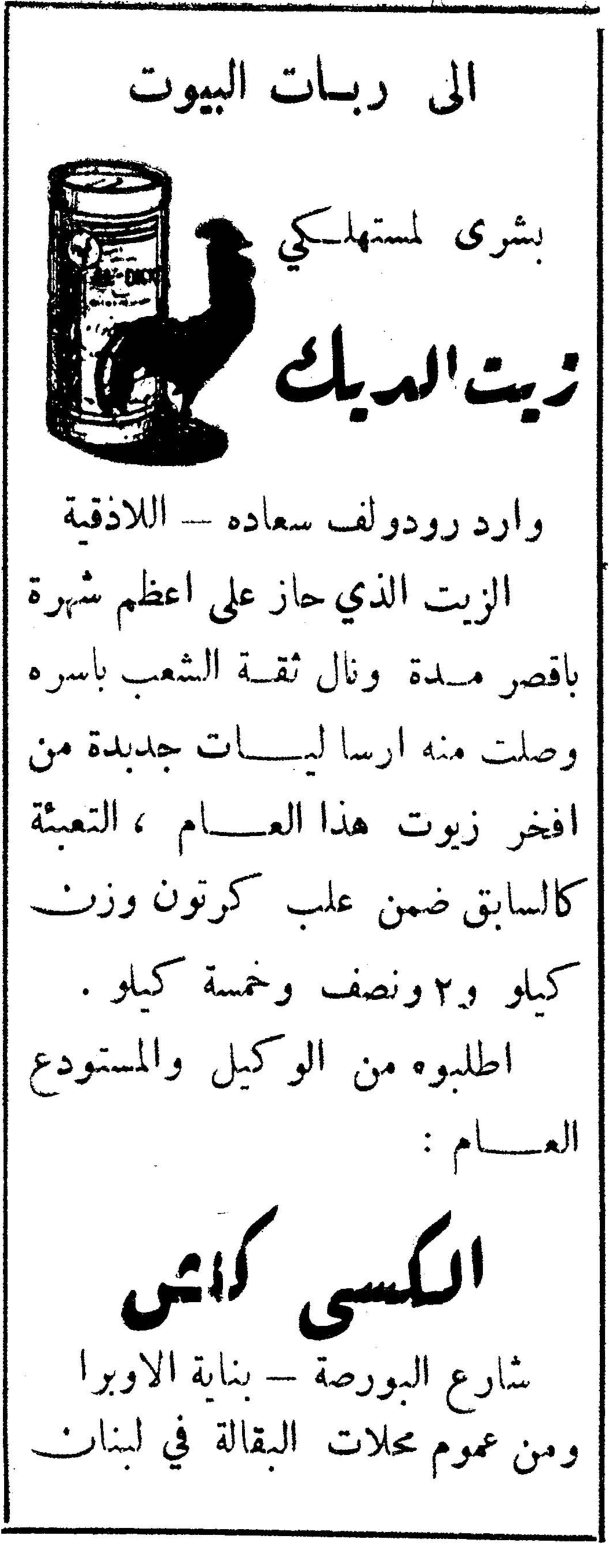
Rooster Oil
To housewives
Glad tidings to the consumers of
Rooster Oil
Imported by Rudolf Saadeh — Latakia
The oil that won the greatest renown in the shortest time and gained the confidence of the entire people. New shipments of it have arrived, of the choicest oils of this year; packed as before in cartons of one kilo, two and a half, and five kilos.
Ask for it from the agent and general depot:
Alexi Katz
Bourse Street — Opera Building
And from grocery shops throughout Lebanon
The Women's Research Association has succeeded in producing a new kind of wallpaper with the property of reflecting heat, so that warming a room takes only a third of the time needed to warm it ordinarily; for instead of absorbing the heat, it reflects it. The reason lies in the paper's being coated with a light film of a special metal, which likewise prevents the heat from seeping into the plaster.
The inventor of this type is Miss Miriam Grift of the British Electrical and Allied Industries Research Association.