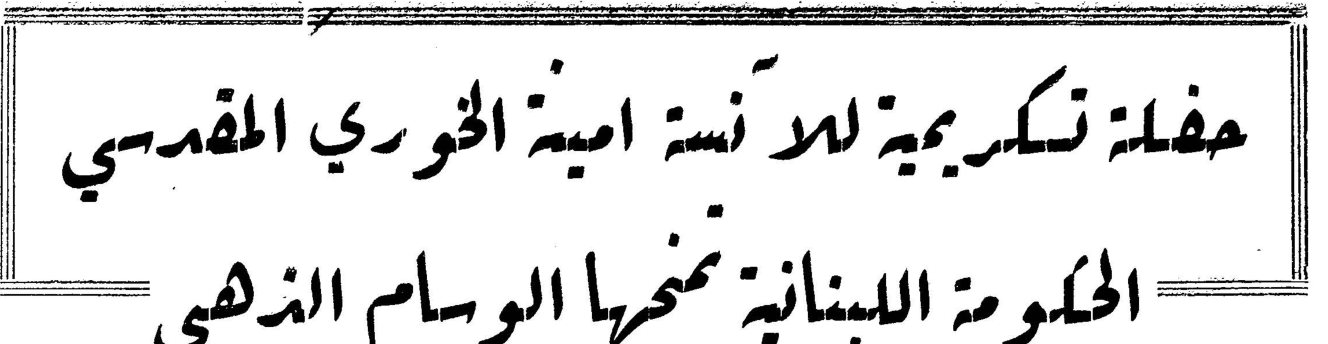
A committee of notables invited a large company of ladies and gentlemen to attend a tribute ceremony held at West Hall for the distinguished educator Miss Aminah Khoury Makdisi. Mr. Emile Nassar opened the ceremony with a measured word in which he set forth its purpose; he then presented the first speaker, Mr. Habib Riz, who delivered a valuable address showing the Miss's service to teaching. Then Miss Layla Shahin spoke, and her word was graceful; then Miss Hamadeh, who was felicitous; then His Excellency Adel Bey Osseiran, who delivered a bold word. Then His Excellency the Minister of the Interior and Finance, Emile Bey Lahoud, rose and read the decree conferring on Miss Makdisi the gilded Order of Merit, and pinned it on her breast amid a storm of applause. The final word belonged to the honored Miss herself, who gave an excellent address (which the reader will find below).
***
The address of Miss Aminah Khoury Makdisi
Your Excellency the Minister, Honored Chairman, Distinguished company,
Our children are tall, beautiful columns on which the edifice of the nation rests, and teachers and educators are but workmen who prepare those columns: some labor at the foundation, some at drawing and engraving, some at polishing and ornamentation, until the work is complete and those columns appear in the fullest manifestations of beauty and art. And I, ladies and gentlemen, was destined to be one of the workmen who labor at the foundation. Today, generous fellow citizens, you have chosen to set this
workman's name upon the plaque in place of the architect's, and you have attributed to me a number of the shining luminaries of the homeland, saying they were my pupils. With all pleasure and pride I accept this attribution, though I am but a workman who shares in grounding them upon the love of God, of the homeland, and of their Arabic language.
The school destined to rear the child in the first stage of his life, from the age of five to twelve or thirteen — the age of development, of planting good habits and implanting high principles — could not do without the partnership of the parents. And so the esteem you have shown me, and this medal our exalted government has bestowed upon me, are not for me alone: I have partners in them. My partners are the parents, above all the wise mother watching over her children, who values the educator's work and regards her with honor and importance in the child's life. My partners, too, are my teachers, to whom God granted a gift for teaching, a tenderness toward the little one, and a long patience in dealing with him that eased this profession for them. For is not teaching — above all the teaching of little ones — a kind of motherhood?
My partners are the members of the Women's Educational Society, who made its aim the teaching of the needy, gifted child in the Ras Beirut school.
Distinguished company: just as nothing equals, in the parents' eyes, the sight of their child advancing day by day in stature and grace, full of health and beauty, so nothing equals, in the educator's eyes, the sight of a child who enters the school small and leaves it in the bloom of youth, his mind broadened,
his knowledge increased, his gifts made manifest, having drunk in the principles the school planted in his thoughts. And what more can the educator ask than to see men and women spread through the walks of life — deputies, teachers, physicians and engineers, men of politics and of business, mistresses of houses and women working in the service of the homeland and the raising of society?
And does the homeland rise except upon the arms of its educated, cultivated sons and daughters who follow the highest ideals?
Yes — and though the work of education and teaching is a giving more than a taking, a labor for others more than for oneself, it has many merits and blessings. Among its blessings is that the educator never feels lonely or solitary in this life: his acquaintances do not vanish from his sight, and his friends grow in number with the passing of the days. Wherever he goes and whichever way he walks, he sees faces smiling at him and eyes radiant with the light of past memories. And he is forever renewed in the liveliness, the energy, and the vigor of the young. This spiritual feeling and this moral bond are the greatest reward gained by one who practices the profession of teaching over a long time. And this favor with which our exalted government has singled me out is beyond anything I imagined or expected. Long live His Excellency Sheikh Beshara El-Khouri, by whose struggle, together with the valiant men of his government, Lebanon gained its independence, and national culture was freed of its
foreign fetters, so that our children and our pupils now breathe the open air of freedom and drink at the sweet springs of independence. And here is the country marching forward with firm steps to buttress its independence, the solid foundation of which is being built by houses of learning and institutes of education. Were not