On the morning of one of Paris's soft, silvery days, after a short excursion through the Luxembourg Museum, during which we reviewed modern European art from the "Impressionists" to the "Fauves"—Picasso, André Lhote, Maurice Denis, George Desvallières, Jean Marchand, Matisse, and others—down to "academic" canvases by Jean-Paul Laurens and his two sons, and René Inchefry, and Boujon, and others and others still... a visit that served us like bitter coffee, waking us from a daze that would take hold of us whenever we wearied of the unbroken work at the academy, the study from the living "model," and the weight of the professor bearing proudly upon his shoulders the
heritage of Ingres and David and the ancient honor of the French school.
We came back brooding, while hope tempted us and tickled our vanity, each of us wanting to be the genius painter capable of dictating his law to his age. Is it just that a slip in Matisse should count as one of art's novelties, while we are measured by the yardstick of David and Ingres, and whatever departs from that yardstick is still an error that must be corrected? Why is Picasso allowed to place one eye above the eyebrow and its sister below the nose, so that his work belongs to the realm of the "metaphysical," while the shifting of an eye a hair's breadth from its place, by a hand with no drum and fife behind it, is an unforgivable sin? Why? Why? And this "why" tormented us and stirred up a raging tempest in our souls.
We reached the academy and found the model sitting waiting for us. "No! We don't want this pose. Who told you this was beautiful? Change it at once." And the poor thing began changing poses—now standing, now leaning, now kneeling, now lying down—while we shouted at her: change these hackneyed poses. She arched her back and twisted her thighs and bent her head and lifted her arms, and nothing pleased us. So we all shouted at her: "Go, go!" And the poor creature went out with a tear in her eyes, complaining of the cruelty of artists and the arrogance of the little creator.
Come, off to the Louvre, to make Rubens and Rembrandt and Titian and Delacroix speak. As for Velázquez, that insoluble riddle, silent as the Sphinx, we had no strength to study him. And while we were walking toward the door, we heard
a light knock, and the door opened
and there looked in on us a fair face with reddish-hazel hair, and two deep, sunken eyes in whose pupils a suppressed pain peered out, with a terror drawn upon them and upon all the features of the face; upon the nose, a pride that time had begun to humble; as for the mouth, it was finely drawn—and perhaps it was she herself who had perfected its
drawing with the druggist's rouge. We drew back as if before a vision, but one of us gathered his strength and cried, in a voice with a tremor in it we had never known in him: Show us your nakedness.
She answered abjectly: —For just this I have come. I want work, whatever that work may be.
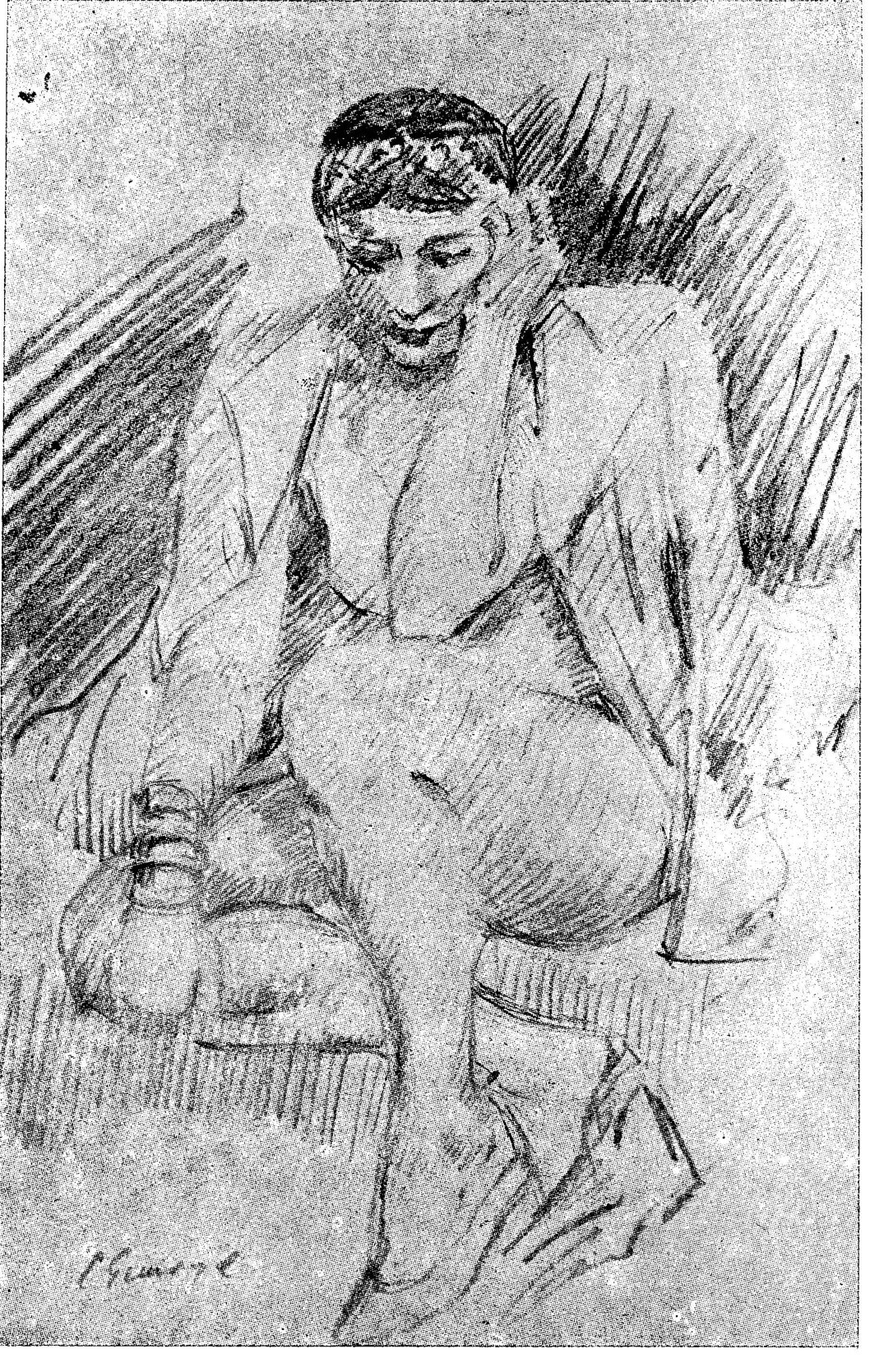
She took a step into the hall, and we made way for her; then she withdrew to a corner and took off her clothes... She stood upon the model's platform, leaned her back against the wall, and let her arms fall slack, as though they were a heavy burden she wished to cast off. And she stood forth perfect of build, harmonious of line, translucent of coloring, slender without gauntness, rounded of body—such as would make the mouths of Boucher and Fragonard water. Each of us leapt to his easel, spread out his