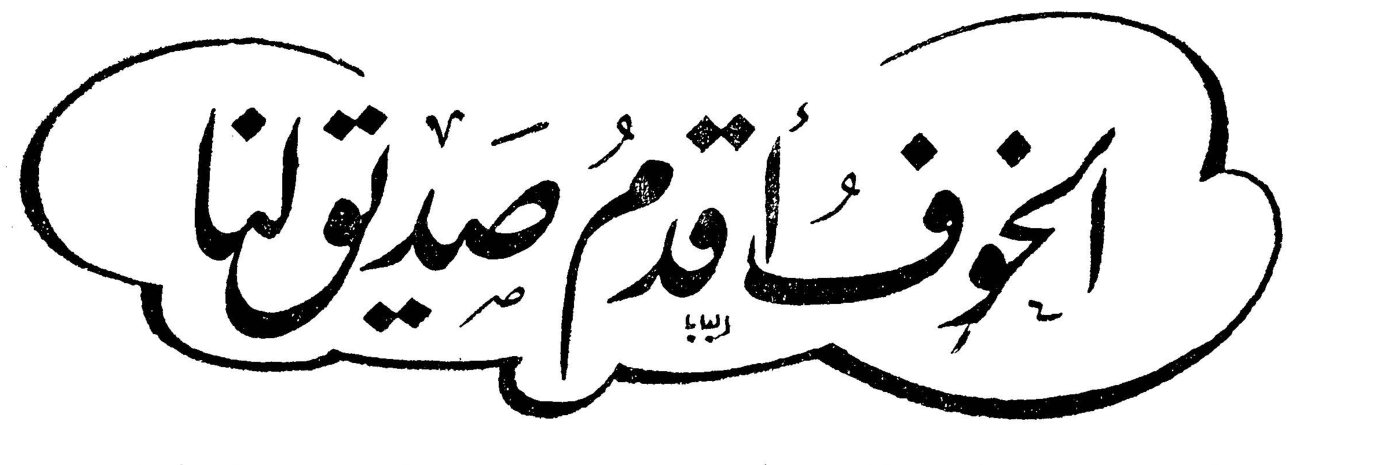
A short while ago I donated a quantity of my blood to a patient in the hospital. I had long yearned to perform this act. And yet, in spite of that, and in spite of my volunteering of my own free will to carry out this humane duty, my color drained, my lips went dry, and the beating of my heart quickened when I lay down on the operating table and saw around me that great array of surgical instruments of every kind; and I knew of a sudden that the symptoms of a frightened man had appeared upon me.
When the doctor began the painless operation of transfusing the blood — an operation whose effect upon me was like the action of a tonic — I began to think about this reaction, that is, about this feeling of fear, and I perceived that it is a great ally of man. From man's first appearance in the world of existence, the flowing of blood has never ceased to be a peril to life; and had the first man done nothing to stop the bleeding of his wounds, the matter would have been grave in the extreme. But fear spurred him to act to stop his blood from flowing out of his wounds: in the intensity of his fear he pressed his hand tight upon his wounded arm, and so he made use of the first of all kinds of clamps to stop bleeding. Afterward he laid a lump of clay upon a wound, and that was the first dressing man used. The fear of the flowing of blood was the protective impulse a million years ago, just as it was with me yesterday when I lay stretched on the operating table.
Fear is in its truth useful. Take, for example, an incident or two and analyze them. A few days ago I was talking with a parachutist who is counted among the boldest of men. He confessed that he had to make a tremendous effort to master his fears every time he threw himself into space from on high. The fear of falling is one of the basic fears in man. That is why you see the father, proud of his firstborn child, carrying him gingerly as though he were a vessel of glass; and with all the father's caution you see the child cry — whereas when the capable nurse, who has no fear of his falling from her hands, carries him, he does not cry. The fear of great heights rooted in us is without doubt for our good; for millions of years ago we lost the power to swing from branch to branch in the tops
of the lofty trees, and a fall from a height of twenty feet came to cost us our lives. The fear of falling now works in us like a faithful sentinel whose eyes cannot leave us for a single moment — so much so that a man needs great strength of will before he can advance a step or two toward the edge of a crumbling precipice.
There is another natural fear: the fear of the dark. Children in particular are more subject to it than grown people. But I remember a soldier who described the first night he spent as a sentry — a night of pitch darkness, of heavy winds and storms. Said the soldier: 'I set my back against the wall, and every limb in me became as it were ears straining to hear.' Yes, the dark is dangerous: the beasts of prey and the serpents grow active by night in the jungles, for they come out under the wing of darkness to hunt their prey. And so the fear of the dark drove man to take refuge in his cave, huddling upon himself close by the fire as soon as the sun went down. And were it not for this innate fear of the dark, the human race would have died out while it was still in the stage of savagery.
Mental or psychological fears are useful to man too, like the natural or bodily fears. Take, for example, the feeling of lowliness, which gropes at everything out of fear of everything. Though it may be harmful now, it was in times past, without doubt, one of the protective factors or defensive causes. Picture the danger to which the gazelle would expose itself if it dared to walk in among a pack of wolves. And so it is with man. It was for his good, therefore, that he was given the sense of his weakness and helplessness before his enemies when he was in the Stone Age, or before it; and for that reason too his feeling of insufficiency spared him the pains of facing hardships and terrors he had no power to endure. This feeling was rooted in him like the other instincts, and it enabled him to survive and kept from him the danger of extinction.
For these reasons I have counted fear our oldest friend. Yet we usually reckon it an enemy to be subdued, or a weakness of which to be ashamed. The truth is that we have risen to a level above the animal, yet we have in it such lofty interests,