
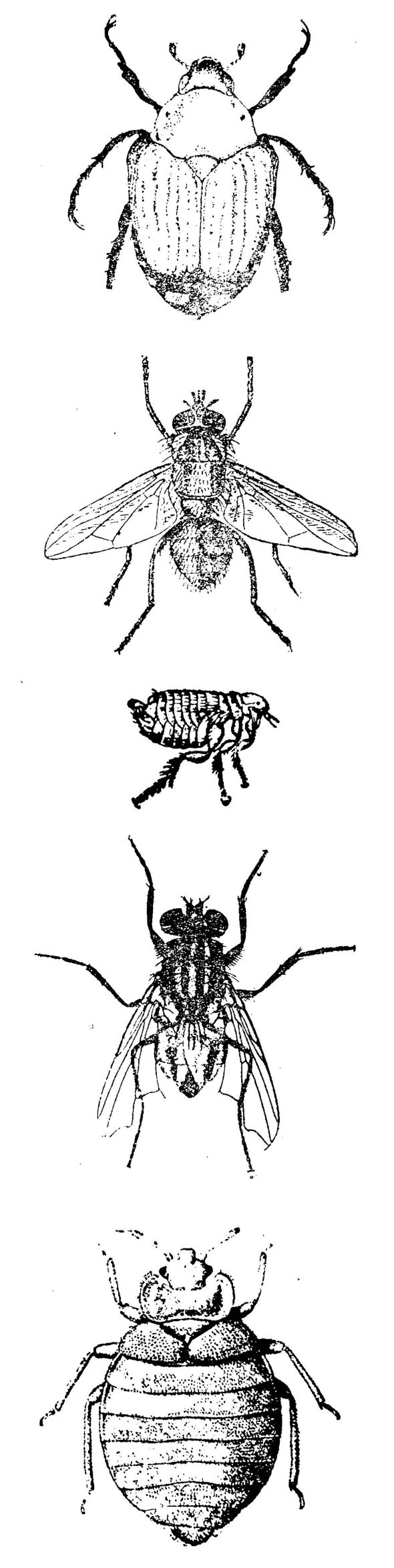
One of the Allied news agencies collected more than thirty thousand articles, all written about DDT between May 1944 and October 1945 — the period in which the Allied war departments disclosed to the public the secrets of this wondrous preparation, which saved the lives of thousands, nay millions, of those who plunged into the depths of the war in swamps and jungles where sudden death lay in wait.
The war departments did not permit its use by civilians until last August, and it was natural that the advertisements should herald it in all manner of enticing styles. Some publicity bulletins have called it "the atomic bomb that is deadly to insects."
DDT was first known as a disinfectant in 1874 in Germany, but its merits as a powder deadly to insects were not discovered until 1939, when a Swiss scientist used it against the insects that were then wreaking terrible havoc on the potato crops, and against the lice creeping over the bodies of homeless refugees.
This scientist soon distributed it to his laboratories in the United States and Great Britain, to take the place of "pyrethrum," the well-known insect killer; and from that time enormous quantities of it were used, saving the lives of millions of fighting soldiers.
Its Nature and Its Merits
DDT is a transparent white substance with a faint, refreshing odor, formed by the combination of monochlorobenzene and chloral with sulfuric acid. It is ground together with other solid elements, and its effective strength depends on the
materials with which it is mixed, the extent of its action varying as they vary. This powder can be dissolved either in water, in various vegetable oils, or in petroleum derivatives.
Insect-destroying preparations are poisonous either upon contact, killing the insect when they touch its body, or upon being eaten, or upon being inhaled. DDT is a poison on contact and, in the intestines, when eaten; and it is unique among the other preparations in the merit of destroying the insect that lands on it, or on which it lands, gradually and slowly.
Those in charge of its trials hope that its use will become general in the home, in public health, in livestock, forests, agriculture, and crops. Experiments to date have proved a great success in its use to exterminate insects on livestock without harming or injuring them — quite the contrary: sheep sprayed with it four times during the season gained 230 grams in weight daily.
On the agricultural side, however, the trials are not yet complete, and its far-reaching effect has been verified only in potato crops and the like. The quantity to be used for this purpose ranges between 225 grams and 450 grams for every 400 liters of the liquids prepared for spraying. This quantity is enough to wipe out moths and weevils — the two deadliest enemies of fields and orchards — within a mere two weeks.
Great Britain and the United States were the first to broadcast the results of DDT, for their