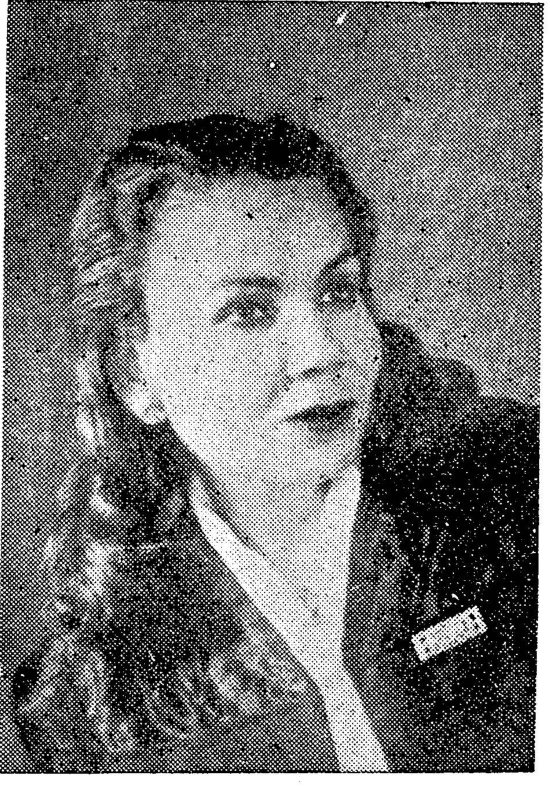
She is Miss Bahija Bayoumi, a graduate of Bedford College in England and directress of the Kobri al-Qubba kindergarten in Cairo. She traveled to England to study, after completing her elementary schooling in Egypt, and there she specialized in education and teaching, especially in child psychology and the methods of raising children. After her return she took charge of the Qubba kindergarten and made of it a model kindergarten containing the newest of everything that helps the child in his growth, his guidance, and the formation of his personality — for in it he learns life by living. Miss Bayoumi is also an author, and the Egyptian Ministry of Education has published several of her books, among them: "To Mothers" — a book on raising the child from birth until just before puberty; and another entitled "Woman" — for setting the family right, solving its problems, and acquainting it with the newest ways of modern social life; it also acquaints man with woman's nature and with what she ought to be, and discusses men's opinion of her with regard to education and work.
The Egyptian Ministry of Education sent her on a mission to visit Lebanon as a technical adviser, after Omar Bey Daouk had visited some of the Egyptian schools. So she resolved to work, sacrificing her rest during the summer holiday for the sake of raising the standing of the Arab woman and improving the manner of raising the child. She will remain in the hills of Lebanon for nearly two months, at the end of which she will return to Egypt so as to be there before the coming of the month of Ramadan, to share it with her family as tradition requires. She gave the correspondent of The Woman's Voice the following interview:
"The child is the pillar of every nation, and for that reason the Egyptian government gives its full
attention to the sound foundations that help the child grow up healthy and strong in body and in mind. It has prepared for him the wholesome environment for his development according to the modern methods that help refine his instincts, his inclinations, and his character. And this can be accomplished only by constant contact with the home, through parties and meetings with the parents for true cooperation in guidance, because the mother is the kernel of reform."
When I asked Miss Bayoumi about the Egyptian woman, she answered that she herself has represented her, and that she is proud to say that the Egyptian girl has entered several professions in which she has given proof of her mind and her readiness to walk with man hand in hand in the arena of life without dread or fear. She believes, moreover, that the renaissance can be achieved only on the shoulders of woman, who, if she is set right, the whole world is set right — because she is the reformer of herself, her child, and her husband, and thereby she is the reformer of the world.
Miss Bayoumi is visiting Lebanon for the first time, and on arriving she felt that she was visiting Egypt's brother. She finds it very beautiful, but lacking a certain
care which, were it supplied, would make it the most beautiful summer resort in the East. As for the Lebanese girl, she regrets that, in her opinion, she is still backward-looking in her rigidity and in the religious beliefs out of which she has created for herself fetters that carry her backward and lower her social standing. Then she said to me with fervor:
"If the veiled woman believes that religion commanded the veil, this is a great error, for the Prophet mentioned nothing of it, neither in his Koran nor in his sayings, and he said, 'Seek knowledge, even in China.' How, then, can a veiled woman broaden her knowledge and her studies? Woman must be given her complete freedom, and the more true freedom there is, the more the girl will return to her conscience in her conduct. The mother must build up in the girl her confidence in herself, and must herself trust her and leave her her freedom in life."
Yet this has not prevented Miss Bayoumi from being entirely faithful to her principles and her religious beliefs. For despite her five years' stay in England, she recently visited Mecca with the intention of making the pilgrimage, and she always calls for holding fast to religious beliefs without fanaticism. She favors the innocent mixing of the sexes that brings out personality and makes its possessor known; and everything that lies within the bounds of good manners, propriety, and religion is likewise favored by her.
And when the correspondent of The Woman's Voice asked her for her picture for the readers, she answered:
"I offer my picture so that the readers may see their Egyptian sister Bahija, who studied in Europe and then made the pilgrimage, and who despite this goes unveiled, within what God and religion require."
(Samia)