this function is of less importance than before in civilized circles, it still receives special encouragement from society, prompted by tradition on the one hand and by the instinct of preserving the species on the other.
The economic function: the economic function was the most important factor in the creation of the family. Man's need of woman's labor in the age of early agriculture drove him to take her as a permanent wife, in place of the shifting or temporary marriage that prevailed in the primitive ages. This economic factor was also among the causes of the taking of several wives in agricultural circles, for the man whose properties multiplied needed several women to carry on the work of farming.
Woman is very necessary to man on the farms and in rural circles, and for this reason early marriage is widespread in these circles. Woman was necessary to man in the age of household industry — the domestic system — and so were the children, because of his great need of the labor of wife and children when the home was the factory. At that time the home was woman's place, because it was the center of work. But now that industry has moved into the mills, thanks to the industrial revolution, the economic function of the family has declined in the cities, and woman's work there has been confined to the management of the house, or to domestic service where servants are lacking. Woman has begun to leave the house to work in the factory; and in the emancipated city circles, leaving the house leads her to other kinds of productive work, in offices, cultural circles, and elsewhere. In the wealthy conservative circles that
keep servants, woman remains a parasite of little use, working neither outside the house nor within it.
The cultural function: in some of its ages the family was a means of preserving the cultural heritage, when the means of spreading learning were few and difficult. Today its function in this respect is narrow and limited. Even so, the home is still the source of the first impressions in the child's soul, and there is no one who denies the value of its cultural influence. One manifestation of this function is that certain families keep among themselves the secrets of certain crafts and bequeath them to their own children and to no others. Under the cultural function comes also the function of modifying and refining the sexual instinct in husband and wife, of widening experience, and of completing life by means of married companionship and the rearing of children. For in this there is a broadening of the parents' horizon, an increase in the subjects of their daily concern, and a pushing of their thought out of the region of self into the region of the children and the circles of the society that must be made ready for the new generation.
The affectional function: the family is a means of creating lasting friendships and bonds of pure affection between husband and wife, and also between parents and children. It is likewise a means of relief and rest after the toil of work, and of enjoyment in protecting the children and guiding them and exchanging with them affection and a comradeship free of selfish aims, where that is possible.
These are the most important functions of the family in the past; on another occasion I shall speak of the development of these functions in the modern age.
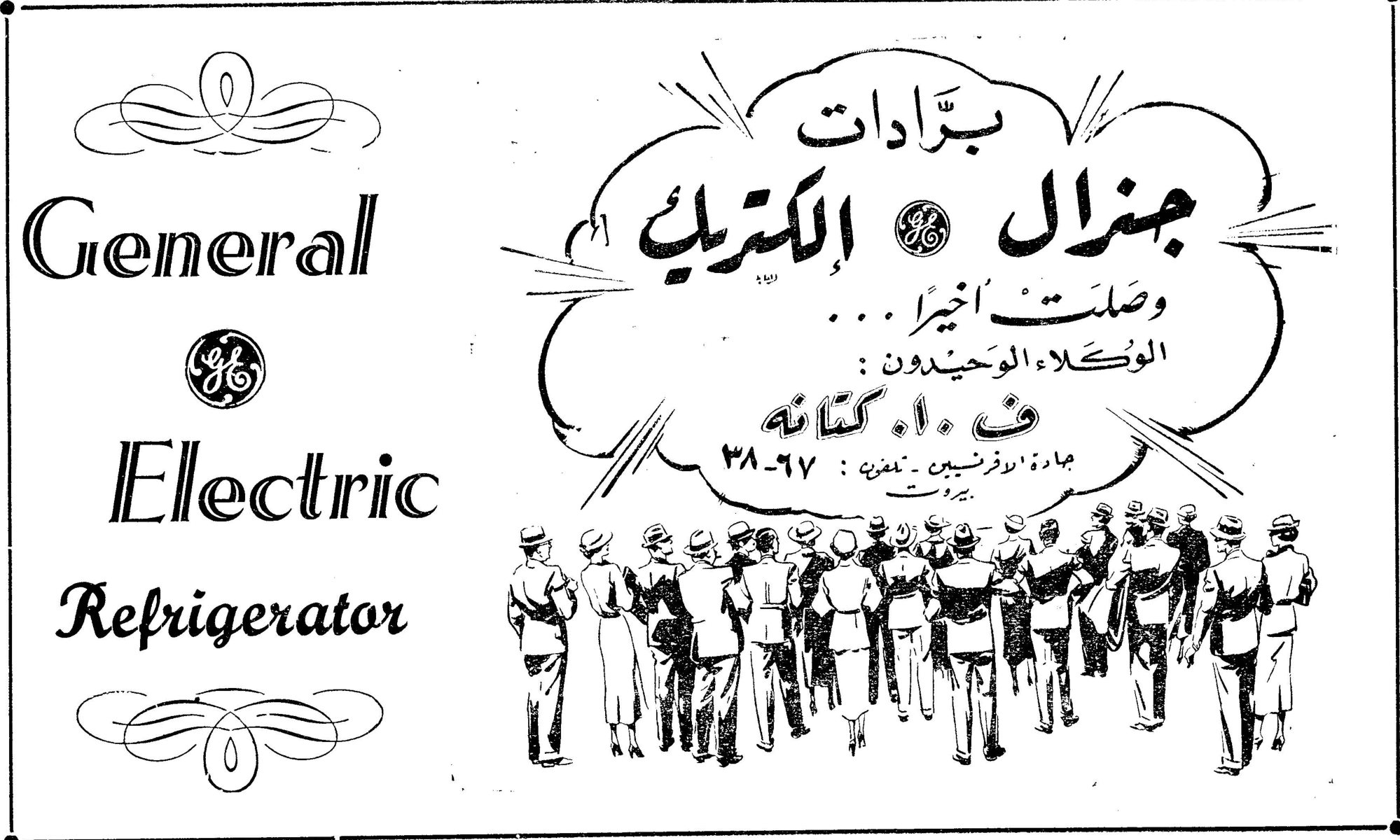
General Electric Refrigerators
General GE Electric Refrigerator
General Electric refrigerators
Have arrived at last...
Sole agents:
F. A. Kettaneh
Avenue des Français — Telephone: 67-38 — Beirut