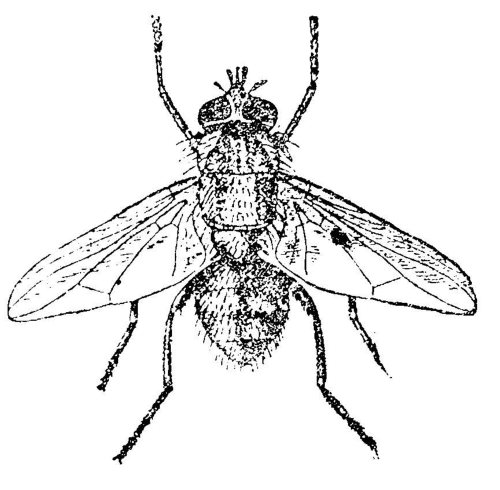
The common house fly hardly exceeds a quarter of an inch in size, from the front of its head to the rear of its body. And yet it is the best natural agent for the carrying of germs. Scientists who have made many precise scientific counts have found that different kinds of infectious germs are carried by the fly on its legs, its wings, and its mouth, and inside its body, all at one time. The number of these germs may range between a million and a quarter and six million six hundred thousand — germs such as those of anthrax, typhoid fever, leprosy, tuberculosis, amoebic dysentery, and bubonic plague.
It would appear that the natural mission of the house fly is the spreading of dangerous germs, for it spends its time moving between the animal pens, the refuse heaps, the kitchens, and the daintiest foods, as though it had no occupation but the trade in germs — and this not from any evil intent or any special enmity toward man, but because it happens by chance: the fly alights upon delicious food while loaded with harmful germs which have no effect whatever upon its own body, as if it possessed a natural immunity against these germs that are so deadly to man.
Thanks to these small wings the fly is able to move swiftly from place to place. One scientist has proved that the fly covers, in the space of twenty-four hours, a distance of more than twelve miles. During its flight the vibrations or beatings of its two wings number more than sixty thousand a minute. It is estimated that eleven percent of the fly's weight is made up of the muscles that move the wings; hence the fly's speed reaches five miles an hour.
Among the reasons that make it difficult to hit a fly with a blow while it is in flight, or while it squats upon some surface, is its extraordinary ability to see things in all directions. At the front of its head are two protruding eyes, each of which has four thousand
lenses, separate one from another, so that the lenses in its two eyes total eight thousand — whereas the eye of man is fitted with a single lens. Nor are the fly's eyes fitted with lids, as is the case with man. The full-grown fly is fond of light, while its larvae and its young before maturity shun light and love darkness. The males love light more than the females, who are equipped with a strong sense of smell, which helps them to scent out the best places in which to lay their eggs. The organ of smell consists of two hairs protruding between the eyes, containing a great number of olfactory nerves, so that the fly can scent the faintest odors — odors which the olfactory nerve of man cannot perceive.
At the lower part of the house fly's face is a proboscis, or sucking tube, which takes the place of the mouth in animals. It cannot bite, therefore, for it possesses neither teeth nor jaws, but feeds upon food in its liquid state. And this is what makes it a permanent danger to man. When the fly settles, for example, upon a solid piece of sugar, it ejects from its inner parts — or rather from its salivary glands — through its proboscis, a salivary fluid loaded with germs. This fluid dissolves a little of the sugar, which the fly sucks up, leaving behind, as the price of what it has taken of the sugar, a quantity of germs. And when it has finished its banquet, it raises its proboscis, folds it away under the lower part of its face, and flies off to another place.
Have you ever asked yourself how the fly can walk upon a smooth glass surface, or how it can settle and walk upon the ceiling of a room with its body turned upside down? And how it can move its six legs at one and the same time without stumbling in its walk? The answer to the last question is that it moves three of its legs together at one time: it moves the middle leg on one side together with the front and rear legs on the other side. And each leg is fitted at its tip with claws, and a fleshy pad between them; it uses the claws to hold fast to a rough surface, and the fleshy pad to climb upon smooth, polished surfaces and to walk upon the ceiling when its body is inverted.
It is worth mentioning that the fly is fitted with several organs of taste, in the form of tiny hairs scattered over all the parts of its body and on its legs, so that the moment it settles upon some appetizing substance it senses it at once through these taste hairs in its legs, and it stops at once to let down its proboscis and take what pleases it of the substance — leaving upon it a quantity of germs from its proboscis and its legs.
The fly's body remains all its life long loaded, within and without, with a vast number of deadly germs of every kind. The female, moreover, lays her eggs — six hundred in all — in several places and in batches, each consisting of a hundred and twenty eggs, or a hundred at the least, and this in putrid places or on the refuse heaps. Sunlight helps these eggs to hatch quickly: no more than eight hours pass before they hatch and there emerge from them the fly larvae, which turn into full-grown flies within five days. The best ways of fighting the fly are cleanliness, the use of the chemical substances that kill insects, and the greater use of motorcars in place of the carts drawn by horses — for in this way the number of animal stables, in which flies abound, is reduced.