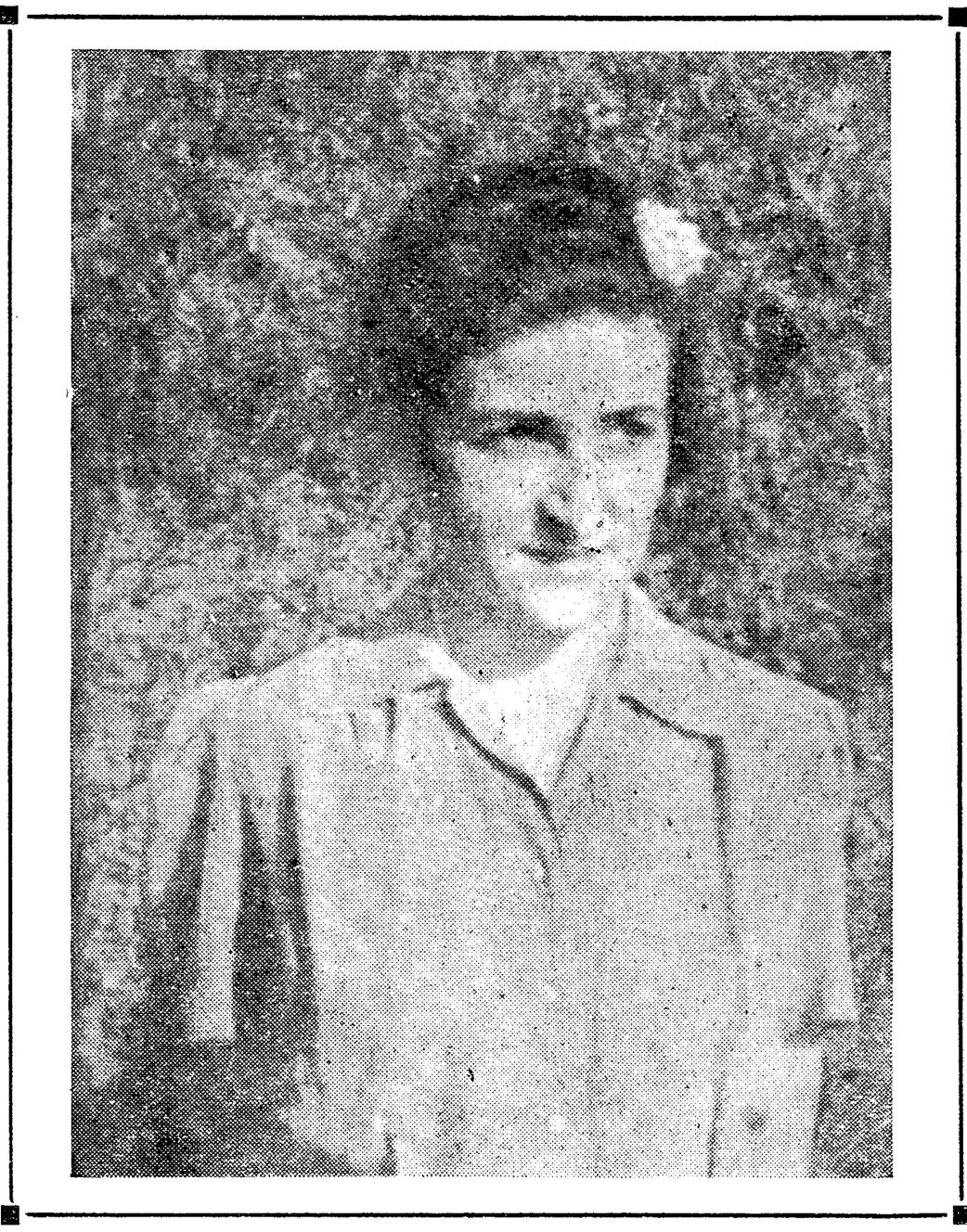
Dr. Salwa Nassar is not merely one of the glories of learning and character in Lebanon, or in the Arab East; she is one of the glories of the mind in the world's circles of science. After graduating with distinction from the American University of Beirut, she passed through Smith College in America, where she took a master's degree in the sciences, then moved on to the University of California, where she earned the title of doctor of physics with a distinction beyond all distinction, and pursued her deep researches until her name filled the halls of science. She has published works on "The Absorption of Rays" and on "Cosmic Rays and Matter," which were counted among the studies that have added to the wealth of science; she was accordingly appointed a member of the American
Physical Society, and was also elected a member of the society "Sigma Xi" —
an institution that grants the honor of membership only to one who has made an important scientific contribution.
Today she teaches the sciences at the American College for Women in Beirut. When I called on her in the name of The Woman's Voice, she welcomed me most graciously and listened with modesty and intelligence to my questions. I said:
— What were the most important things that caught your attention in the life of the West upon your arrival there?
She smiled and said: The first thing that struck me, on my arrival, was the speed of work, its thoroughness and its usefulness, and the great number of women engaged in it. Then, everyone's concern not with what his neighbor is doing but with what he himself is doing. But after I had experienced Western life, other things struck me, such as social responsibility and all that branches from it — health, organization, cleanliness — and then the extraordinary honesty, so that a person can leave his door open without fearing trespass. I was likewise struck by the clarity of purpose among people — every person knows what he wants — and by boldness in undertakings, and then by the positive nature of competition, in the sense that competition in business aims at personal gain, not at the subjugation of others. Finally I was struck by the use they make of the radio for guidance, the broadcasting of information, and general education.
— I said: And is there a fundamental difference between the Eastern girl and the Western girl?
— The first difference is that the Eastern girl is more emotional than rational. Then, the Western girl is distinguished by her sense of freedom, together with a responsibility to govern that freedom. She has self-reliance, frankness and ease of movement, sincerity and conviction. She is not inferior to man in any human activity. The proof of this is that women, by their experience and their mutual support, were able at once to take up men's varied work when the men were called to the war. And the Western woman is striking in the personal attention she gives her children, instead of relying on servants.
— I said: And what are the Eastern virtues that you did not find in the West?
She smiled, then said: Our girl has a femininity and a gentleness that may be native to her, or may be the result of her withdrawal and her lack of frankness. She also has obedience — I do not know whether that is in itself a virtue if it is not joined to understanding. Perhaps the greatest of what we count among our apparent virtues falls, among Westerners, within the sphere of conduct founded on thought.
As for Western women, they have frankness, ease of movement, self-reliance, no disdain for work, and energy in everything — in play and in earnest. When they work, they toil like men; when they stay up, they stay up until two past midnight. I have friends each of