whom carries out
all manner of tasks without neglecting her home or herself, and that is one of the proofs of energy. The Western woman's idea of a man is a conscious one: they think not of his wealth but of his talents, his learning, and his character, and they share with him, with pleasure, in building his home and his glory.
— I said: And what, in your view, should woman's aims be, and how can she attain those aims?
She answered at once: Her first aim must be a complete home life, then the society around her, then work. And I believe she is capable of carrying out all these things excellently. The way to reach those aims is sound learning, freedom, and equality between her rights and the rights of man — not between her and man, for that would make her lose her femininity. And in every work or science or field of guidance she must be trained to take up her responsibility.
— I said: And what is your opinion of our educational curricula, and what are the fundamental changes that ought to be introduced into them?
There is no doubt that our curricula are very deficient. We need, first, unified curricula for all schools, for girls and boys alike, in the cities and in the mountains; and if instruction can be coeducational, so much the better, so that we learn from childhood to live with one another. Education must be compulsory until at least the age of fourteen. We must give the sciences their proper place, so that our thinking becomes scientific — precise, orderly, responsible — even in literature. We must lay stress on the study of the arts and the appreciation of them, above all music. We must also set aside time for practical matters, and not content ourselves with theories. And in order to carry out this program we need trained men and women teachers who know their subjects and the methods of teaching, and who have a sense of responsibility.
— I said: And in which field of human activity can woman surpass man?
She answered: I find this a difficult question, because if woman and man are given the same upbringing and the same opportunities, they prove the same capacity for excellence. But woman may perhaps excel in matters connected with children, such as nursing and teaching. And the experience of this war has shown that woman surpasses man in matters that require not much thought but a great deal of precision and patience.
— I said: And does the Eastern man differ from the Western in the same measure as the Eastern woman differs from the Western?
The difference may not be in the same measure, but he does differ. He differs, for example, in the quantity of his work and its usefulness, and in his sense of responsibility, particularly where woman is concerned. The Western man has a blend of the spirit of chivalry and self-confidence that inspires respect toward woman. He likewise has a sense of his responsibility toward his children: he will leave his most important business to return home, feed them, and watch over their doings. He differs also in the
freedom he grants to woman. He is further removed from jealousy, has more confidence in woman, and a better understanding of what her freedom means.
— I said: Were there particular factors that led you to specialize in the sciences? And if you went back to being a student, would you choose the same specialty?
From childhood I had a special liking for the sciences and mathematics; then this liking grew when it became possible for me to solve some of nature's riddles, and that was a spur to me. And if I went back to being a student, I would begin early with the very same specialty!
— I said: And what is your plan for the scientific future of this country?
She answered: In my view it is our duty to begin laboratories, however simple, which would then grow with the growth of science and scientists in the country. These scientific laboratories must rest on a purely scientific basis; whatever economic benefits come of them are an unintended "blessing." And these laboratories must not be confined to the physical sciences, but must go beyond them to chemistry in its various branches, to agriculture also, and to medicine.
— And I said finally: What is your message to our society, and to the woman in it in particular?
She answered immediately: First, the fight against illiteracy — and by that I mean not merely the writing of our names, but making use of our leisure hours in reading. When we reach a sufficient degree of education, we shall be able to fight our diseases in all their kinds. It is these diseases that keep us from measuring up to the West. From this education, too, comes the sense of responsibility.
And my particular message to woman is the raising of children rightly, in health and in mind, and that she attend to this herself, for it is for this that she was educated. Woman must feel that children's future depends on the first year of their lives. And woman must rid herself of dependence on others, feel her social and economic responsibility, use her learning for her society, and not fear roughness for her hands.
"R."
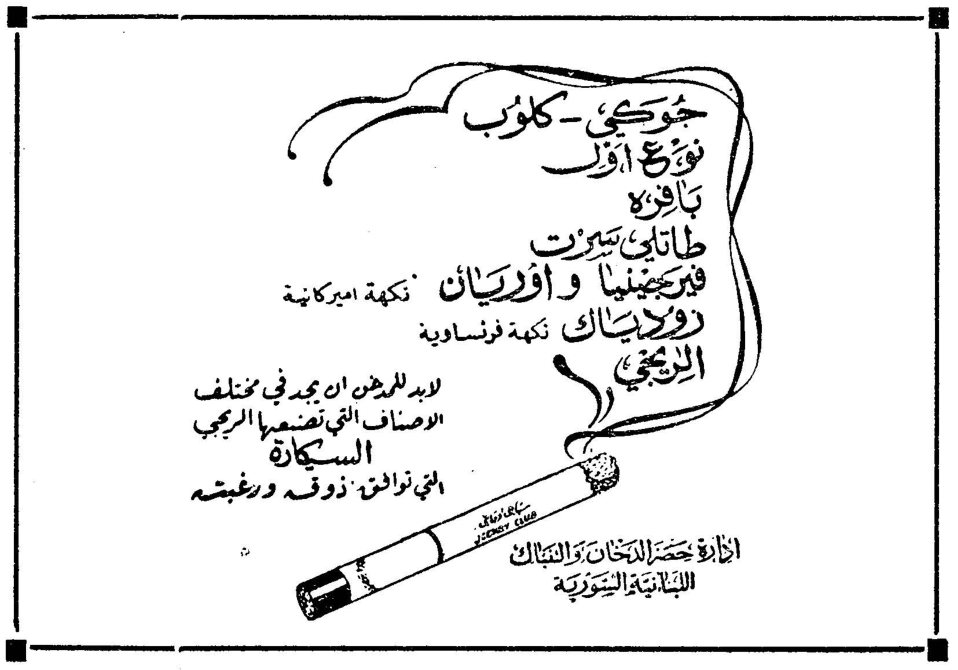
Jockey Club (a Régie Advertisement)
Jockey Club
First quality
Bakoura
Tabati Beirut
Fransiya and Afrikiya — American flavor
Dubank — French flavor
The Régie
The smoker is bound to find, among the various brands the Régie manufactures, the cigarette that suits his taste and his desire
The Lebanese-Syrian Tobacco and Tombac Monopoly Administration