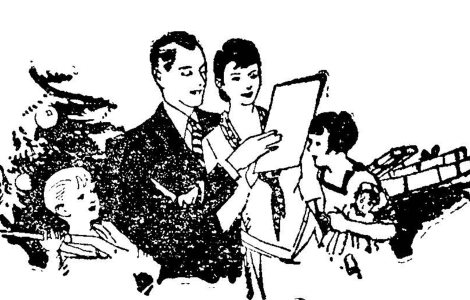
Yet there are those who take a positive stand upon the future of the family, and hold that the family, though it evolves, is enduring and does not die, and that it is our duty to support its survival by teaching parents the principles of upbringing and household service; for the mother, if this study is made available to her, becomes better than the specialists and worthier than they of rearing her children, especially in the first years, when the child's need of affection is keenest. The social workers have found that the home — if it has a wholesome, cultivated atmosphere — is the best place for rearing the child; for this reason they try to find suitable families to adopt stray or abandoned juveniles. As for the modern inventions, they have restored to the home some of the tasks that had for some time moved outside it — such as washing and sewing. The spread of television will be a factor in the home's recovering its importance as a center of amusement and enjoyment; and the use of steel in building houses will make their construction cheap and their acquisition easy.
Summary
We have seen that the family was built, at the beginning of its eras, upon material functions: procreation, economic cooperation, the rearing of children. These functions branched out and advanced with the advance of civilization, and the spiritual functions appeared, such as the cultural function and — more important still — the function of affection. With the progress of the sciences and industry, the collapse of the tribal system, the rise of the individual's standing, and the spread of the idea of independence, the functions of the family began to contract and to submit to the developments to which all the circles of society have submitted.
But one function has kept the first
and permanent place in the eyes of modern public opinion: that the family is the center of affection, companionship, and mutual love between the two spouses — that is, the spiritual function is the greatest justification of its existence, and on this foundation it must be built. The other functions, such as the question of children and the like, take on a secondary importance; and the material and economic bonds which make some members of the family a burden upon the others are a kind of enslavement, while the bond of affection is liberation and release, because it is elective and willed.
If we wished to measure the family evolution that has taken place in this country of ours, the matter would be difficult for us without conducting surveys; but we can say that evolution among us proceeds along the pattern we have described, though slowly and within a narrow compass. What we observe is that our practical evolution outruns our intellectual or theoretical evolution. We still raise a great outcry at every departure from family traditions and at every bold or unfamiliar social step. Yet these bold steps occur every day despite the agitation of the reactionaries and their clamor — but how many are those who are affected by that clamor and that agitation!
I once heard from a Western lady the following observation: "Man and woman in the West marry so that each may find a companion with whom to exchange affection, understanding, and esteem; but the Eastern man marries for material ends: to have an heir, or a woman to serve him. And likewise the Eastern woman marries in order to live."
And I said to myself, in comment upon this remark, that there is in it a generalization which does not hold true of all Easterners nor of all Westerners. But is it not true that the East's disease is still materialism? And I went searching, in the hope of finding some proof to show me that the East has begun to shed its materialism.
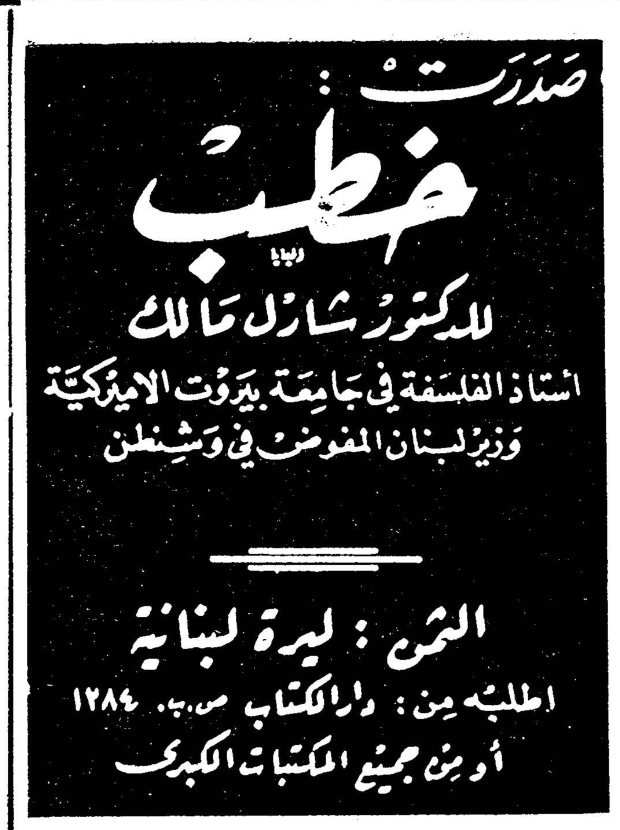
Speeches by Dr. Charles Malik
Just published: Speeches by Dr. Charles Malik, professor of philosophy at the American University of Beirut and Lebanon's Minister Plenipotentiary in Washington. Price: one Lebanese lira. Order it from: Dar al-Kitab, P.O. Box 1284, or from all the major bookstores
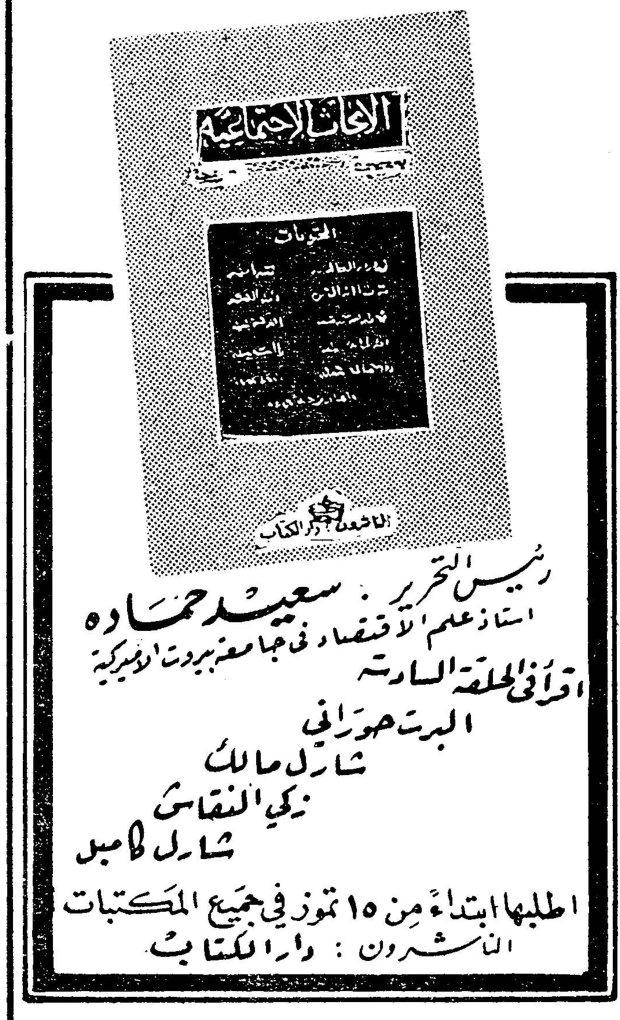
Social Trends
Editor-in-chief: Said Himadeh, professor of economics at the American University of Beirut. Read in the sixth installment: Albert Hourani, Charles Malik, Zaki al-Naqqash, Charles [...]. Ask for it from July 15 at all the bookstores. Publishers: Dar al-Kitab
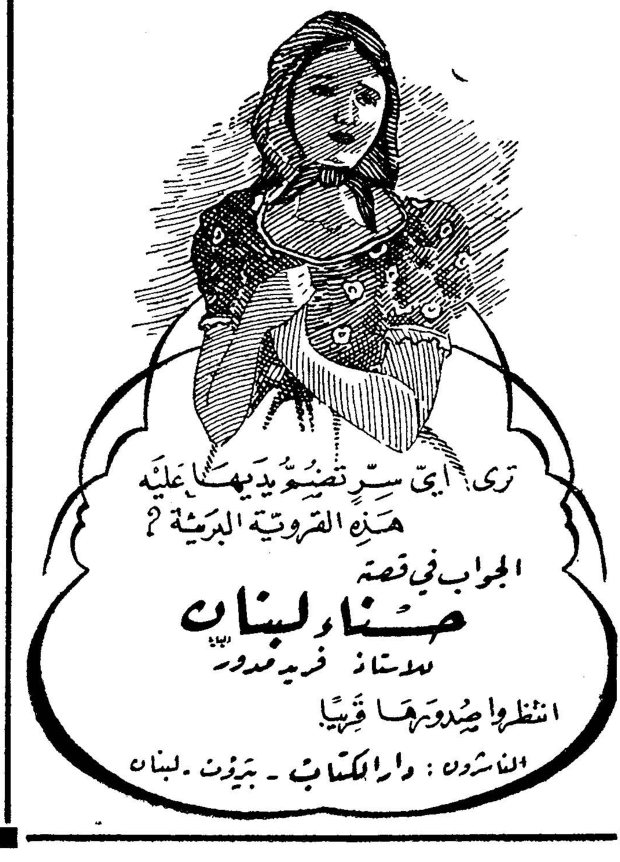
The Belle of Lebanon
What covering, one wonders, is this ... Bedouin village girl fashioning over it with her own two hands? The answer is in the story “The Belle of Lebanon” by Mr. Farid Medawar. Await its publication soon. Publishers: Dar al-Kitab — Beirut — Lebanon