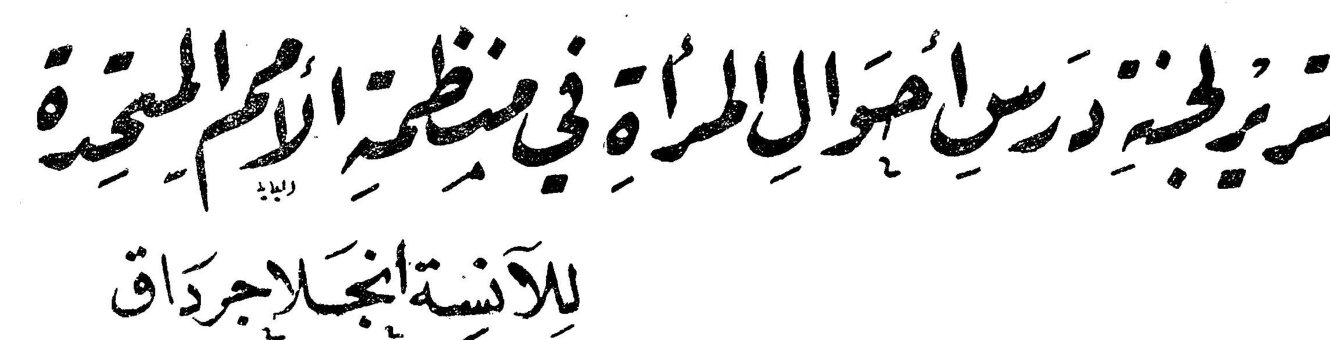
The nucleus of the subcommission on the status of women was formed by the Economic and Social Council under its resolutions passed on the sixteenth of February 1946, in order that it might submit proposals, recommendations, and reports concerning the status of women to the Commission on Human Rights, and submit proposals concerning matters within its competence and the manner of its composition to the Council by way of the Commission on Human Rights. This subcommission met in Gillett Hall at Hunter College in New York during the period between April 29 and the thirteenth of May 1946, under the chairmanship of Mrs. Bodil Begtrup. The discussions turned on the fundamental principles to be adopted, the breadth of the scope of the work to be undertaken, and the composition of the full subcommission.
A general feeling prevailed among the members of gratitude to the Economic and Social Council for its concern with the question of the status of women and for its creation of this subcommission to study the complicated questions, and in this way to carry out what is stated in the preamble to the United Nations Charter: "the equal rights of men and women."
It was officially affirmed that the subcommission was formed to give counsel to the Commission on Human Rights in matters concerning the status of women. Accordingly, the subcommission must work in harmony with the Commission. General agreement was reached that the subcommission must study the status of women from all sides and present to the Commission proposals as broad as possible concerning human rights and concerning the scope of the work the subcommission will undertake when it is constituted in final, permanent form. The members defined the ideals to be aimed at and the principles in whose light the work will proceed, and this stood as a preliminary step in their reasoned endeavor. The members considered that the work of the subcommission must continue until woman has reached a point
at which she stands on an equal footing with man in all fields of human activity. Practical preference had to be given to political rights, since without them no great progress is possible. Nevertheless, improvements in the civil, educational, social, and economic fields were also considered of special importance, and all must therefore be treated together with political rights at one and the same time.
The question was discussed whether the Trusteeship Council, upon its formation, should be invited to consult the subcommission with regard to the status of women in the countries that have no independent governments and whose affairs are entrusted to that Trusteeship Council, on the basis of Article 76 (c) of the United Nations Charter. It was generally agreed that this is a question that can be left to another time, when the full subcommission holds its coming meetings.
In the course of discussing the question of constituting the subcommission in its final, permanent shape, the disadvantages and advantages of adopting a small membership were closely studied. It was found that a small body could be more capable of work, although the larger body could represent woman's activity and works more broadly; and it was decided to propose that the number of members be not fewer than 15, including three members who were formerly members of the Commission on Human Rights. As for the other members, they would be elected from the regions not fully represented in the first subcommission, and in particular from the countries in which the condition of woman has reached different stages. A difference of opinion arose over the question of outside
representation: some members held that representation should be on a governmental basis, since the work of the subcommission cannot be effective without government backing. Others were of the view that members should be chosen on the basis of their personal competence, as was the case when the Economic and Social Council chose the members of the founding subcommission. The members reached the following conclusion: since in practice the Economic and Social Council does not appoint persons unwanted by their governments, the Council should therefore select on the basis of personal competence. As for the term of membership, the members held that continuity is necessary during the first years, in the course of which their program will be applied; after 1950 a system of rotation should be applied, conforming to the main lines laid down by the Economic and Social Council for the other committees.
In the course of their meeting the members of the subcommission expressed their faith that democracy is now the only social order in which women can enjoy their full rights as human creatures; that a great number of women have made many sacrifices for the sake of democracy and freedom, and have proved by deed that they are capable of carrying out all duties and tasks; and they affirm their resolve to work in the service of world peace with all the strength of heart, mind, and will that they have been given.
Accordingly, the subcommission recommends that the full subcommission should proceed in its coming work by the guidance of the following ideals:
1) Freedom and equality are necessities for the progress of the human race. And