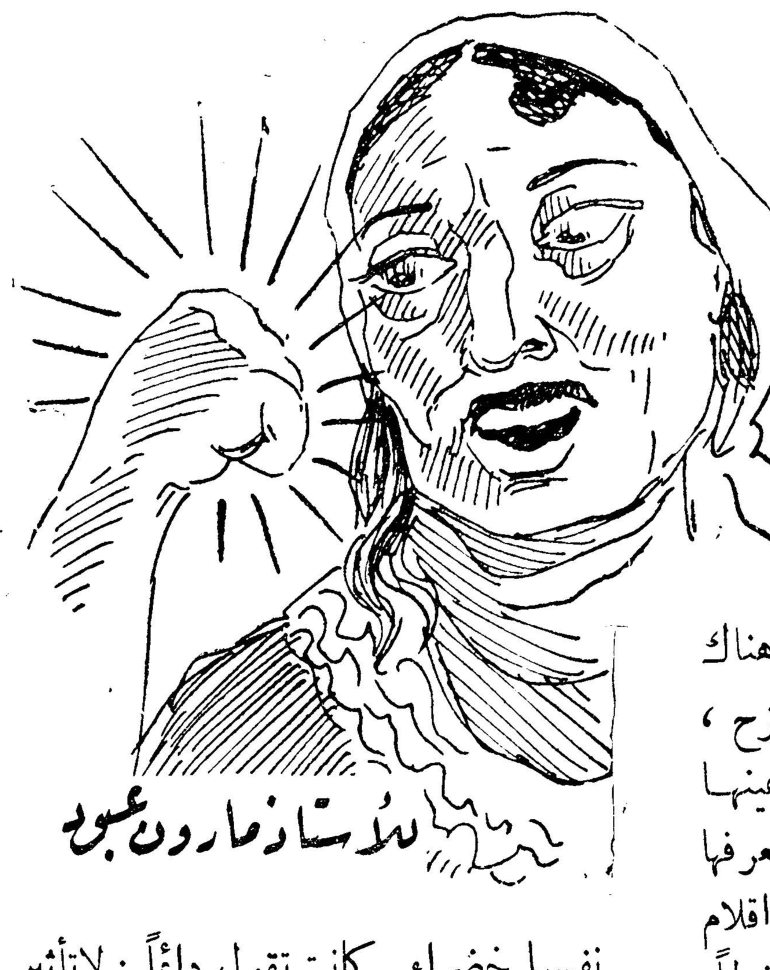
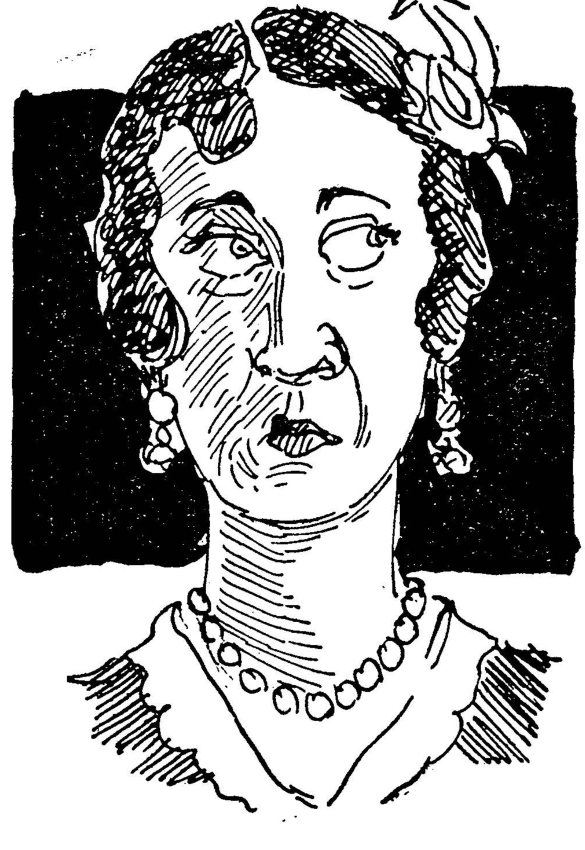
Jamileh reached forty and balked there: the years rolled on while she stood fast, not budging. Whenever you asked her age, her eyes dropped and she answered: about forty. Anyone who did not know her would take her for her daughter-in-law's sister, not her mother-in-law. The pens of the years had not traced a single coarse line on the page of that radiant face; there was nothing there but fine lines like the watering of a sword blade. For Umm Latouf was the rarity of her age: a captivating beauty and a tall, straight figure, neither stout nor slight; two almond eyes that would bear out the tales of Harut and Marut, in which the water of youth went on shimmering until they were snuffed out. Whoever looks closely will see that her nose was no small one, but its bulk was lost in that broad plain.
The late lady was a headstrong tyrant, ruling by her own decree, holding sway over her husband and his cousins; no order of hers was disobeyed, and she was consulted in knotty matters. A word from her small mouth could set the village aflame; and when trouble flared she would trade volleys of stones and lay about with a stick. Had she not lived within the village's narrow circle, she would have amounted to something far greater than she did.
Like the girls of her generation, she bound her head with a band strung with jihadiyyas — gold dinars — so that one could scarcely tell the pure gold from that broad brow. She plaited her long hair so that it hung down to her waist, braid upon braid, with
three dinars at the tip of every braid; and on her head a silk kerchief, which she knotted beneath her sweet chin. The "coquette" walked as though she were a girl of fifteen. She passed sixty and her spirit stayed green. She always said: age counts for nothing; it is all in the spirit. She was ever-smiling, famous for generosity and open-handedness, and nothing ever troubled her mind until she thought about her son's marriage.
She tried to marry into the great houses and did not succeed. Her son was a handsome young man of sound mind, but decent men's daughters feared his mother's arrogance and despotism and shrank from storming her house.
Umm Latouf never curbed her tongue about other people's daughters. Whenever her son mentioned one to her she scoffed and rebuked him, saying: I thought you had sense. A boy with no taste — low! This one's father is thus, and that one's mother is thus and so. And so the days ran out, and Latouf reached thirty-five unmarried, and his mother never got the daughter of decent folk she was forever claiming.
Umm Latouf had no wish to see her son wed. She refused to become a mother-in-law, and her flesh crept when she pictured herself become a grandmother, hailed with "ya sitti!" She would be angry if we called her by her kunya instead of her name. Whoever said "ya Jamileh" to her — she flashed her teeth at him and hailed him with welcome, as though he were one of the winners of a doctorate in letters and philosophy...
At last Latouf grew weary and fed up. The gray hairs advancing on him with drum and fife took him with alarm. So on one of the nights of Carnival our friend took fire and brought his
mother the girl he had chosen — and she welcomed him with the slipper, slapping his face and the back of his neck. The father stepped in between them, and she rebuked him with the phrase kept ready for his use: Shut your trap; sit off yonder. So he shook his head and held his peace. He was a man of the field whom his wife managed, more obedient than the ring on the little finger. And for this meekness of his, people traced his son to his mother.
Umm Latouf insisted on sending the bride back, but her son said to her: We are married, mother; do not keen. What God has bound, man does not loose.
She screamed at him: Would you were laid out for your funeral before the Lord! So you've turned philosopher, you jackass! And she began to go yellow and green and red, and to tremble as though stricken with the ague. At last she fainted. The swoon dragged on, the pulse vanished, and
the priest was summoned. She woke after a while and saw the reverend father crouched at her head, and made to seize his beard; he took flight, hearing as he went: If my eye lights on his eye there will be a reckoning. He crowns my son and never asks after me? His beard must be mowed!
With the passing of the days Umm Latouf's temper cleared, but her life was soured. Her daughter-in-law treated her sweetly, and she only grew the more averse and disgusted. If the girl walked, she found fault with her; if she spoke, she traded winks about her; and she would scarcely taste her cooking. All this
while the daughter-in-law bore with her, humoring her and coaxing her — and she waxed ever more overweening and tyrannical. At last the scales came level, and the battles that flared were savage