ones.
Then old age fell upon Umm Latouf, and before it she was routed. Her gaiety forsook her when her dominion forsook her, and the press thinned at the spring whose water had been sweet; and she would answer the company by saying: Jamileh has grown old — and Hanneh is young.
And the lady Jamileh made ready a counterattack, to win back something of the strongholds of her beauty: she dyed her hair, and powdered, and rouged, and penciled her brows. She would take fright every time she saw that beauty being routed, pressing hard in its flight.
Then all at once she resolved on a visit to Beirut. No one knew what she was about until she came back after a week, having changed her Heraclian garments for new
fashions — nor did she forget the handbag and the parasol. She sold her coin-band and her braids and bought the choicest and costliest of stuffs, and came back to the village like a bride. She cast off the sash and bound her hennaed head with a rose-pink kerchief, as though to rival her daughter-in-law and preen over her. But she met with no regard from the people, and the sallow laughter mixed with bitter mockery was killing her. She was at her wits' end, and grew fierce in quarreling; she fled her own house — nay, every house —
and fancied all the people her adversaries. She would sit beneath a historic oak under which her own mother-in-law had so often sat before her... and talk to herself as
though she were talking to some other person. She would remember the days of glory and greatness, and weep. People, to her mind, were traitors, backing her daughter-in-law against her because she was young; and everyone had turned from her, even those who loved her.
One day she came in upon me with her grandson. She seated him beside her and sat down — no "God keep you," no "God's peace." She was absent, as though she wished to say nothing, or did not know where she was. I did not provoke her, lest the whole quarter be set in an uproar. When the waiting had drawn long I said to her, smiling: It seems you have swallowed your tongue. God be with you.
She answered with a listlessness shot through with aversion: Neither God be with you nor peace upon you. You are all against me. The Master has no friend. So saying, she drew from her bosom a ka'keh left over from her provisions from Beirut, handed it to the boy, and said: Do you know why I love this lad?
I hitched my left shoulder by way of saying no, and she burst into a witless cackle and said: Because tomorrow he will take my revenge. I reared, and met with nothing.
I said to her: Do you want the truth, Jamileh? The fault is all yours. Let be — your turn is over.
She wagged her head and said: I am worn out. My daughter-in-law is a she-ass and my son is a jackass. It was I who built up the house; it was I who made it a house. And then some scrap of a beast, a stranger's daughter, comes to lord it over the place, and never asks after me. This is what God has sent down in a book.
I said to her: The world goes by turns; your turn is over.
She said: She eats only just as she pleases; her talk is all without savor; her chatter is jaw-clacking, more wearing than the mill-clapper. She consults me on nothing, as though I were a bitch. It never crossed the baggage's mind that I am the mistress of the house.
I said to her: The world goes by turns; your turn is over, Jamileh.
At hearing "your turn is over" she blazed up. She had been sitting; now she stood and swept on with her talk, at one moment bearing down on me and thrusting her
fingers in my face, at another falling back like a colt. At last she said: My son loves his wife more than his mother; our boy is an ingrate. The proverb says: the world is a mother. The proverb lies — the world is a wife.
I said to her: Don't rave on; your turn is over, Jamileh.
She shrieked like a madwoman: And soon enough your turn will be over!
And she flung out in a rage and slammed the door behind her, and I heard her saying: He who cuts from another man's hide cuts it generous. They are all of one feather. People side with the man on his feet.
The boy screamed when the door proved too much for him to open, so she came back, her lips dancing the Charleston, snatched him up with a jerk, and said, biting her lower lip: May the monkeys drag out your mother's soul!
I moved to stop her, meaning to say: Your son is dying, Umm Latouf; he has grown like a consumptive. But she would not stop, so I pelted her with my words as she went; and she hurried off, saying: For a mule, death is the decenter cover.
Latouf, meanwhile, was in grievous straits of life between his mother and his wife. He was always silent as a fish, saying neither yea nor nay. He weighed his problem and could not find his way to the lesser of the two evils.
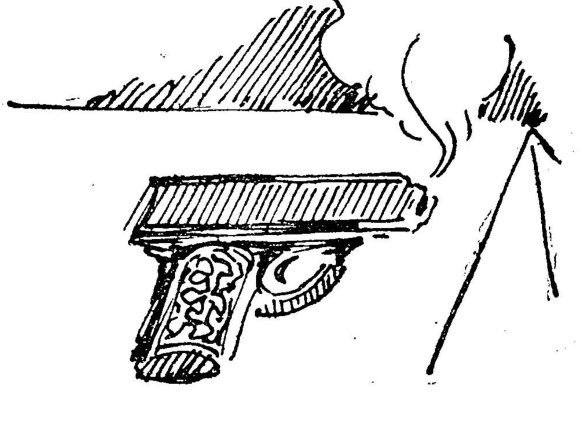
Then came a decisive battle between the mother-in-law and her daughter-in-law, and Latouf leveled his pistol at his own head in threat. His mother screamed and clung to his hand; the pistol went off and ripped open the belly that had carried him nine months. And so the knot of the tale was undone thus: the mother in the grave, the son dead in prison, and the wife under another man.
"From Faces and Tales"