liberality, and his freshness.
It is a good thing for this country that Dr. Mahmasani should crown his practical life by devoting himself to writing, and so fill, in Arabic letters,
a gap that many could scarcely fill with the like of the faithfulness, sincerity, and understanding for which he is known, whether in this book of his, in his other writings, or in his practical life.
As for the third book, it is on another plane. It is a story, entitled "The Belle of Lebanon," by Mr. Farid Mudawwar. Publishers: Dar al-Kitab. Its pages number 192, and its price is two Lebanese liras.
In this splendid popular story the Lebanese stamp shines forth: it reflects Lebanese life and treats a problem you may call, if you will, the struggle between village life and city life. I have not yet read, among all that I have read, a long Arabic story that pulses with reality and makes the reader live in it as this story does. It is a singular color of narrative literature, reminding us to a great degree of Walter Scott and Dickens — that living, realistic color in which there is no straining and no affectation.
No doubt whoever knows Mr. Mudawwar through his plays will not find the atmosphere with which this story is suffused strange to him.
Mr. Mudawwar has, beyond question, carried the banner of the Lebanese play; will he now, in "The Belle of Lebanon," carry the banner of the Lebanese story as well?
However that may be, there is in this singular realistic story what should win the reader's admiration and stir in him both pleasure and profit. It is enough that it is an attempt at the long story, of whose like our Arabic literature stands in want.
gives the cellulose fibers a pure white color. The water is then drained off these white fibers, and they are washed well with clean water until every trace of the bleaching powder has gone.
Now that the cellulose is in a pure state, it is mixed thoroughly with a little "rosin" (collophane) — the substance used for rubbing the violin's bow — and with aluminum sulfate, to give the paper strength and firmness. When this stage is finished, the cellulose paste has become a paper paste, ready for the final step in its transformation into paper.
The paper paste, mixed with a great deal of water, is placed in a special vessel with an opening in its bottom, from which the paste issues at a known rate according to the size of the opening. The paste falls onto a steel screen, and most of the water passes out through its many holes, leaving behind a paste denser than before. During this draining the screen is pushed forward, and it is also shaken from side to side, so that the cellulose fibers may interlace and hold fast to one another.
This steel screen moves forward at a speed of about a hundred meters a minute. At the end of its course there are two cylinders that press the cellulose between them, removing most of the water still left in it. It is now no longer a paste; it has become moist paper.
To dry this moist paper it must pass over a number of heated cylinders, the paper wind
ing around them. When it is thoroughly dry it passes over six further cylinders, heated as well, but whose task is not drying but pressing, so that the cellulose fibers may adhere well to one another; the paper thus gains in smoothness and becomes fit for writing, for this pressing operation closes up every gap between the fibers. Without this operation we should get what we call blotting paper, since the many cells between the cellulose fibers absorb the ink. Blotting paper, then, follows all the stages of the manufacture of ordinary writing paper except this final pressing stage.
To make glossy, shining paper, ordinary paper is coated with a special solution containing calcium carbonate or barium sulfate mixed with a substance extracted from milk and called casein (Casein), which is the protein (Protein) of which milk is composed.
As for the brown-colored paper used for paper bags and for wrapping various goods, it is made as ordinary paper is made, by cooking it with the sulfurous solution mentioned above, except that in this case it is cooked for a shorter time. The non-cellulose woody substances therefore do not all dissolve as they do in the cooking of ordinary paper; a large part of them remains mixed with the cellulose fibers, and the result is a brown-colored paper, but one stronger and better suited than ordinary paper for use in making bags or wrappers.
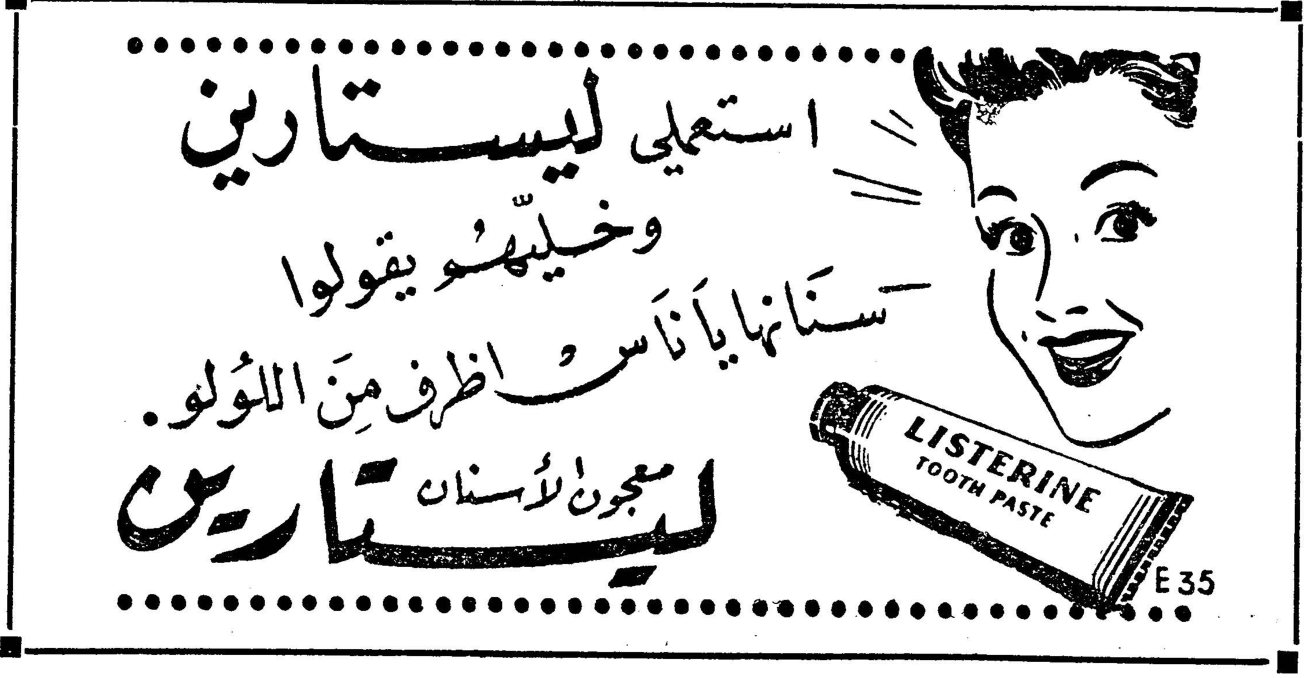
Listerine Tooth Paste
Use Listerine, and let them say: her teeth, my dear, are daintier than pearls.
Listerine Tooth Paste
LISTERINE TOOTH PASTE
E 35