Fourth — the Charter stipulates that the decisions of the Security Council — and the Security Council is the principal body of the organization — be taken by a majority of at least seven votes (out of eleven). It stipulates also — and here is the essential element of corruption — that among these seven votes there be the votes of all five of the Great Powers (Article 27). That is, the Security Council can take no decision unless the United States, the Soviet Union, the United Kingdom, China, and France approve that decision. Should one of these powers see fit to differ with its companions on any subject whatsoever, it paralyzes the work of the organization completely, even if all the states of the earth are against it in opinion. And when we recall that states listen only to the voice of their interests; that the Great Powers
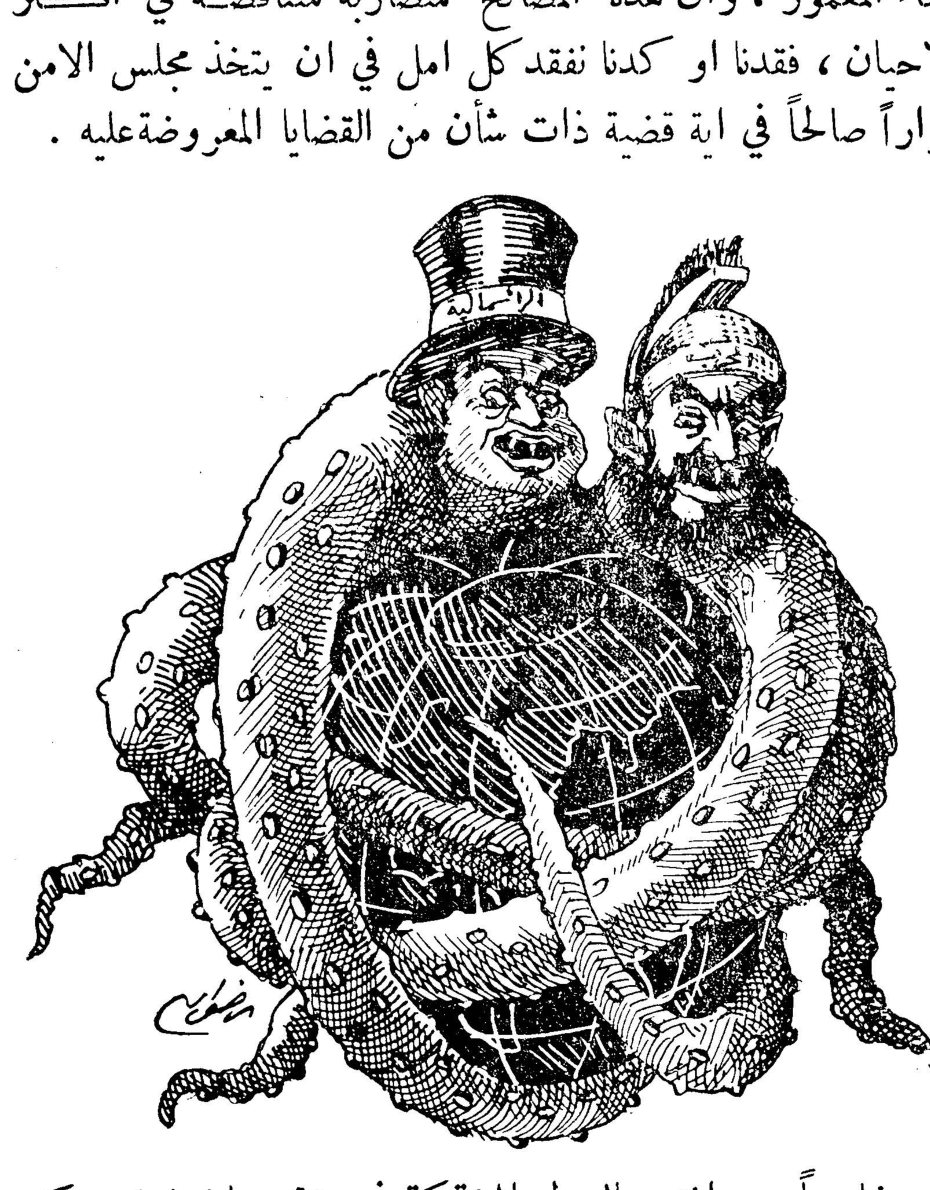
have interests in every quarter of the inhabited world; and that these interests are, more often than not, clashing and contradictory — then we lose, or all but lose, every hope that the Security Council will take a sound decision in any question of consequence among those laid before it.
Fifth — the states taking part in the San Francisco conference agreed in principle on the necessity of “regulating” armament (they agreed on “regulating” it — not on “abolishing” it, nor on “reducing” it). I do not know what is meant by the word “regulating” armament; it is one of those words that come in out of place and can be interpreted in a thousand and one ways, and there is no doubt that the states picked it deliberately, because it answers the purpose exactly and admits all sorts of strange interpretations and theories. And yet, although the “regulation” of armament means nothing in reality, the organization shrinks from alluding to it, and I do not think it will dare to raise it in the near future. Meanwhile you see the Great Powers going forward with the building of huge war factories, the improvement of their weapons, and the encouragement of “scientific” discoveries and
inventions that multiply their destructive capacity. And armament, even if it is not the direct cause of war, nevertheless stirs up pride and vainglory and encourages the plunge into the fray of war, because it strengthens the hope of prevailing.
Sixth — the United Nations organization possesses no effective means of executing its decisions. It was expected, and agreed at the San Francisco conference, that the states would place at the disposal of the United Nations armed forces enabling it to execute its decisions. But the texts of the Charter dealing with this matter content themselves with laying down the principle, postpone execution to an unnamed date, and pass loftily over the practical details: they set no date, name no state, designate no post, define no competence, and determine neither the size of the contribution nor the conditions of command and execution. And I do not think the Great Powers — floundering today in a mighty political struggle, as though preparing for a decisive war, as though that war were at the gates — I do not think the powers have become readier today than they were last year to give up a part, however small, of their forces, to present it as a gift to the United Nations organization.
Let us suppose that a dispute broke out between two states or more, grew worse, and threatened catastrophe. (Let us not suppose — though the supposition would be in place — that the catastrophe actually occurred; for the outbreak of war must be regarded as a death sentence upon the United Nations organization, a sentence final and executed on the spot.) Grant that the Security Council succeeded, after long labor and pains, and after the reports of committees and experts, in taking a decision on which the unanimity of the five Great Powers was achieved: can the United Nations organization execute this decision if a state, of its own free will, declines to carry it out? The Charter provides, in this case, that the Security Council ask the members of the organization to impose economic sanctions on the recalcitrant member (and the sanctions are decided, of course, only by the unanimity of the Great Powers). If economic sanctions avail nothing, then the members are asked (following the same procedure) to apply certain military sanctions. Do not imagine these “sanctions” a grave affair: there is nothing frightening in the word but the name. As for what the name contains, it amounts to no more than an innocent pleasantry and a Platonic piece of bluster. Article 42 has described it, citing as examples of military “sanctions”: “the carrying out of maneuvers, and the imposition of a blockade effected by forces belonging to members of the organization.” I do not think these sanctions will be applied; and if one day they are applied, they are in any case not frightening, and may produce no effect beyond the gathering of the boys of the coastal towns on the shores of the blockaded country to watch the warships of the allied powers carrying out their maneuvers.
No — the United Nations organization cannot prevent the coming of war. The restraints it imposes upon states are verbal restraints that diminish no one's liberty, and no one pays them any heed.
War is an inescapable necessity in our present world, because our world rests on corrupt foundations. These corrupt foundations are the division of the world into “independent” states concerned only with the realization of their own particular interests,