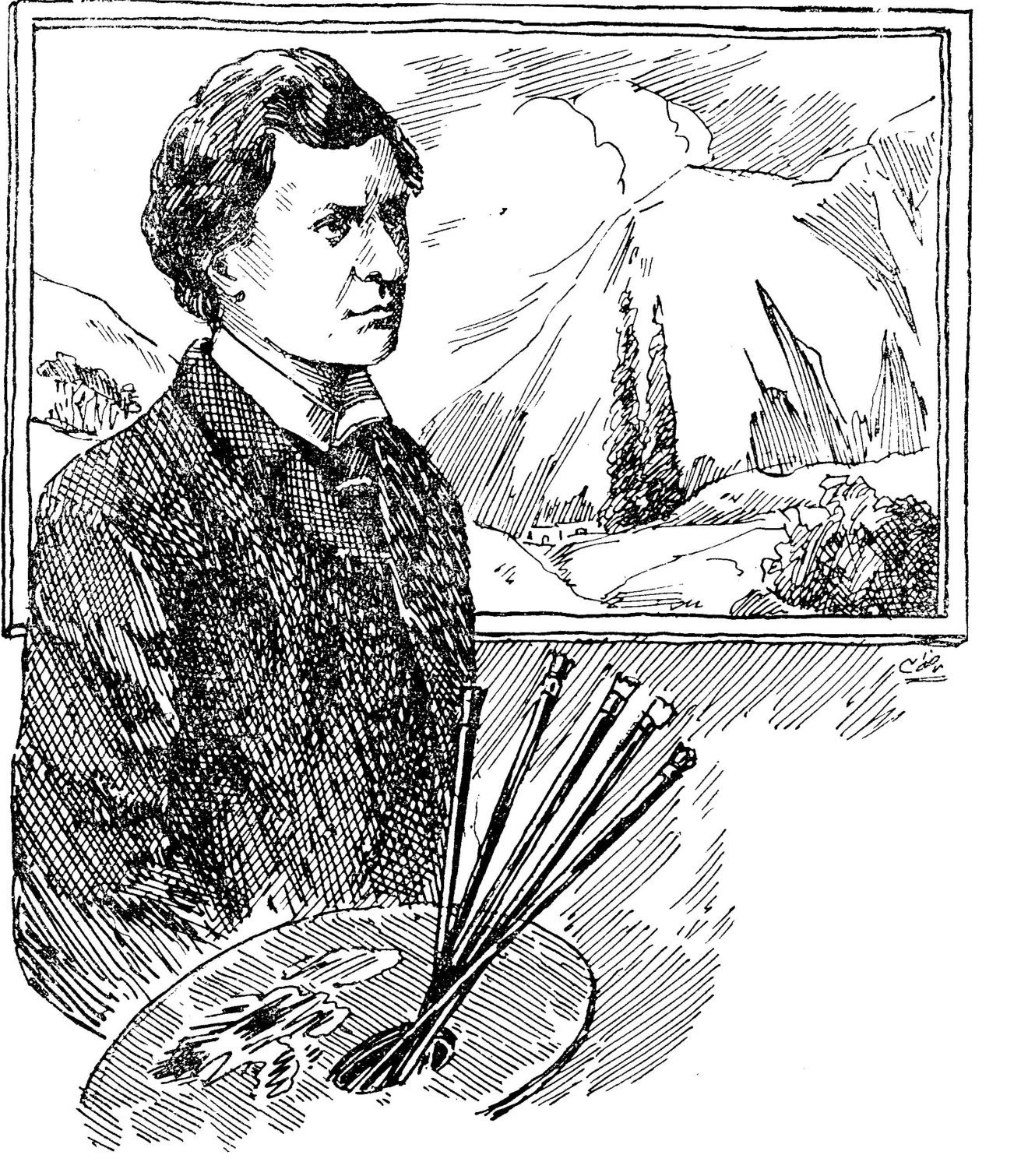
Khalil Saleeby was born in Btalloun. His artistic gifts appeared from his childhood. It was granted him in his youth to go to England, America, and Paris, where he studied and practiced the art of painting. Then he returned to Beirut with his American wife at the beginning of this century and settled there, practicing his art. At times he was obliged to take up work outside his art in order to provide for the needs of his life. He used to go back to his village and spend the summers there. Then there was a period shortly before the First World War which he spent in England and Europe. He exhibited his paintings at the Paris international exhibition at the beginning of this century, and then at the general exhibition held by the Residence of the French High Commissioner some twenty years ago. Each time he won the distinguished honorary award (Hors concours), which is given only to eminent artists of world rank. He had in his homeland a minority of admirers who appreciated the value of art in the life of individuals and peoples. But many times he criticized his countrymen for falling short of the Western nations in their understanding and appreciation of art and artists. After the First World War a dispute arose between him and the people of his village over a water spring, which led to a bitter enmity, and then to the murder of him and his wife in Beirut in the summer of 1928. He had a strong, sharp personality that left its mark on the circles of the people with whom he came in contact. His legacy was not confined to the pictures he painted — which still adorn the walls of many houses in Beirut and elsewhere — but extended beyond them to what settled in the souls of those who knew him, whose minds were enlightened with something of the artistic taste and artistic knowledge that he diffused in his conversation. He had pupils who learned from him, and they are still among us, prominent artists in the Lebanese capital.
"The Woman's Voice" saw fit to ask one of his intimate friends, Mr. Emile Doumit, to write a word about him. We thank him for granting this wish of ours, as we thank Dr. Shaheen Saleeby for permitting us to copy
some of the late artist's paintings that adorn his flourishing home; we may publish them in a coming issue.
I met Khalil Saleeby shortly before his death in Beirut, where he spent the summer season contrary to his custom, for he always summered at al-Shqif, above Btalloun, in the house he loved and beautified with the flowers of which he was so fond, and in whose planting and cultivation he was expert. He used
to promise himself that he would carve a tomb for himself in the rocks of the cliff on which his house was built. His summering in Beirut was due to the intensifying of the enmity between him and the people of his village. When I greeted him he said, his eyes brimming with melancholy and a lump in his throat that almost choked him: "My soul is exceeding sorrowful, even unto death." I said to him: Why this melancholy, when you are famed for your courage and your strength? He said:
"I feel lonely and forlorn. And beyond that, they are trying to assassinate me." We parted with a promise that he and his wife would come to Souk el-Gharb and pass a few days at my house. I, and others who loved him, thought that he was exaggerating his fear of assassination, for we thought it most unlikely that the people of his village were such as would go so far as that hideous deed. How many an appointed meeting has no meeting after it in this world.
A few months after his death it fell to me to settle on the ninth floor of one of the buildings of New York, in a room overlooking the Hudson River and the gardens of the riverside, where I felt some measure of independence from the din and clamor of the great city. One night there appeared to me in a dream a halo of light, and at its center an old man so great that he filled it; and he was revealed — and there was Khalil Saleeby, looking at me and saying: "It is true that they killed me, but what