Saba — or Yemen — lies in the southwest of the Arabian Peninsula. It is thought that 'Saba' is derived from the Sabians, that religion which gathered together many Jewish and Christian beliefs.
The Sabaeans were famed for agriculture and trade. The most important of their ancient monuments is the great water reservoir called the 'Dam of Ma'rib,' in whose building Bilqis took part; it was counted among the wonders of the world.
Some German Orientalists say that the story of Bilqis is a spurious borrowing from the Indians and Jerusalem, on account of the contradictory tales told of her in their legends. The English Orientalists, for their part, hold that she was an Arab princess, while Arab history ranks her among the kings of Yemen.
Josephus calls Bilqis by the name Nikaulis, saying that she ruled Egypt and Abyssinia.
Bilqis lived in the tenth century B.C. The reason she came to the throne, despite the Arabs' disdain for the rule of women, is that her cousin — Hadhad ibn Sharahbil, who inherited the throne of Yemen after her father — abused his people most grievously: he no sooner learned of the existence of a beautiful girl, be she daughter of vizier or of emir, than he defiled her honor. This drove Bilqis to offer herself to him. He told her that he had long thought of marrying her but had never found in himself courage enough to come forward with the proposal. He then wrote to her to come to him; but Bilqis refused, unless he asked her hand of her people and the wedding were held in her own palace. On one of those evenings Bilqis prepared the
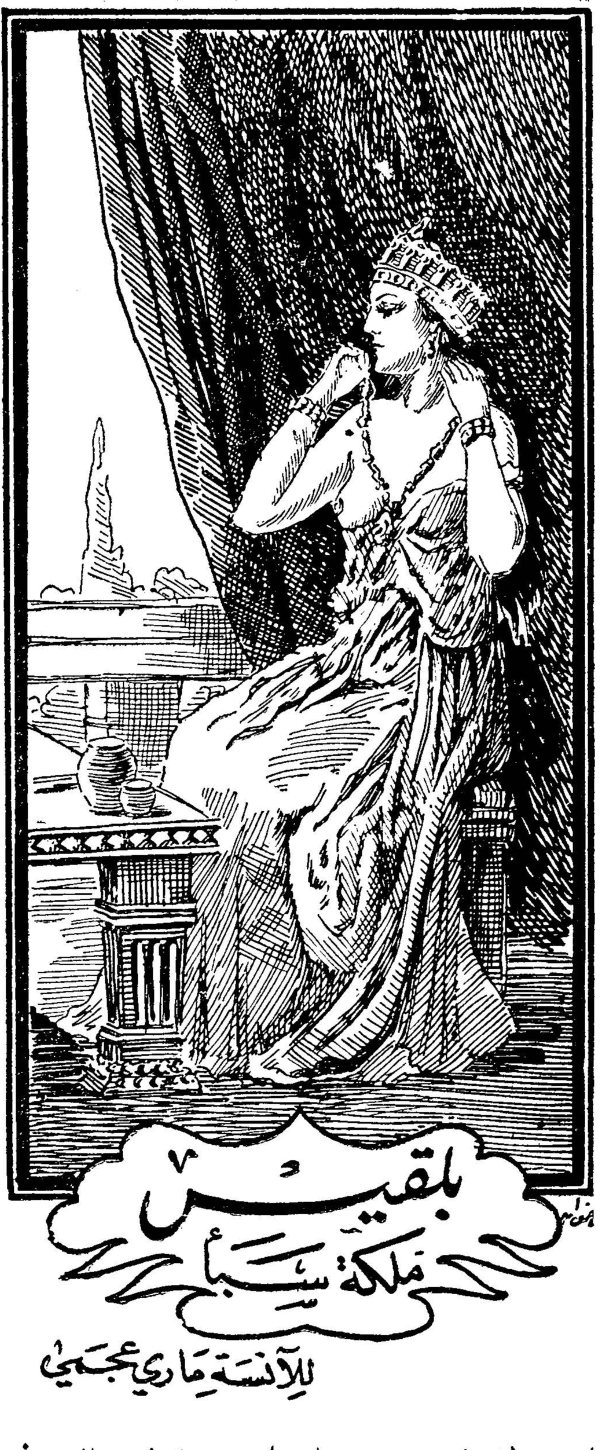
Bilqis, Queen of Sheba
pretended banquet, and scarcely had Hadhad crossed the threshold of her palace when two men lying in wait for him dealt him the mortal blow. Bilqis then summoned the viziers and the commanders and told them that she had killed her cousin to save the honor of their daughters and to avenge their plundered
dignity; and she went on to upbraid them for their slackness in guarding their daughters' honor, out of their self-abasement before him and their fear of his tyranny. So they elected her queen over them in reward for her good deed.
The transmitters differ, moreover, over Bilqis's lineage, though most agree that she was of Qahtan. One party of them excelled in weaving legends around her descent; and in some of these there is a literary symbol pointing to the shrewdness and influence that certain women possess.
In Bilqis's killing of her cousin there is proof of her tenderness toward her sex and a witness to her championing of its dignity. How could it be otherwise, when she was the chaste and stately lady who withheld herself even from King Solomon?
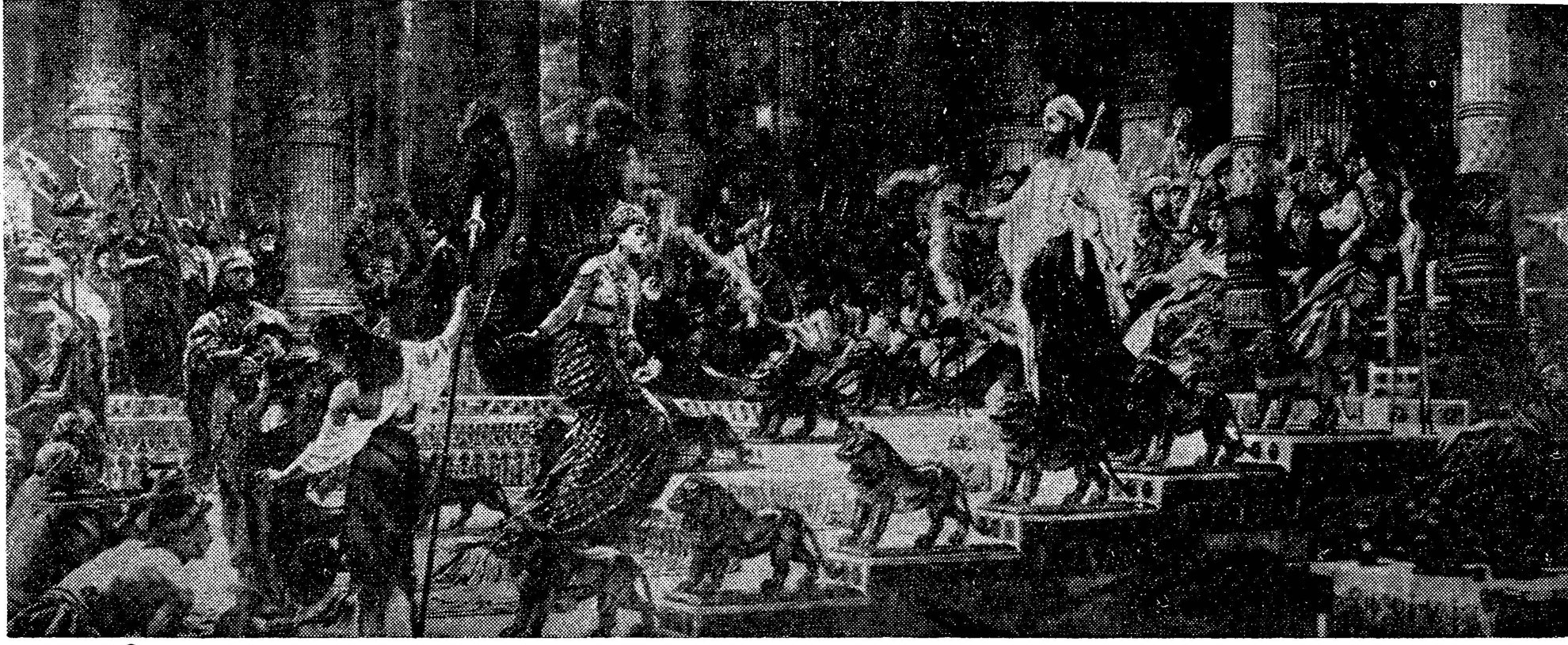
The most famous things known of her are the multitude of her soldiers and the magnificence of her throne.
Ibn al-Athir, however, rejects the exaggerations in the descriptions of her throne and the numbers of her armies, saying they are among the things that cannot be believed.
Among these exaggerations is the claim that her throne was a couch of pure gold and silver, studded with precious jewels, standing within seven chambers, in the innermost of them.
It is said that its front was of gold, inlaid with red rubies and green emeralds, and its back of silver, crowned with every kind of jewel and pearl; it had four legs — one of red ruby, one of yellow ruby, one of green chrysolite, and one of white pearl — and the panels of the couch were of pure gold.
It was said to