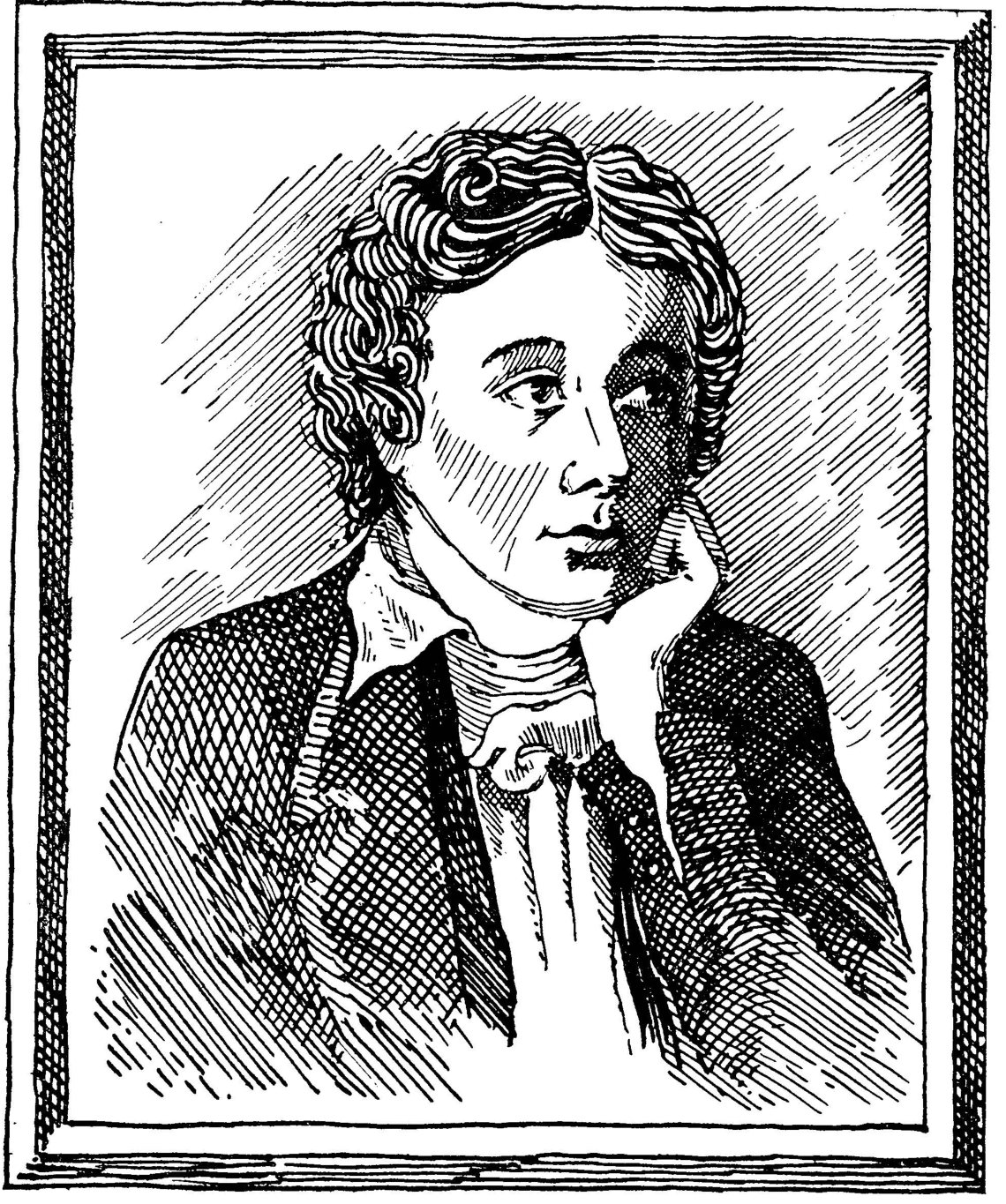
How I long to return to "Keats" from time to time, and to live with him moments whose happiness grows as my power grows to rise to his heights. He is the nearest of men to Shakespeare, and had God prolonged his life beyond those twenty-six years, he would have joined the master of poets at the very threshold. On this the critics are all but unanimous. Consider, then, what a loss literature suffered by his early death.
"Keats" was the contemporary of geniuses of thought and art such as "Shelley," "Byron," "Goethe," "Beethoven," and "Hegel"; he lived in an age when the Romantic wave reached its height. And while most of his contemporaries drowned in its billows, we find him, for all the freshness of his youth, finding
his way to the lifeboat: Classicism. He clings to it as the drowning man clings, and so restores to authentic art the luster of luminous expression and the old majesty of the idea.
Among his qualities, then, was his distance from emotional liquefaction and from that irresponsible, mystical dissolving into nature and life. Yes, he was touched by the sickness of the generation, but only to a degree at which we find him gripping, like the giants, the reins of his emotion and his thought. Hence came this superiority of his that admits of no dispute, and hence too this fortune of his in drawing near to Shakespeare.
What I admire most in "Keats" is his deep feeling. He thinks with his heart and feels with his mind;
and he is, besides, a devoted, intimate friend of life: he draws from it as though he gave it more than he takes from it. And this, upon my life, is the utmost of generosity and nobility. Rarely did he draw near to nature and fall under her spell and describe her in bewilderment, as "Shelley" did, for instance, or lord it over her and harness her to his purposes, as was the case with "Byron." Keats is so deep in feeling that, when he draws near to her, he tries to comprehend her, to learn from her, and to clothe her with his own self. Thus he had the power to shake his reader violently before arousing his admiration, or luring him into hasty stupefaction and affected awe.
And Keats, likewise, has a strange sense of beauty. This strangeness, too, comes of the depth of his feeling. When he portrays some beauty for you, you almost touch it with your hands and see it with your eyes and engulf it with your heart. Or, to put it in another word, you almost desire it — and I do not say love it, for desire is a truer expression, in such a case, than love.
Often it has seemed to me, as I read Keats, that man can be nothing but immortal, and that human existence is not mere chance or natural evolution. There is a mind and a spirit that work together to create — to share with God in creation. The universe is a means, not an end. Do not wonder, my reader, at this saying, nor chafe at it. It is enough that you return to yourself for a moment and examine it well: you will find, without doubt, in its deepest depths a power that knows no limit and no bound.
Finally, I am an admirer of Keats to a far degree. He never leaves my satchel. And whenever I sense in myself an inclination toward a spiritual and artistic exile in the world of beauty, I turn to the masterpieces of "Keats," chanting from them and chanting on, until the hour comes to return to this reality in which I live — this reality in which I find no consolation surpassing my consolation in the hour I take up the pen to set down upon paper a world of my own, which I myself have created...
August 16, 1946