The idea of literary societies is of recent date in our Arab lands; it goes back one hundred years — apart from the religious confraternities that preceded it by some years — most notably in Syria and Lebanon.
They appeared first in Beirut, drawn from the various communities, their guide learning and letters, their means research and study, their aim the enlightenment of thought, the spreading of the sciences and letters, and training in the methods of debate and the rules of meetings.
The first of them was "the Syrian" in 1847, followed by "the Oriental" in 1850, "the Literary" in 1851, "the Scientific" in 1868, "Shams al-Birr" in 1870, "Zahrat al-Adab" in 1873, "al-Funun" in 1874, and others of their kind.
Most of them did not last more than a few years; but our Shams al-Birr lasted forty-five years, until 1914, and it was my good fortune to be lit by its rays for thirteen years.
Before the formation of "the Scientific Circle" in 1881 and the founding of "the Oriental Scientific Academy" in 1882 — which lasted five years, and which we revived after a third of a century under the name "the Syrian Scientific Academy" in 1920, though it did not last a single year despite obtaining an official license; and before the government of Lebanon created "the Lebanese Scientific Academy" in 1928, whose pillars tottered after a few years, in 1932, and whose revival the government renounced in 1944 after having counted upon it; and before the multiplication of our learned and literary societies in the twentieth century — the ladies of Beirut formed the first of their societies in the second half of the nineteenth century, sixty-seven years ago.
They formed it first under the name of "the Christian Sisters," on Saturday, November 22, 1879, and
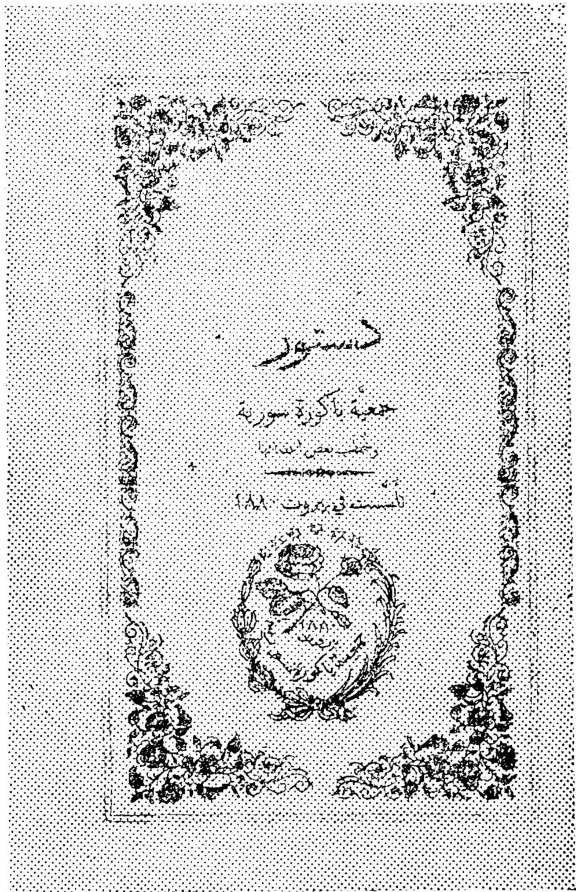
Constitution
of the Bakurat Suriyya Society
[...]
Printed in Beirut, 1881
its first session convened in the home of Fumiya Kassab, mother of Marie, founder of the Ahliah School in 1917. It was attended by the founding members Julia Hourani, Yaqut Sarruf, Mariam Makarios, Nafja Rayyis, Sarah Ibrahim, Jamila Yaziji, and Katie Yusuf, together with the lady of the house. Miss Rayyis delivered an address on "the condition of our country and its need of societies," and they deliberated on organizing the society and preparing its bylaws.
Its second meeting was on December 13 at the home of Mariam Makarios; there the bylaws were confirmed, and it was decided that no one should preside. The lady of the house undertook the recording of the minutes, Yaqut Sarruf the treasury, and Sarah Ibrahim the writing of correspondence, with Julia Hourani and Nafja Rayyis as assistants. At the third meeting an official board was confirmed, and Helaneh Baroudi and Saada Adib joined them, along
with the two regular members Jamila Yaziji and Katie Yusuf.
At their fifth meeting, on January 24, 1880, they changed the society's name, fixing it as "Bakurat Suriyya," and accepted Miss Collette, Miss Sibley, and Katibeh Khoury Trad as honorary members. Farida Hobeiqa, Hafiza Abd al-Nur, and Rawa Mansi attended, desiring to join with them. And so, at their following meetings, did many of their companions and some of their mothers, until within ten years they numbered about one hundred.
"Al-Bakura" printed its bylaws in its fourth month and gave them to all the members, and reprinted them in its second spring, 1881, as its constitution, together with six addresses by its members, in a booklet of 32 pages. Its preamble: "The aim of the society is to raise the literary condition of the women of Syria and to refine their morals."
Among the rules of its constitution: the promotion of letters; moderation in all doings; resistance to extravagance and to every harmful custom, in knowledge and in practice, old and new; the keeping of good conduct; attentive listening and complete silence, with a ban on two speaking together at one time.
The society consists of a board, regular members, honorary members, and corresponding members. The board and the regular members must present addresses and discussions and attend the sessions; the honorary and corresponding members, whenever occasion permits them. All must visit the sick and the needy, or teach in the Sunday schools.
Its sessions open with the reading of a chapter from the Holy Scriptures and a prayer for God's blessing; then comes the reading of the members' names and the minutes of the previous session, and addresses or discussions are presented, of the speaker's own composition, without the least assistance save from books.