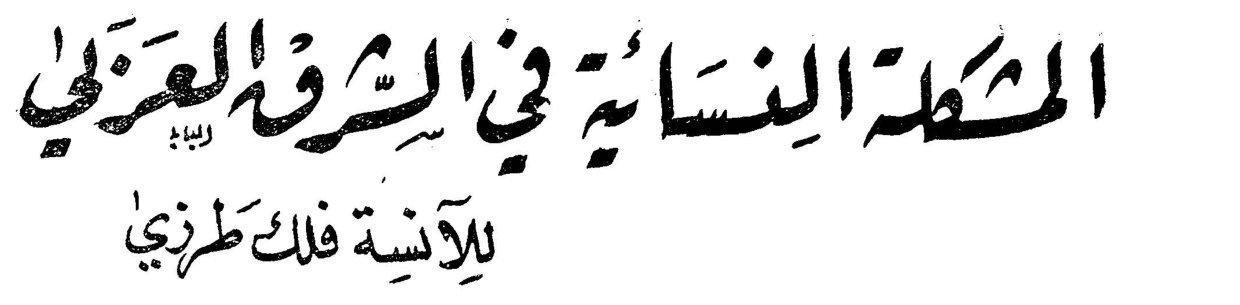
There is no doubt that a study of woman cannot be a comprehensive study if it confines itself to the aspects we have grown accustomed — or rather, that writers have accustomed us — to treat whenever they take up her subject and examine it. I shall therefore keep away from that side of the inquiry, and study woman from an angle I might call "the social philosophy of woman," or, to speak more exactly, "the philosophy of woman's life from the psychological and social standpoint," and the relation of this life to the child's upbringing and to the life of man and of the nation.
Before I clarify and analyze some of the problems that arise out of the problem of woman, I must divide her conditions into three categories:
1 — The enslaved woman, who sees in enslavement a natural condition — indeed, who sees every other condition as nothing but a mistaken one. This belief has been planted in her from her earliest years and has become so deeply rooted that to uproot it from her has become a difficult matter. It is no secret that environment, whether inside the home or outside it, is the fundamental agent in rooting it within her and imposing upon her the mentality that results from it.
2 — The emancipated woman: she who scarcely exists in our circles. For do we know her, or perceive any presence among us of her — that woman who has cut through whatever stands as a barrier between herself and life, and has launched herself forth, not from the single cage of her environment but from all its cages together; who has set out to soar in the air of this life, free save for the legitimate restraints she imposes upon herself, or which freedom imposes upon itself so that its dignity may remain protected? She looks upon life with a sound, healthy gaze, fearing no harm behind it, because that gaze carries from her soul only the purest of meanings, and because the bond
between her and this life stands firm. She has understood that life, even if it deals unjustly with her, must in the end grow gentle — nay, that she herself, by her capability and her good management of affairs, must bring it to this pliancy. Is not life at her very core, and she at the very core of life? There is no fear for her from it, then, so long as she has penetrated to its depths and succeeded in demolishing the barriers that rise between them.
3 — The enslaved woman who is in between. Her condition, too, divides into two kinds. The first inclines toward the enslaved, and we call her the half-enslaved: she whose soul is divided between two forces. She feels, without knowing it, this enslavement; but the unconscious in her thrusts the feeling back, so that she considers such a thing a sin — nay, a departure from the sacred and familiar order. It is not for her, then, to feel these fetters or to complain of them, since tradition has laid them upon her; and their gravity, no doubt, has been such as to lead her environment and other environments to raise them to the rank of the sacred. To complain of them thereafter is rebellion — nay, unbelief and heresy.
The second draws near the emancipated woman in one respect and stands far from her in others; we call her the half-emancipated: she who has freed herself from the fetters of outward appearances yet has remained, in her soul, enslaved to the most violent of moral fetters, those most dangerous to her inner life and her future; who has remained, in her mind and her thinking, a captive who imitates and does not create, and who does not draw life, and thought about this life, from her own inner spring.
•
Now that we have divided the conditions of the Arab woman into three categories, let us return to examine some of the problems that arise out of her problem. The first of these is the problem of the home,
and the first of the difficulties that spring from it is the difficulty of divorce and polygamy. The harm done by these two evils touches not only the material side of the life of woman and of the young generation; it touches a graver and weightier side — it touches the morals of both woman and man, the personal and the social alike. I shall try to make the reason for this plain.
In our people there are faults and vices which we discover day after day, and to which experience guides us. I do not consider these faults and vices anything but traits it has come to bear by force of the corrupt conditions that have succeeded one another upon it. The human soul, at its beginning, knows neither good nor evil, and does not distinguish a virtue from a vice; it is rather the effect upon it of environment and its ways, the kind of spiritual direction it receives, its contact with life and with people, and the various factors — poverty and wealth, anxiety and stability — which combine to lead it down many paths: all these factors together cast over the soul one of the colors of life and stamp it with a particular, definite stamp. If our nation's faults outnumber its virtues, and if the scale of its inclination to evil outweighs its inclination to good, this does not mean that the metal within it can hold nothing but the inclinations of evil and vice. These have piled up upon it over generations and years, and it has not yet been granted to anyone to remove them from it and expose it to the sun, that it might be cleansed of their filth.
Why do we see lying, deception, evasiveness, and the preferring of private interest above everything — why do we see these traits and others spread through our nation to a frightening degree? Why do we find in the sons of our people an inclination to treachery, deceit, and hypocrisy? Is it because thus they were made, and thus life willed them to be? Such a belief, in this age of ours, must be counted naivety — nay, stupidity. These vices are neither foundations nor roots; they are branches of crooked roots and results of corrupt conditions. The free, candid man who grows up in a free, candid environment and lives among a free, candid company has no need to resort to treachery, deceit, and hypocrisy, or to make of them a method of his life and of the ordering of his relations with