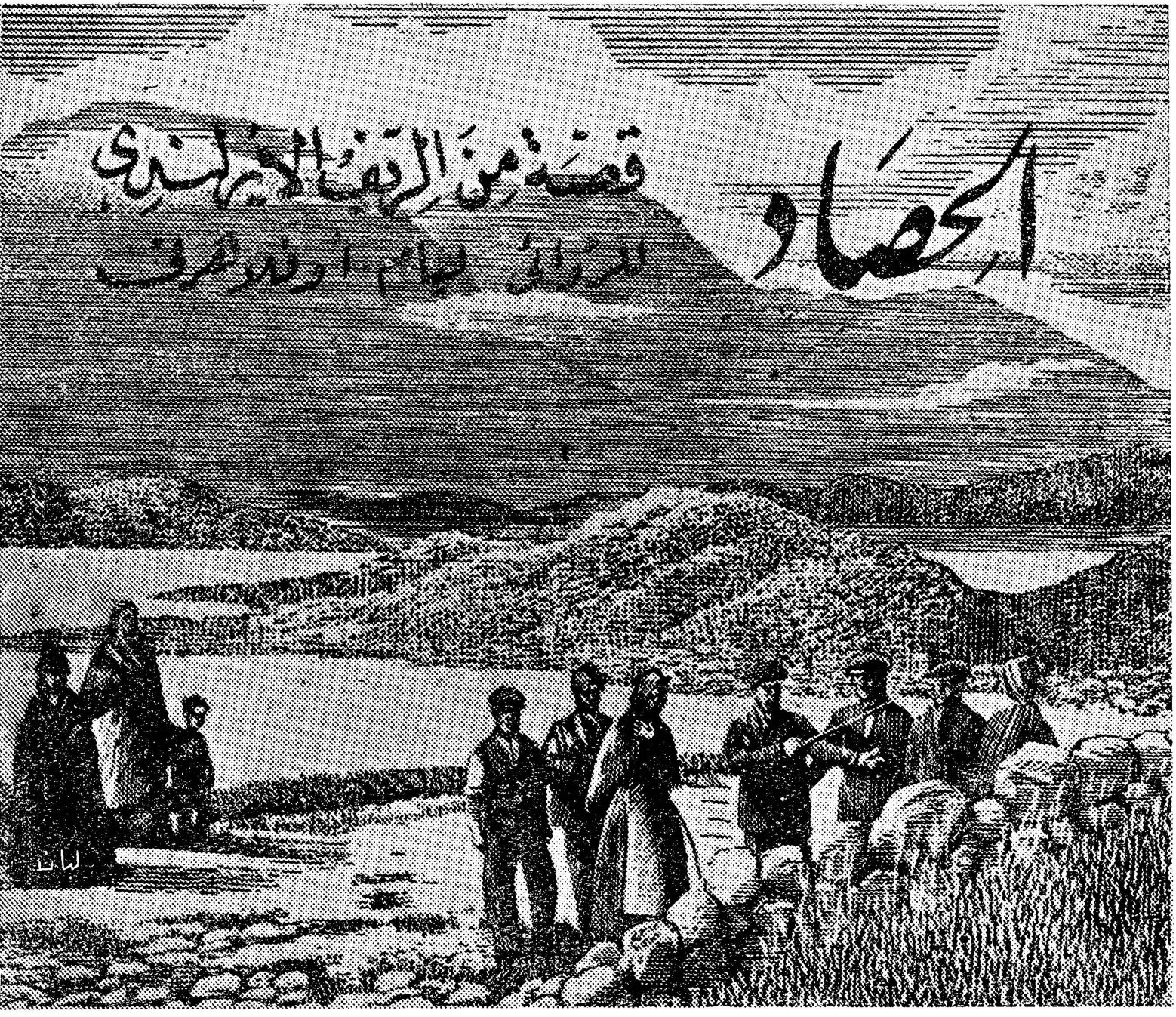
Dawn had scarcely broken when the reapers had gathered in the barley field — the great oblong field owned by James McDara, the retired engineer. The field began on the slope of a knoll and descended slowly to the sand-covered road that ran along the sea. It was bounded by a low stone wall, and the yellow ears of barley leaned over the wall and ringed it round in dense clusters that waved and jostled whenever the morning breeze passed over them, filling the air with its rustling.
As for McDara himself — an elderly, white-haired man wearing a coarse-woven gray woolen suit — he stood outside the wall on the sea road, waving his stick and talking to the few people who had gathered at that early hour. His deeply flushed face was alight with excitement, and he brandished his blackthorn stick as he talked in a
loud voice to the men around him. He was saying:
"I measured it and divided it myself yesterday, as fairly as division can be. I swear on my honor there isn't a single span's difference between the three strips. Do you see? I laid ropes down the length of the field so they can't go wrong. Come and I'll show you."
And he led the men from one end of the field to the other and showed them how he had divided the field into three strips and had marked the strips with ropes laid along the ground.
Then the old man cried out, excited as a schoolboy: "Yes, by my faith, this is the fairest division there can be. When I fire my pistol they start together, and the two who finish their strip before the others win five pounds."
The peasants bowed their heads in approval and looked at old McDara with new eyes, though each of
them believed in his heart of hearts that he was a fool to spend five pounds on the reaping of a field that could be reaped for two. Yet for all that they were hardly less excited than McDara himself, for the three men who were the best reapers in the whole island of Inverara had come forward for the contest. They were now at the head of the field, above on the slope of the hill, ready to begin. With each man was his wife, to bind the sheaves after they were cut and to bring food
and drink.
They had drawn lots for the strips by pulling three blades of sea-grass from McDara's hat. Then they took their places on their strips, awaiting the signal to begin. Although the sun had not yet warmed the earth and the sea breeze was still cold, each man had stripped to his shirt; the shirts were open at the neck and the sleeves rolled above the elbow. They wore gray woolen shirts, and each was girded with a belt woven of pure wool in many colors; below this they wore trousers of coarse white wool, their ends stuffed into long woolen stockings embroidered at the top. Their feet were graced with shoes of untanned hide, and not one of them wore anything on his head. As for their wives, each wore a red bodice and had bound her head with a little shawl.
On the left were Michael Gill and his wife Susan. Michael was a tall, wiry man with fair hair