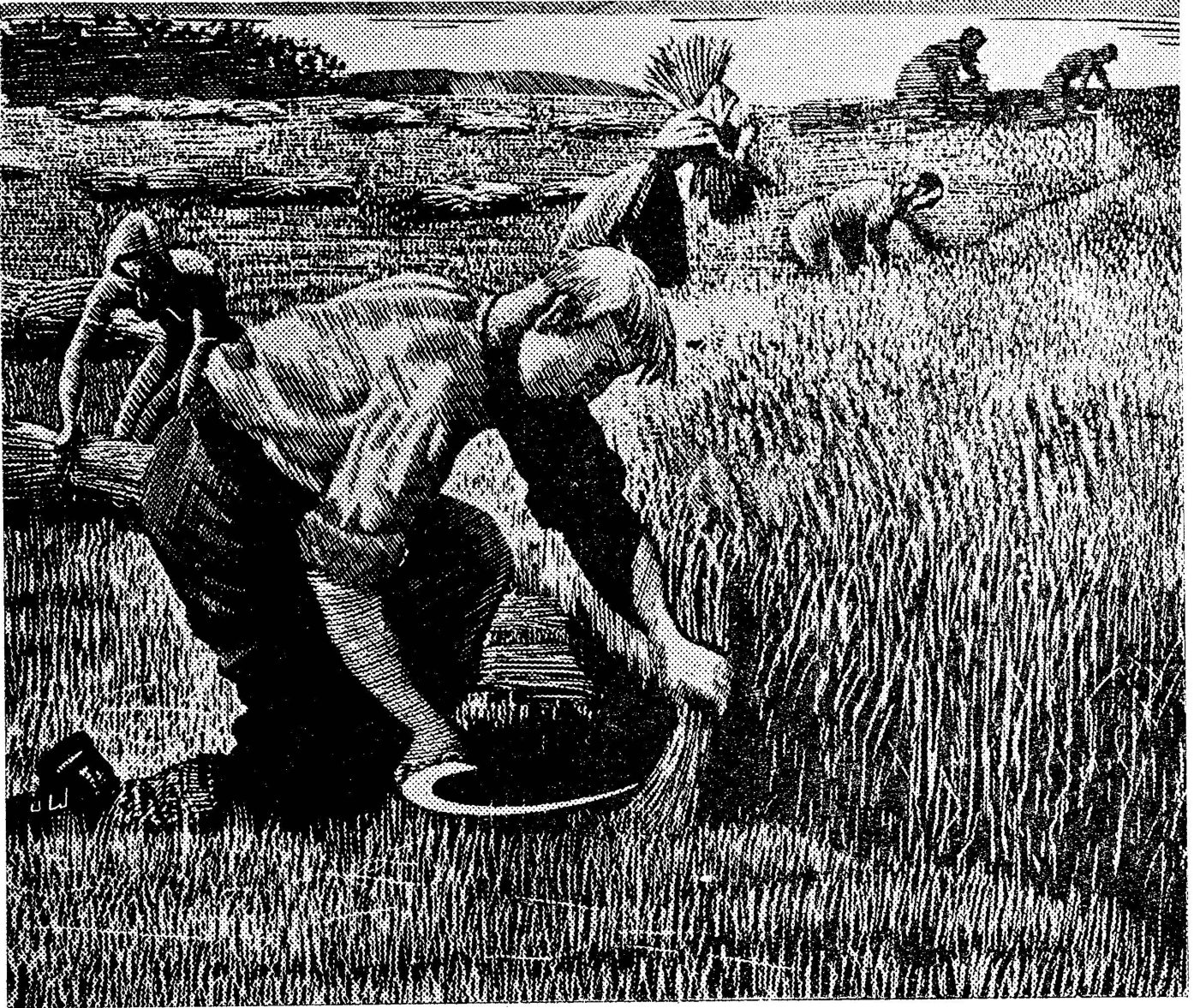
single movement the three men sank onto their right knees like soldiers at a military review about to fire. In the same movement their left hands wound about a bunch of barley stalks, the curved hooks whirled swiftly in the air, and there followed a crunching sound, like the sound hungry cows make as they eat the long fresh grass in spring. And behold, three small slender sheaves of barley stalks fell on the dewy grass below the wall, each sheaf behind the reaper's bent left leg. The three women stood watching for the first sheaf in a silence charged with excitement, for it would be a tiding of victory or an omen of defeat.
One sheaf, two, three, four...
Johnny Bodkin was snorting like an excited horse, his sheaves falling one after another with scarcely a pause between them. With a loud, joyous cry he raised his hook in the air, spat on it, and shouted: "The first sheaf!" His wife pounced on it with both hands, separated a small handful of stalks, wound it round the head of the sheaf, and tied it with an astonishing, marvelous speed, her
long thin fingers moving like knitting needles. The other two reapers and their wives did not stop to look. Each of the three reapers had cut his first sheaf, and each man's wife was kneeling, binding it.
Bodkin went on working with the same ardor and frenzy with which he had begun, and before long he drew ahead of his rivals. He cut his swaths without order or method, leaving uncut patches behind him, for his strokes were not regular; but his speed and strength were truly astonishing. His huge hands swung the hook and wound about the stalks with a heaviness devoid of grace, and his body hurled itself forward, colliding with everything, like the carcass of an elephant hurrying through a forest; yet the continual movement of his joints had a rhythm not without beauty. His wife followed him, binding, binding swiftly, her rigid face contracted in a sharp frown, like one pondering some grave matter.
After them came Considine and his wife. And now, as Considine threw himself upon the work, he showed
a wondrous strength and nimbleness, like a mountain goat. When his long, lean, bony arms moved to strike the barley, the muscles stood taut on his bent back like a tangled net of coiled springs compressed. Every time he hopped forward on his right knee to advance along his line of reaping, a gasp broke from him like a stifled grunt. As for his wife, the sweat poured from her in streams, and she followed him so closely she almost touched his heels, never ceasing to urge him on, laughing and jesting in her accustomed loud voice full of ardor.
As for Michael Gill and his wife, they came last. Gill had begun to reap with slow, regular movements, like the motions of a machine driven at low pressure. He kept exactly the same pace, neither changing his speed nor lifting his head to see where his two rivals were. His long, lean hands moved without noise, and nothing was heard but the sharp crunching sound of his hook's teeth in the yellow barley stalks. His long, lowered lashes were always turned toward the spot where his hook was cutting. Not once did he look back to see whether he had cut enough for a sheaf before beginning another; all his movements were arranged beforehand — calm, monotonous, controlled with a frightening precision. Even his breathing was regular, coming from his
nose like a man's in peaceful sleep. His wife moved behind him in the same fashion, binding each sheaf gently, deftly, and without strain.
When the day's sun rose high, people gathered from every quarter to watch the