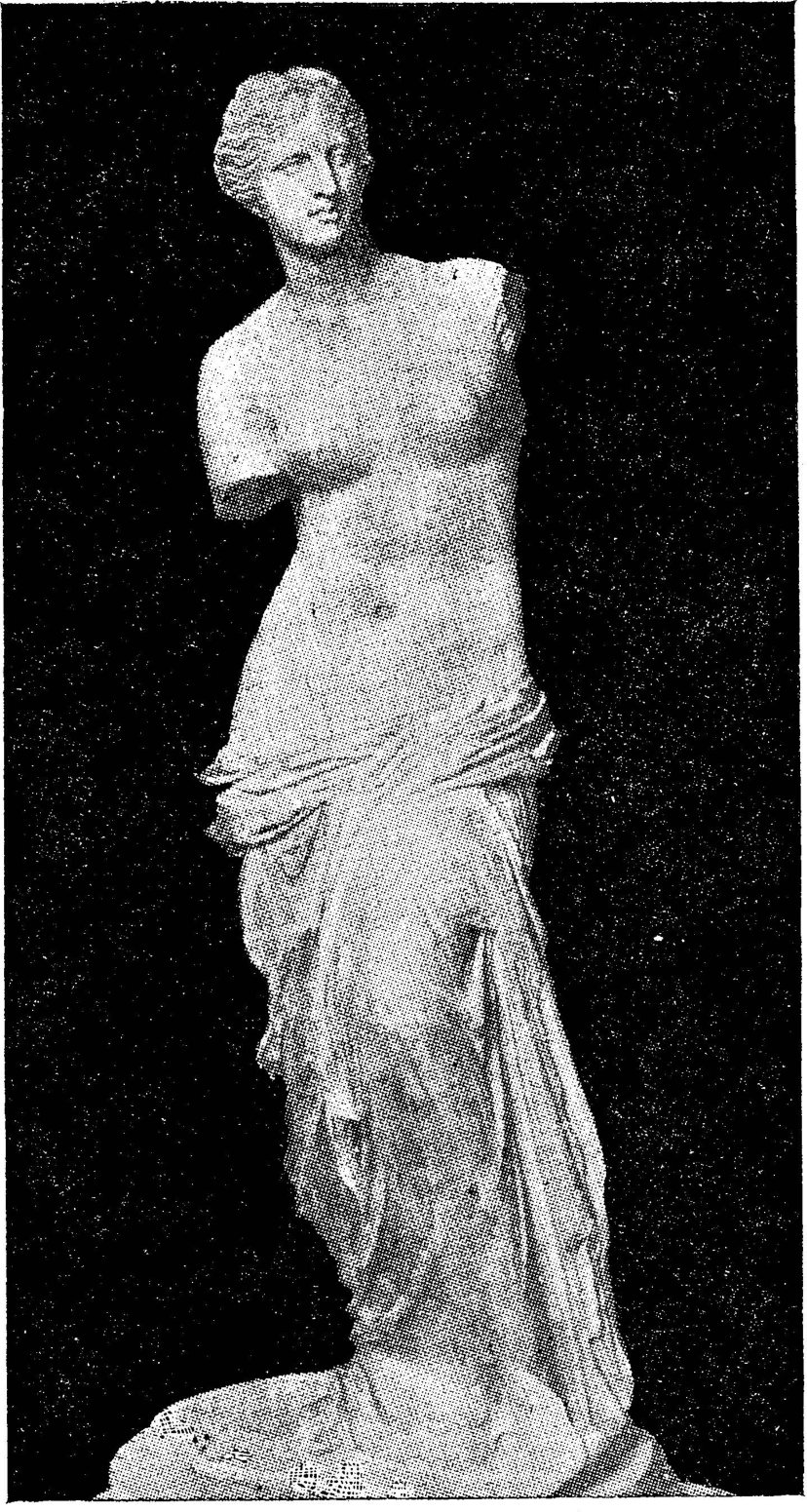
The statue of the Venus de Milo
interventions, and considerations that bear no relation to love and intimacy: so that marriage becomes compulsory, not elective; and the partners are chosen by special councils or bodies in the state, instead of each choosing the other of his own full will, by the inspiration of his love, and by the working of that inward harmony which springs from the depths of the soul and the recesses of heart and conscience...
We find the Greeks, accordingly, looking upon woman as a creature whose task is diversion or amusement or production, instead of looking upon her as a human being possessing the intrinsic, final worth of the human being, the sacred destiny of the free human being, and the dignity of the
human being in himself...
And we find the Greeks delimiting woman's task in society... She is a means of procreation and a means of diversion; it does not befit her to occupy herself with matters that please her and that she chooses in full freedom; rather she must seclude herself in her house, providing her man his food, keeping his house in order, and overseeing the internal affairs of the household. Thus we find the Greeks narrowing the horizons of woman's interests and activity, and stifling the vitality buried in her soul, as in the soul of man — that vitality which yearns to soar into the spheres of creation and invention, into the horizons of free work and of activity fettered by no consideration!
Such is the classical Greek view of woman — a view springing from a mistaken estimation of her humanity and her womanhood, and suggesting that she be considered a being
lower than man in the level of its humanity, and less than he in worth and standing.
Woman, in their eyes, is not man's equal in his humanity — and here is the source of their view of her limited task, her truncated rights, and her lowered station. And woman's femininity, in their eyes, is not a variation of the humanity of man, which embraces both sexes alike — not a rich variation of an abundant nature capable of variety: rather woman, in their eyes, possesses a portion of humanity smaller than man's portion, and lower in quantity...
Within the frame of this view of woman — her nature, her station, her task, her rights and her duties — the errors of the Greek view of human nature in itself become clear to us, and of the meaning of the rich variety within its fertile nature. To this view we may attribute a great deal of the sterility and rigidity in the philosophical and social ideals that come rolling down to us in the Greek heritage, as we attribute to it the paralysis of Greek social institutions. And finally, to this same view we may rightly attribute the barrenness of personal human life among the Greeks — that barrenness which limits the refinement of Greek literature and art, and prevents the human soul from revealing itself there in its loftiest manifestations, its most perfect elements, and its deepest mysteries...