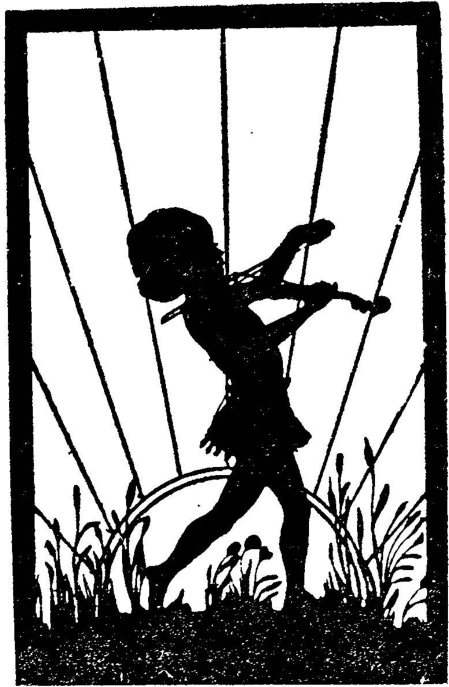
The Nutcracker: a piece Tchaikovsky completed at the end of the last century, two years before his death. It belongs to that kind of ordered, successive music which comprises a group of dances, bound together by a subject, or a melody, or something resembling a melody.
As for its subject, it is this: a little girl received as a gift, at Christmas, a wooden nutcracker, carved in the likeness of an ugly old man with movable joints, and she loved it more than all the other dolls and toys she had. Toward midnight she heard a strange noise and crept down to the lower floor, where she saw that all the toys had begun to walk and move! And those toys, under the leadership of the nutcracker, were fighting the mice that had come to eat the sweets! When the girl arrived, the battle between the chief of the mice and the nutcracker was at its fiercest, so she startled the mice with her glove — and behold, the nutcracker turned into a handsome young man, who took her by the hand, saying: Do not be afraid; thanks to you I have become a young man. Come, let me show you the land of the fairies: the land of flowers and leaves and brooks and animals, where the scenes are enchanting and the happenings joyful; you shall see who it is that adorns the flowers and the grasses, who sprinkles the dew in the stillness just before dawn, who colors the seasons and puts them
to sleep and scatters the snows, a white gown. And you shall see the dwellers of the forests playing and dancing, and you shall hear the music of nature. In the twinkling of an eye she found herself walking in the darkness with the nutcracker prince! And lo, she heard a soft musical overture, from which she knew that the scenes had begun.
At this moment you begin to hear that overture which the girl heard, then pass on to a Russian dance, during and after which we feel that the prince and the girl are moving lightly from place to place — from the bank of a brook beneath towering trees, to the top of a hill, to a bend in the road, to a deep valley. It is as though we hear the whisper of a quick, continuous conversation — a conversation between the youth and the girl. Then it develops into a fairy dance, with which we can almost see the fairy spinning and leaping as no human being can, while over the whole there reigns a melody that is almost Oriental. Then we hear an Arabian dance, which carries us into a sweet atmosphere we are accustomed to hearing.
Children's Corner: This piece has been, ever since Debussy composed it, and still is, a source of joy to thousands upon thousands of people in every land. Its title is "Children's Corner," and it is in truth the children's paradise. Debussy composed it in an attempt to turn the imagination of children, in their hours of merriment, into ordered musical melodies.
To be able to savor it, we must picture ourselves in a great hall, with the children seated in one corner of it, chatting together and playing with the various dolls in their hands: this one imagines that the signora in his hand is dancing on the snow; that one fancies that his children want to take a stroll in the moonlight; a third lines up the colored blocks of wood as soldiers in full readiness to march. And in the midst of these fancies arise innocent squabbles among the children, interspersed now with weeping and now with laughter, in a descriptive, pictorial music, rich in melody, which varies
in proportion as the scenes vary, while keeping one and the same atmosphere from the beginning of the piece to its end. In this kind of music we cannot fail to recall what Beethoven enjoined in speaking of the Pastoral Symphony, when he stressed the necessity of not going too far in tying every sound to the image or the state it represents — this so that the listener may keep the pleasure of discovery. And I, though I have given the basic outlines of this piece and offered some examples of what Debussy may have imagined of children's thinking when he composed it, have mentioned only a little of the much that the listener may gather when he lends a close ear to this excellent piece — though it is not among the essential classics — from Debussy.
For in Children's Corner there are sweet discoveries for the piano such as astonish those of experience and specialty, and there is in it such novelty and charm as astonishes every man. Who, for instance, would ever imagine that there is music for the walk of a cake, or for the amblings of the Abyssinian elephant, or for the dance of the snow! But Debussy is a delightful creator, who knows the keys of delight in people.
And to make it easier for us to follow it and savor it, I call attention to the fact that the music of the first quarter of this piece turns on the signora's stroll — and in her stroll, as in the strolls of people, there is enchanting nature. The music of the second quarter turns on the dance of the snow — and in the dance of the snow there is a cold that turns to warmth, and a softness of touch, and white melodies; and melodies have colors, as connoisseurs know. In the third quarter is the walk of the cake — and who says that a cake does not walk? Every child imagines that his cake has legs to help it escape from him. And in the last quarter the music turns on the amblings of the elephant; and this little elephant in the child's hand is a symbol of that huge animal, so that if Debussy portrays it, he portrays it as the child sees it with his imagination, not with his eye.