
Masters of Song among the Arabs
2
Ibrahim and Iblis:
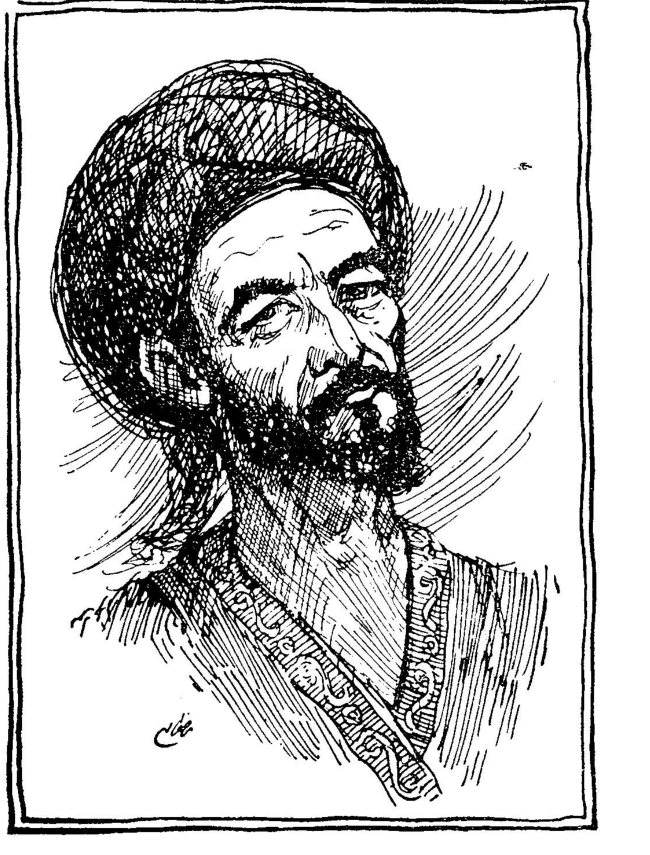
Ibrahim al-Mawsili has his tales with the devils, it would seem. One day, when Ibrahim was withdrawn from people in his house, his slave girls about him, coming and going before him, there entered upon him an old man of fine bearing and beauty, wearing two short boots and two soft shirts, on his head a close-fitting cap, in his hand a staff knobbed with silver, and the scents of musk wafting from him until they filled house and courtyard. He sat down before Ibrahim and asked him to sing, and Ibrahim could not refuse him any request, despite his intense vexation at the man's impudence and boldness toward him. Nor was our venerable sheikh content with hearing our singer: he compelled him to hear his own singing, and the old man sang him these verses:
I have an ulcered liver — who will sell me, in exchange for it, a liver without ulcers? People refuse me — they will not buy it: and who would buy a sick thing with a sound one? I moan, from the longing within my sides, the moan of one choking on his drink, wounded.
No sooner had he finished his song than Ibrahim said:
By God, I thought the walls and the doors and everything in the house was answering him and singing with him, so beautiful was his singing — until I fancied, by God, that I myself, my very bones and my clothes, were answering him; and I remained dumbfounded, unable to speak or answer or move, for what had seized my heart. Then he sang:
O doves of al-Liwa, return once more, for I sorrow for the sound of your voices. They returned, and when they returned they all but bewitched me, and I all but laid
bare my secrets to them. They called, cooing over and over, as though they had been given strong wine to drink, or were mad. Never has my eye seen doves like them: they wept, yet no tears wet their eyes.
All the while Ibrahim stood bewildered, agape:
O east wind of Najd, when did you stir from Najd? Your night journey has heaped longing upon my longing. Was it because a ring-dove called in the glow of forenoon, on a branch of tender growth, of the rand tree, that I wept as the sorrowing weep for passion, and melted with harrowing longing and strain? They have claimed that the lover, drawing near, grows weary, and that distance cures the longing: with both have we treated what ails us, and it remains — yet nearness of the beloved's abode is better than distance!
Then the singer vanished suddenly — and Ibrahim leapt for his sword, drew it, and ran to the doors to inspect them; he found them locked, and marveled at how this old man had come in upon him, and questioned the doorkeeper closely,
but got no answer to satisfy his curiosity. And while he was in that state, a voice called to him from the corners of the house: "No harm shall come to you, Abu Ishaq. I am Iblis, and I was your companion and boon-fellow today — do not be alarmed..."
Al-Rashid learned of the affair — and found himself wishing that Iblis had favored him with his company for a single day, as he had favored Abu Ishaq!
Singers of genius:
Ibrahim told of his teacher in the art of song, saying: The first from whom I learned singing was a madman. Whenever anyone shouted at him, "O Mudar!" he would fly into a frenzy and throw stones. Ibrahim would use guile with him, bringing him into his house, feeding him and giving him drink and beguiling him until he took from him what he wished.
Ibrahim was the first to sing for al-Rashid verses of his own after he assumed the caliphate; for this the caliph honored and esteemed him, and yearned for him and for his visits — so much so that once he rose from his sleep and went out muffled, making for al-Mawsili's house, with a retinue of four hundred white servants, not counting the footmen. Al-Mawsili was alarmed when he saw him and cried: O Commander of the Faithful, do you appear at such an hour as this? He said: Yes — a longing for you drove me to you. And he sat at the end of the iwan; delicious foods and fine drinks were spread, and the beautiful slave girls and maids were brought in, playing two by two and singing one by one; and al-Rashid paid no heed to what he heard, until one of the young girls sang:
O striker of the fire-stick whose flints have failed, take