"Ustad Amin Ahmad al-Sharif has left us for England to pursue his higher studies in industrial chemistry at the University of Liverpool. He has promised to send us his articles from there, and we wish him certain success."
•
Man has always linked, and still links, the idea of agriculture — that is, of plant life — with the idea of the existence of land and soil. Where no suitable soil exists, no plants exist.
But modern science looks at this idea from a fundamental angle and declares that land (or soil) is not necessary for the growth of plants. Numerous experiments have been carried out proving that plants grown in a soilless medium, such as sand, ash, or water, give results that in many cases surpass the results these plants give when grown in a purely soil medium.
To be convinced of the truth of this statement, we must take a look at the active factors in plant growth. We find that these factors are: 1 — the seed; 2 — a source of nourishment (such as soil, for instance); 3 — air and water; 4 — light; 5 — certain complex chemical substances (plant hormones).
From this we see that the function of soil is to supply the plant with water and nourishment; it is therefore self-evident that if we provide a medium that takes the place of soil, we can dispense with that soil as an essential factor in plant growth.
What does a plant "eat"? The plant feeds itself, as
everyone knows, by means of its roots, which contain fine hairs that absorb water and nourishment from the soil. The plant, then, feeds by absorption, not by chewing and swallowing as is the case with
animals. For this reason the plant can make no use of any nutrient substance unless it is soluble in water, for if it is not, the root hairs cannot absorb it. The plant's
food therefore consists of substances of chemical composition far less complex than the foodstuffs used by animals. The chemical substances that nourish the plant must include the following elements: nitrogen, phosphorus, potassium, calcium, magnesium, and sulfur. Plants also need very small quantities of iron, copper, and zinc.
What are the methods of soilless agriculture? There are two basic methods of soilless agriculture: 1 — using sand or ash or any other medium not composed of nutrient substances; 2 — using methods of growing in water.
The use of sand or ash: This method provides a medium for anchoring the plant in place, but it provides no nutrient matter. The feeding of the plant is accomplished by means of solutions containing the necessary chemical substances; these solutions seep through among the grains of sand and reach the plant's roots, where they are absorbed. A large portion of the solutions, however, is not absorbed, and reaches the bottom of the vessel, where it is collected and sent back to the plant by means of special pumps, so that no quantity of the solution, however small, goes unused. This means a saving in chemical fertilizer, part of which is lost in the ordinary kinds of agriculture.
It should be noted that the roots of plants grown in this semi-artificial medium are not as long as the roots of plants grown in soil. The reason is that roots grow and gain in length because they are forever searching for nourishment in the hidden recesses of the earth. If nourishment is readily at hand, as is the
case here, the roots have no need to put themselves to the trouble of searching for food; instead, their strength is turned over to the branches, which grow all the more vigorously.
Methods of growing in water: By this method man can obtain delicious fruit or beautiful flowers without needing a single grain of sand or soil.
The method may be summed up as placing the seeds on a strip shaped
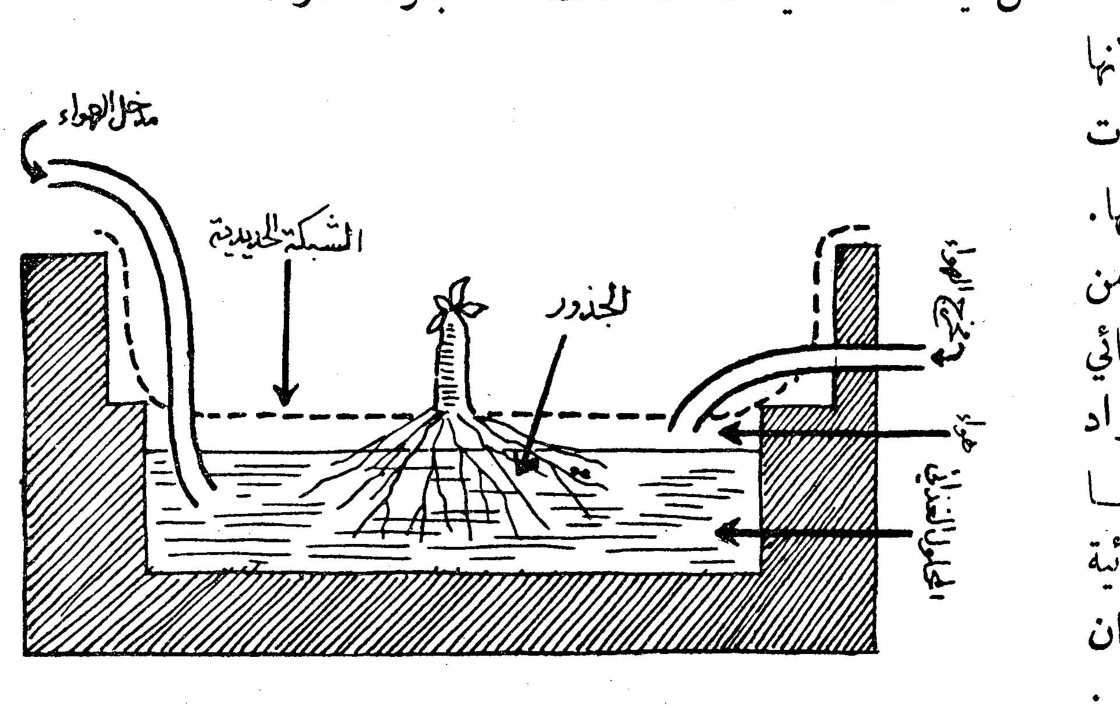
Air inlet / Iron mesh / Roots