like a basket, fixed in a vessel containing the nutrient solution.
These seeds are held in their places on the basket by means of straw or cotton, while the roots reach the nutrient solution through the numerous holes in the basket. The roots in this case are shorter than when sand is used, because they need not search for nourishment at all, being surrounded by the nutrient solution on every side.
But the roots also need air. So either the basket is raised from time to time to air the roots, or air is forced into the solution by means of tubes ending near the roots. The nutrient solution must also be constantly renewed, the necessary nutrient substances being added to it at the same rate at which the plant uses them up.
This method has given very good results with root crops such as potatoes, carrots, onions, turnips, and garlic. The drawing shows the way this kind of cultivation is carried out.
The benefits of soilless agriculture: This kind of
agriculture cannot compete with all the ordinary kinds of agriculture, because it requires greater expense; but it is very well suited to growing plants that find a ready market, such as rare flowers requiring special care. In the United States of America there are several agricultural establishments that use these farming methods to obtain cucumbers, corn, melons, tomatoes, peas, and certain kinds of flowers such as carnations and roses.
Then, too, there are many regions with barren land. In India, for example, we find the land poor in fertility and famine threatening a great number of people every year, while we find India's climate suited to agriculture. By using these soilless methods the crops are increased to no small degree, and one of the great problems facing the world after the war is solved.
The English scientist Lancelot Hogben has proposed that basins for soilless agriculture be set up in the great Sahara Desert in Africa.
This is a new service that science renders to man, to help him solve a problem that has been, and still is, one of the fundamental problems of life.
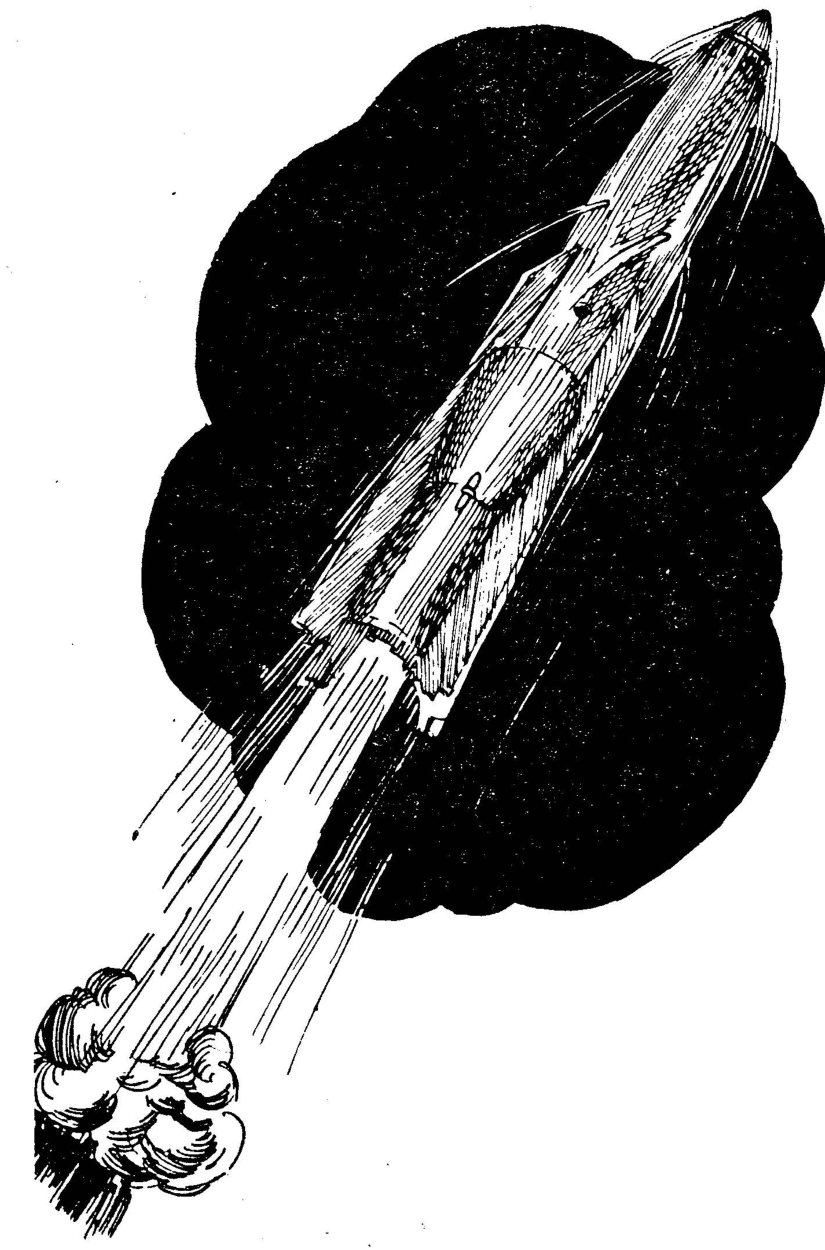
Man's sole hope of soon becoming able to roam the expanses of space lies in his use of a rocket craft descended from the German winged bombs known by the name "V-2," with which the Nazis poured a great deluge upon the city of London in 1944.
There is no machine that can launch itself with ease and surpassing speed through the empty expanses between the stars save this wondrous machine. Nor has man been able to build any machine but this that can yield the power of eighty horses for every single pound of its weight, including the weight of the fuel required. The winged bomb known by the name "V-2" contains nearly fifty times the driving power of any jet-propelled machine man has been able to invent up to now.
This German missile attained a range of two hundred miles at a speed of three thousand miles an hour; as for its British sisters, built on its pattern and tested in Australia this year, their makers claim that the range of each is three thousand miles, at a speed that is still a secret among secrets. Yet it may be said that the world will soon hear of a missile of this type whose speed has reached thirty thousand miles an hour.
When man succeeds in making a missile with a speed of thirty thousand miles an hour, it will become possible to send it off from the earth with ease, like a stone flung from a sling, needing no
further driving force; for as soon as it passes outside the zone of the earth's gravity, it will press onward through the expanses of space to infinity, consuming fuel to govern its motion only when it nears the end of its course. It