In my library is the sixth number of the General Culture Series issued in Jaffa, Palestine, by the Modern Library. The subject of this number is "My Brother Ibrahim," by the woman of letters Fadwa Abdel Fattah Tuqan. It runs to 104 pages of small format.
My Brother Ibrahim — and perhaps, reader, you have realized that he is Ibrahim Abdel Fattah Tuqan, the Palestinian poet whom Arabic literature lost in 1941, when he was still in the thirty-sixth year of his life.
He was, God rest his soul, among the singular personalities that the Arab world was able to bring forth during the era that followed the First World War. I say this not merely on the strength of the poetic legacy he left behind, but on the strength, before all else, of his personality as a human being. Ibrahim Tuqan, in his personality and not in his poetry, stands among the singular few. I know of his personality only what I have heard time and again from his companions, and what I have been able to make out through his poems and those of his writings that I have had occasion to read. That is little, but it is almost enough to arouse admiration and love. Suffice it for me to say that it is marked by delicacy of feeling, a passion for liberty, a scorn of oppression, and a firm hold on the fringes of dignity and honor. And no wonder, for he is the scion of a house long distinguished by all these qualities.
As for Ibrahim Tuqan's poetry, it is fertile, pulsing with life. It is likewise natural and frank, with no affectation in it and no artifice. Perhaps he went to excess in naturalness and frankness, to the point of making it suffer from a want of harmony, of fineness of craftsmanship, and of brilliance of diction. This does not mean that his poems include none that may
be reckoned among the choicest pieces of modern Arabic poetry.
And after all this, "My Brother Ibrahim" is a book worthy of reading; tender in feeling and in phrase, it shows plainly that it is the writing of a loving, admiring sister. How often my eyes brimmed with tears as I moved among its lines. It is success enough for the writing of a biography that it stir in your breast what its author intended of admiration, or sorrow, or a desire to go deeper into the mysteries that surround a human life.
Also in my library, Madam, is a collection of verse by Mr. Kablan Mokarzel entitled "Immortality." It is among the publications of Dar al-Makshouf in Beirut. Its pages number 96.
I found nothing in this new collection of verse to please me save
a few passages. As for the great poem "Immortality," which gave the collection its name, it has had little share of success; it all but teaches the reader what "death" is in the art of poetry. I am sorry for Mr. Mokarzel — deeply and sincerely sorry. May he avoid in future such thorny subjects, which none can treat successfully in verse save those whose feet are firmly planted in this craft. And I do not suppose Mr. Mokarzel claims a firm footing yet.
In any case, there is no harm in reading the collection, for in it is a kind of poetry that does the reader no injury, should he make its acquaintance. And there is no doubt that Mr. Mokarzel, if he wishes to continue composing verse, can produce something better than what he has produced in "Immortality."
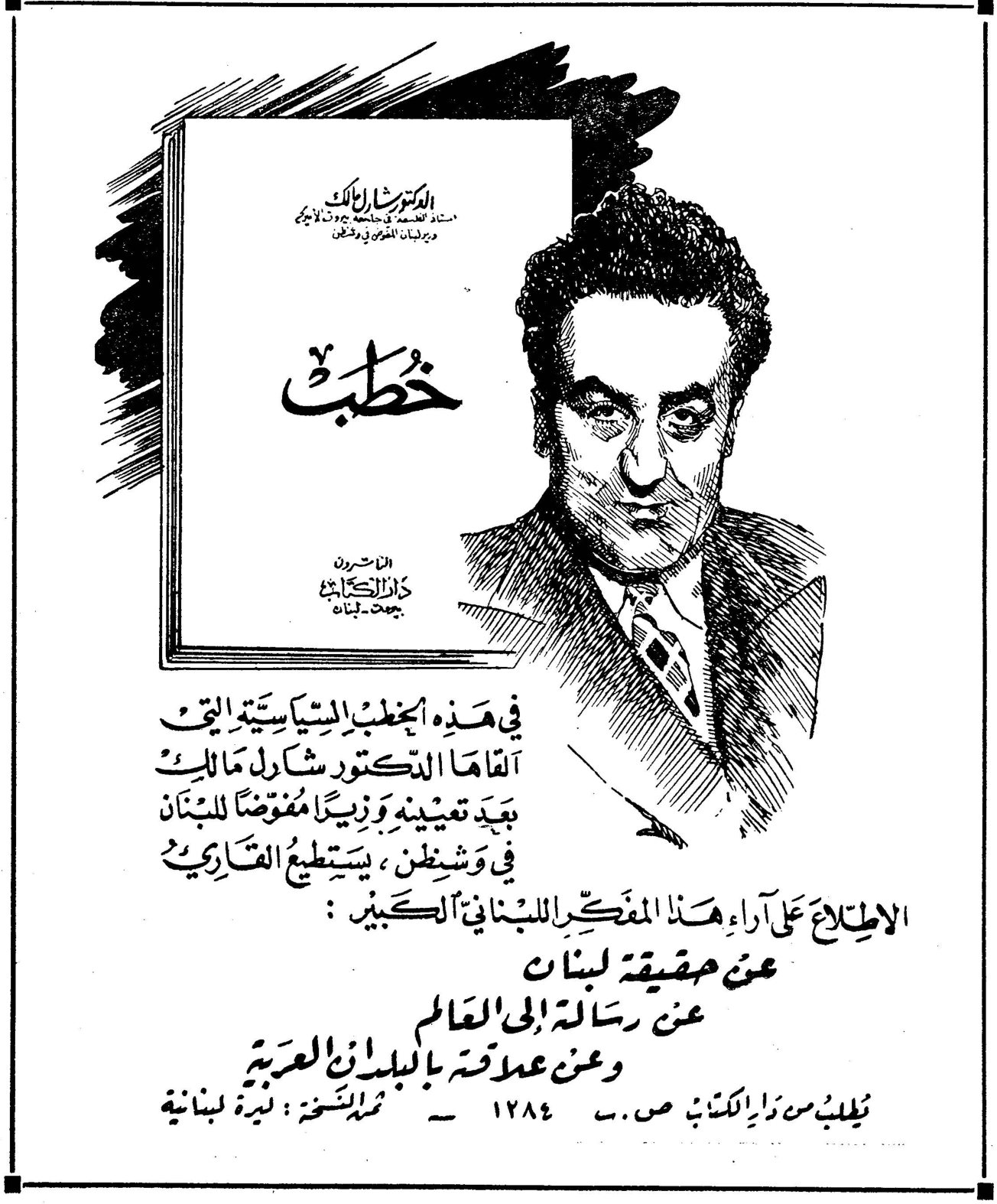
Speeches — Dr. Charles Malik
Dr. Charles Malik
Professor of Philosophy at the American University of Beirut and of studies in thought and religion
Speeches
Publications of
Dar al-Kitab
Beirut — Lebanon
In these political speeches, delivered by Dr. Charles Malik after his appointment as Minister Plenipotentiary of Lebanon in Washington, the reader can acquaint himself with the views of this great Lebanese thinker:
on the truth of Lebanon,
on its message to the world,
and on its relation to the Arab countries.
To be ordered from Dar al-Kitab, P.O. Box 1284 — price per copy: one Lebanese lira.