Mr. Naguib
al-Rihani. As for the other films, you find in the conversations that pass between their characters an artificiality that delivers you over to boredom — to say nothing of the many scenes in which the dialogue strays from the story itself, and the author treats you to a quantity of platitudes which he believes to be deep philosophy, when they are as far as can be from depth and from philosophy.
The director's share of error and shortcoming equals the author's, if it does not exceed it — especially when we observe that he performs the principal task in the film, from choosing the actors and guiding them, to choosing the exterior and interior settings, to supervising the lighting and the photography. He truly represents the essential element in the production of the film; but like his colleague the author, he trifles with the public and with art. You find no taste in the choice of furniture, and you feel no harmony in its arrangement; instead the rooms are crammed with this furniture until they look like great halls or auction rooms.
... And these lapses, if they indicate anything, indicate that the Egyptian director has not to this day mastered the task that falls upon him when he undertakes to direct a motion picture.
... And there is a strange phenomenon in Egyptian films which we have not seen in American or European films: hardly an Egyptian film exists that is free of dancing and singing. As though the Egyptian girl — whatever her social class — had no concern but to dance, and to dance to excess, or to sing, and to sing to excess: she sings in her room, she sings at public parties, she sings in the street if you like. These scenes may sometimes suit the run of the film and fit its events, but in many films we find them uneasy in their place and far out of position.
As for the actors who work in Egyptian films, they represent three classes with no connection among them. Of the first class are the singers who have no acquaintance with acting and no knowledge of it, but whose fame in song the directors prefer to exploit in order
to give currency to their films. It is certain that the participation of a singer like Mr. Mohammed Abdel Wahab, or a songstress like Miss Umm Kulthum, in any film guarantees that film its success — but does it guarantee it artistic success? No; for these two singers do not possess the natural artistic gifts that would help them master the art of acting, even though they have taken part in several films.
Of the second class are the actors who practiced stage acting for long years and then preferred the cinema to the stage, for reasons some of which are artistic and many of which are material. Some of these have not distinguished between stage acting and screen acting, and have set about acting in the cinema in the same manner in which they act on the stage — and between the two kinds of acting there is a difference in the
manner of performance. Some of them have grasped this, and have succeeded in the cinema as they succeeded on the stage; among these are Naguib al-Rihani and Bishara Wakim — though the first has acted in only a few films, which won the same admiration as those plays of his in which he acts with unequaled success.
As for the third class, it includes the "new faces." The choosing of these faces has not been done by the ideal method and the correct course, for in their choosing the directors have preferred handsomeness of countenance and elegance of appearance over native gifts — of which there is no small store in Egypt. Had the choice been made on that basis, the Egyptian cinema would have won many gifted persons, of the kind who raise the standing of the cinematic art.
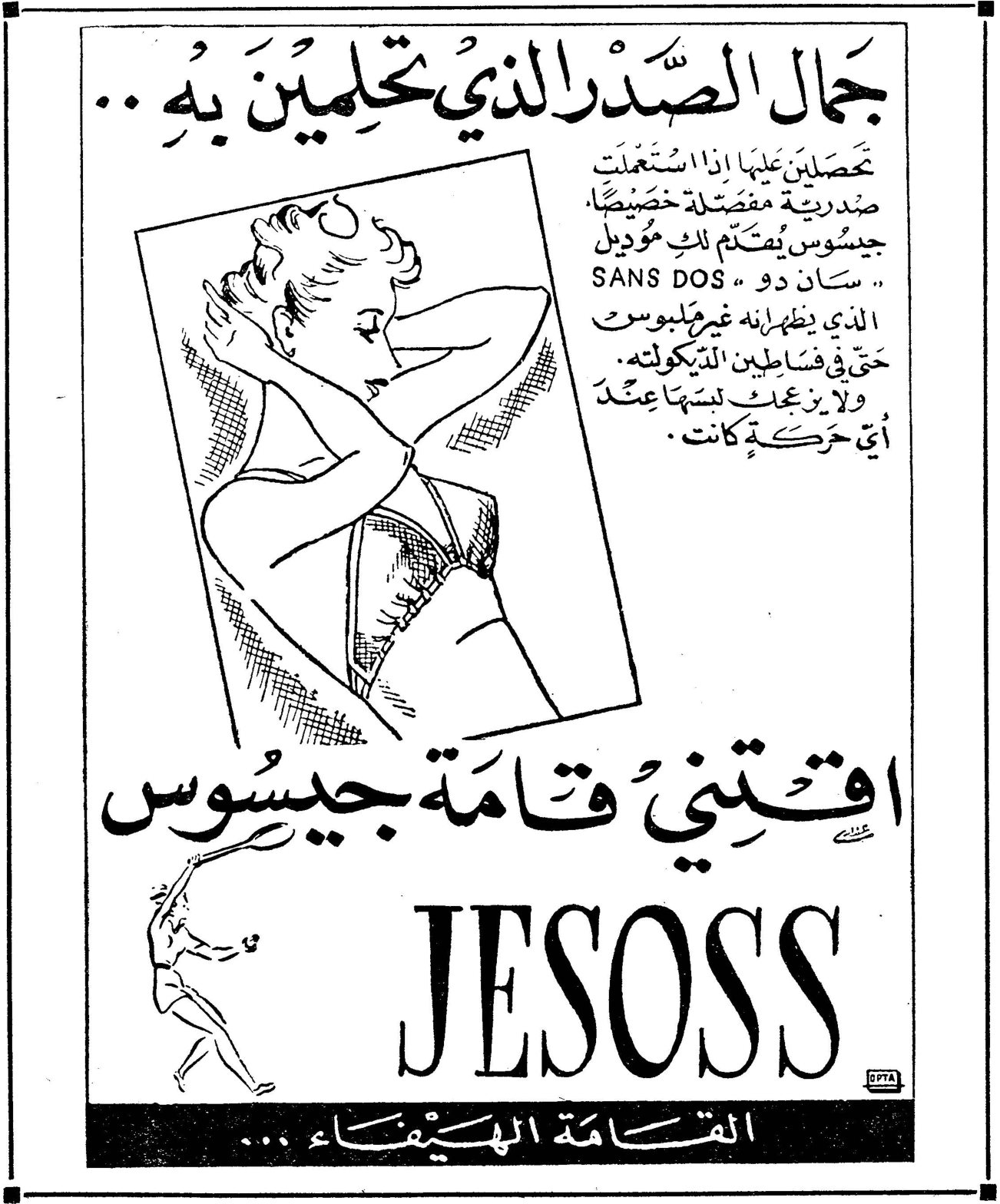
JESOSS
The beautiful bust you dream of...
You will obtain it if you wear a specially fitted Jesoss brassiere. Jesoss offers you the “Sans Dos” (backless) model, which looks as though nothing were worn, even in décolleté gowns. And wearing it will not trouble you in any movement whatsoever.
Get yourself a Jesoss figure
JESOSS
The slender figure...