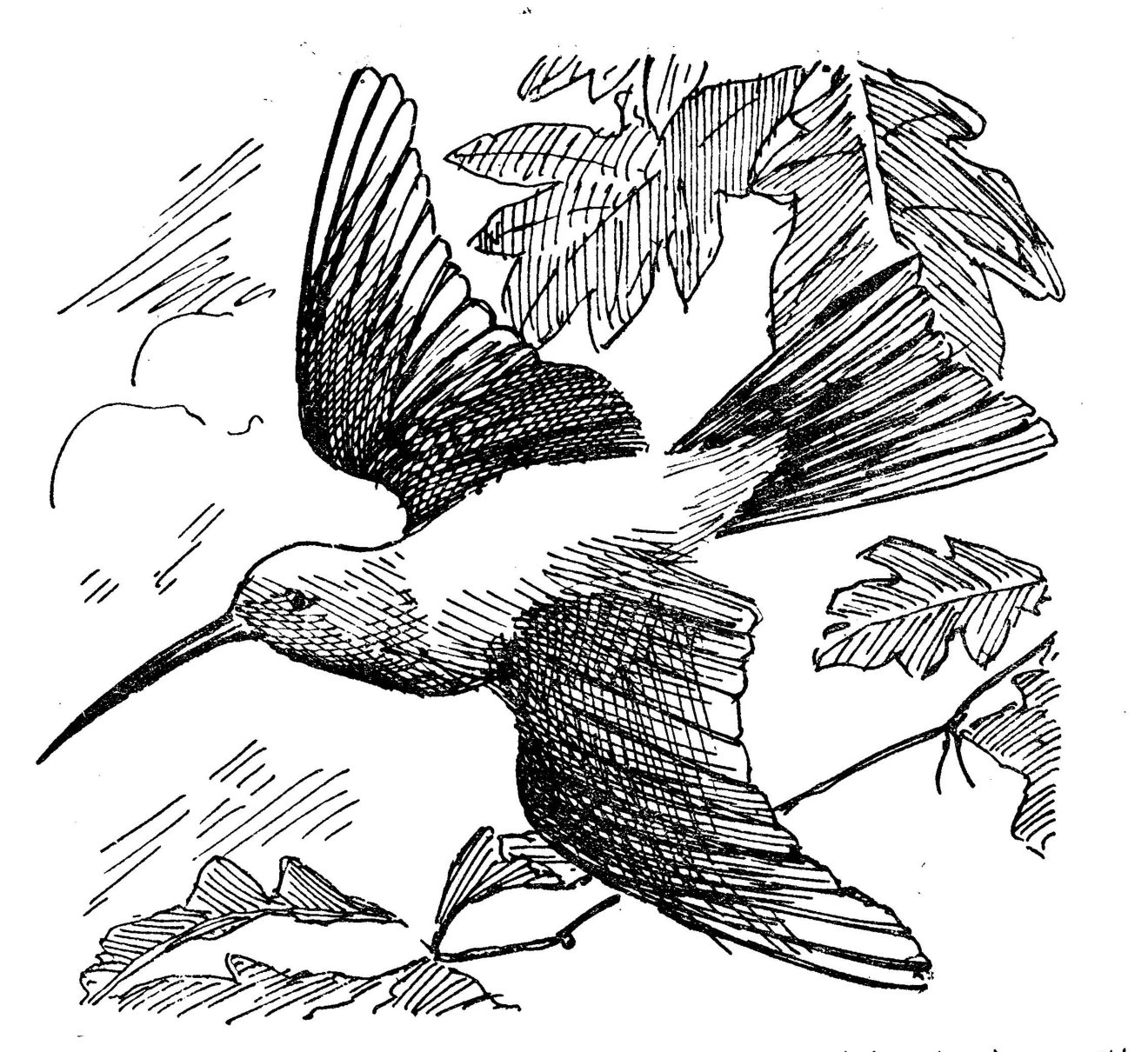

The warbling bird is born of an exceedingly small egg the size of a pea, in a nest the size of a plum, which it builds of moss and soft greenery covered with a thick layer of grass in the fashion of a spider's house — proof of the bird's precision and skill. The nest is concave in shape and deep in its hollow, its rim curving inward to keep the eggs or the young from falling out when the winds blow and the nest sways.
The female is answerable for the ordering of the nest and the choosing of its shape, as the potter is for his pottery. She circles it from the outside and arranges it to her taste, and her body may often be seen rising and falling as though she were kneading the mixture with her fingers to fashion from it the bottom of the nest. Then she sits on the rim and bends downward, and with a light motion of her beak she works at mending the sides and making them smooth.
This bird chooses various sites for building its nest, most of them in trees and vines and tender places, and sometimes at a great height beside the nest of an eagle. It may use the dry parts of young branches, or the tops of lofty trees covered by branches hanging over them from another tree.
One of them built its nest at a height of 1,200 feet beside a volcano, and another over the knot of a rope, or an electric wire, or any support the female happens to find suitable for building.
The warbling birds lay two eggs, with a span of forty-eight hours between them. After the second egg is laid the male departs, leaving behind him a virtuous widow with twins to tend.
The little bird comes out of the egg like a worm, naked but for
two lines of dusty hair upon its back and a faint yellow line which with the days becomes a straight, handsome beak; and it stays at the bottom of the nest, lying on its face, until its size helps it manage to move its head from side to side. Meanwhile the female goes searching for spiders and insects and the nectar of flowers, and returns every now and again to feed her young with what she has digested within her.
The feeding operation is arduous in the extreme: the female stands on the rim of the nest, bending her body until her beak is level with the open mouth of her young awaiting the food; then she thrusts her slender beak deep down into the little one's mouth, with a force that makes the onlooker imagine she is stabbing it. Here the little one grows distressed and tries to rid itself of the beak of its mother, who wrestles with it violently until the operation of passing the nourishing liquid into its inside is done. The result of this feeding shows in the swift growth which brings that little bird to the size of its parents in only twelve days.
The first step of development in growth is the splitting of the little sac within which the bird lives like a worm. After a few days the feathers begin to grow, and the yellow line at the mouth to lengthen, until it becomes a long, strong beak. Then the thin skin covering the eye dries, and the bird can depend upon itself by seeing what is around it. The time from the bird's coming out of the egg until it can fly ranges from three weeks to a month.
The young of the warbling bird begins practicing flight within its nest before venturing upon it outside. It begins by standing in the nest first, then steps little by little toward its rim and begins to move its two small wings, keeping up this motion until it masters the operation of balancing and rising in the air.
The little one may sometimes move its wings with a light motion and then dash off flying with tremendous force, careful to keep its balance, and in a single instant it can subdue the air.
The warbling bird is beautiful in the extreme, and has often