inspired the men of letters of the West with kinds of description and colors of beauty. It is small of body, its length not exceeding five centimeters from the tip of its beak to the end of its tail!
It lives on honey and nectar. It is, moreover, fond of eating insects; investigation once disclosed thirty-two grasshoppers, a spider, a fly, and several other insects in the stomach of one bird.
The vitality of this bird reaches its utmost pitch during the male's courting of the female. This is of two kinds: the “stationary,” in which the male stands in a particular spot of ground and sends forth mournful moans of love, trying to attract any female that passes by him; and the second, the “electric,” in which the bird performs violent, unharmonized movements in the air to draw his female to him. He often wins his female by his swift swoop above her: he rises to a height of sixty or seventy feet, then swoops with lightning speed upon the flying female, circling around her, so that a loud whirring of his wings is heard which catches her eye; and he may repeat this act of his two or three times. Some experts say that the speed of the swoop may at times grow so great that it becomes difficult to make out the bird with the naked eye.
Its tail is a great aid to its nimbleness; it uses it as a “third” wing for movement and balance, however strong the wind. Its breast is far larger than the rest of the members of its body, because it carries its two sturdy wings, which beat far faster than those of any other kind of bird. The pulse of the warbling bird beats 1,400 times a minute — that is, at a rate twenty times that of the ordinary man — and so it needs food once every ten minutes.
And there is a strange merit in this bird: it can store up a large quantity of heat, which enables it to fly five hundred miles without stopping. And it covers a distance of from 55 to 60 miles an hour.
“From Britannia and Eve”
I offer to the magazine “The Woman's Voice” a talk in which I take up a brief study of the teeth, in installments, such as will help the reader to profit as far as may be, toward preserving the soundness of the teeth, the manner of protecting them from the diseases and pains that may befall them, and their relation to the body — holding fast to the proverb: “A sound mind in a sound body.” The truth beyond all dispute is that the mouth has a great effect upon the health of the whole body and its beauty. Accordingly I have resolved, despite the shortcoming I feel in myself, to undertake this task, relying in the writing of it on personal experience that I owe to the profession, and on the medical books and scientific journals in my hands, brimming with the newest and plainest opinions. I shall make the first part of it an introduction, dealing with the manner in which the milk teeth and the permanent teeth appear.
Dentistry, as is well known, is of recent date in this country. Those who discharge this duty faithfully are few; we see that they have bestirred themselves to do their duty, singly and in groups, keeping before their eyes the guidance of the public — and above all of the rising generation — in how to avoid the evils of the modern age in the matter of food and the other conditions of living that bear upon the health of the mouth and teeth. As one of their number, I offer this talk for the same end, moved by the duty of my particular service. I have chosen for it the method of question and answer, and preferred brevity to length, especially in what concerns scientific and technical details, to make understanding easy and the benefit general.
The beauty of the face has a great connection with the mouth and teeth, and most poets and artists, from times long past down to our own day, see in this domain a sign of inspiration and an example of the Creator's marvelous handiwork. And people in general look at a woman for the beauty of the formation of her face and mouth, and for what appears upon her of the clear water of health and its sweetness.
The mouth has its very great importance in speech. The vibrations of the cords of the larynx do not suffice by themselves for the production of speech; they must be shaped with the help of the throat, the tongue, the teeth, and the lips. If one of these organs is damaged, or there is a defect in its formation, a person's capacity for speech is impaired.
The body has a great connection with the mouth and teeth. If the body and the teeth are in a sound and good condition, the benefit is mutual, for this relation is a vital one, of reciprocal effects. It is plain to us that whenever a disorder befalls the teeth, they become a fit refuge for germs, and thereby become a general danger to health; and if a disease befalls the body, the health of the mouth and teeth is affected by its disorder.
The teeth are a working organ like the rest of the important organs among the parts of the human body, and their benefits are many; the chief of them are chewing, speech, and the adornment of the face.
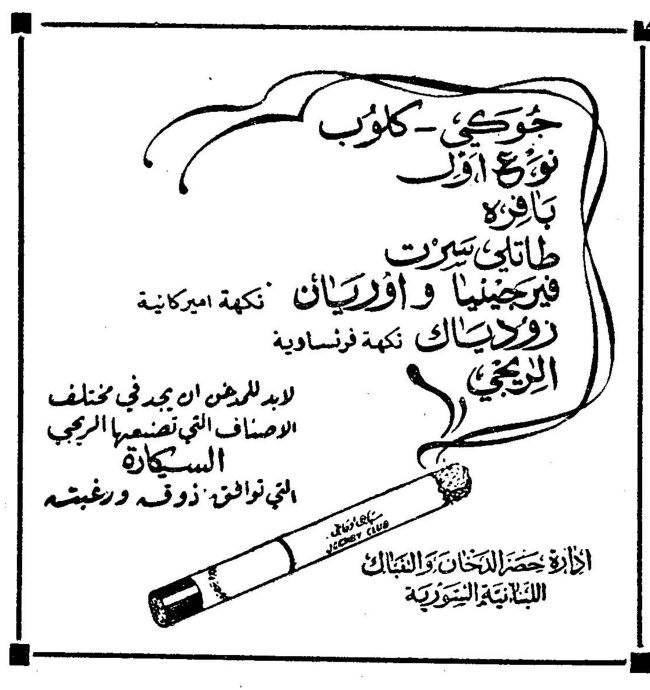
Régie Advertisement: Jockey Club
Jockey Club
First quality
Of the choicest tobaccos, featuring
Virginia and Orient
Rhodesia — Turkish-American
Turkish-French
Spring (al-Rabi')
The smoker is bound to find, among the various brands offered by the Régie, the cigarettes that suit his taste and his desire
The General Administration of the Lebanese-Syrian Tobacco and Tombac Monopoly