In 1886 Father Schmidt founded a school known by his name, which has today become the Schmidt College for Girls, with 400 pupils
and a class to train those who wish to take up the teaching profession. Father Ratisbonne, too, established a school for girls in Jerusalem in 1856 which is still known by his name.
The Russians came in 1882: the Russian Society — whose honorary president was the Tsar himself and whose president was the Grand Duke Sergius, brother of the Emperor Alexander III — founded girls' schools in most of the towns and villages, as well as two boarding schools: one for boys in Nazareth, called the men teachers' seminary, from which graduated eminent men of letters such as Mikhail Naimy, the late Nasib Arida, and others; and the second for girls, on a hill in Beit Jala near Jerusalem, founded in 1890 and called the women teachers' seminary, whose academic program is supplemented by lessons in home economics, sewing, and handwork. Up to 1914 a great number of women teachers graduated from it, some of whom held, and still hold, posts as teachers of Arabic and mathematics in the government schools — which shows how much attention the school paid to these two branches of learning.
And how long that school insisted that its pupils wear the dress of the people of Beit Jala of those days, despite its cost! If you looked closely at the photographs taken in 1906, you would see the long gown, made of the costliest broadcloth in winter and of silk in summer, embroidered on the breast in exquisite colors; the short jacket known as the damir; and the head-covering made of sheer white cloth — all of them a model of that historic dress.
And now, picture with me these hundreds of schools in the towns and villages, working and working since 1848 — all of them free, all of them providing books and school supplies gratis; and among the boarding schools, such as the English and the Russian for instance, some provide clothing gratis and take not a single piaster for the instruction. Then go deep into the large villages such
as al-Rama, Kafr Yasif, Ramallah, Beit Jala, and others, and listen to the middle-aged women and the old women conversing in English; or watch an elderly husband and wife speaking Russian so that their children will not understand what they say. Then picture the hundreds of other schools founded in the present century, and how many girls have graduated and still graduate from them every year — and you will realize the measure of the Arab woman's education in Palestine, and that if a census of illiterate women were taken, their number there would prove no greater than the like of it in the most advanced of the sister countries.
The response to the "Teach Your Child Drawing" contest was very great indeed, which shows that our children have begun to be raised on art and trained in it; and the art of drawing is among the most exalted of the fine arts, and the loftiest in what it signifies of nobility of nature and refinement of taste.
We are pleased to announce that the winner of the first prize is Miss Suniya Salibi, daughter of Dr. Sulayman Salibi of Bhamdoun. The committee has decided to name two other winners of the second prize: Carol Tayyar, son of Mr. Joseph Tayyar of Souk el-Gharb, and Miss Qamar, daughter of Dr. Othman al-Hamra of Haifa. We congratulate them and wish them a brilliant artistic future. We shall publish their pictures in the next issue.
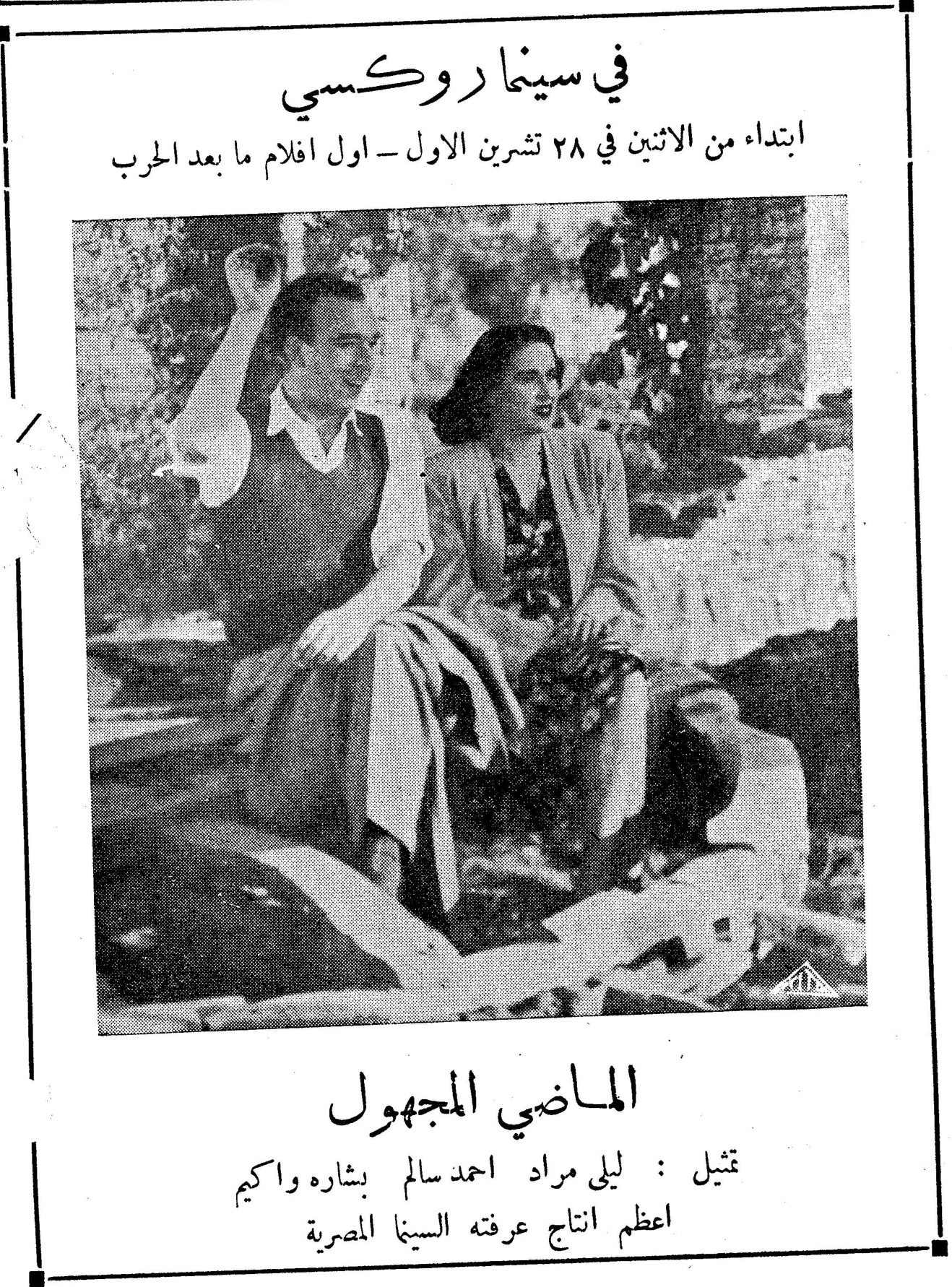
At the Roxy Cinema: The Unknown Past
At the Roxy Cinema
Beginning Monday, October 28 — the first of the post-war films
The Unknown Past
Starring: Leila Mourad, Ahmed Salem, Bishara Wakim
The greatest production the Egyptian cinema has known