institution. I answered them, saying: 'Sectarianism no longer exists in Lebanon. It existed in times past, but today, and especially in the era of independence, it has become an old tune, replaced by a new one — that we are Lebanese, and there is no difference among us between one creed and another or any official sect. In Lebanon we all work for the homeland, and we prefer no one over another except for his devotion to Lebanon and the measure of the services he renders it.'
Some of the emigrants also asked me about what they hear from the preachers of mischief who go out to the lands of emigration to poison minds and stir up trouble against the new era of independence. I answered them that what they hear is wrong! If those who spread these rumors were sincere, they would be defending their beliefs and their opinions in the homeland, not in the Mahjar. For what can the emigrants do about such questions?
They also asked me there about what Lebanon needs, and whether it is in need of material assistance. I answered them that Lebanon needs, before everything else, men — devoted men who will visit it and see its conditions at close hand. The purpose of my visit is to look into your conditions, to become acquainted with you, and to inform you truthfully of the progress we have attained. For Lebanon has advanced greatly in recent years, until it has become other than what you knew when you left it. And here I dwelt at length on the stages Lebanon has traversed and the strides it has made forward."
Then I asked Her Ladyship to tell me of her feelings while she was among the emigrants — did she feel herself a stranger as she moved among them from one country to another? She said: "No. Throughout my stay there I felt that I was among my own people. I shall never forget the warm welcome with which they received me — a welcome directed before all else to Lebanon, which I represented. And I should like to mention the great celebration held for me in Detroit. It was attended by a vast throng of emigrants, who came from all parts of America. Upon my arrival in that great city I was received by the Honorable Mayor, Mr. Jeffries, who presented me with the key of the city in a ceremony splendid in its simplicity, and told me that I had become an honorary citizen of Detroit. I expressed to him the great honor I had received, and thanked him, saying that in thanking him I was in fact thanking the Lebanese, but for whose industry and lofty standing in the city this celebration would never have been held — indeed, I would never have come to this city and received such an honor from its citizens."
Her Ladyship concluded her words by saying that she felt pride and glory when she found the Lebanese there occupying an eminent place among their American brethren, and that the rumor she used to hear before — that the Lebanese there were nothing but merchants who cared for nothing but amassing money — was dispelled.
And I took leave of Her Ladyship, thanking her for this delightful talk and wishing her long life in the service of Lebanon.
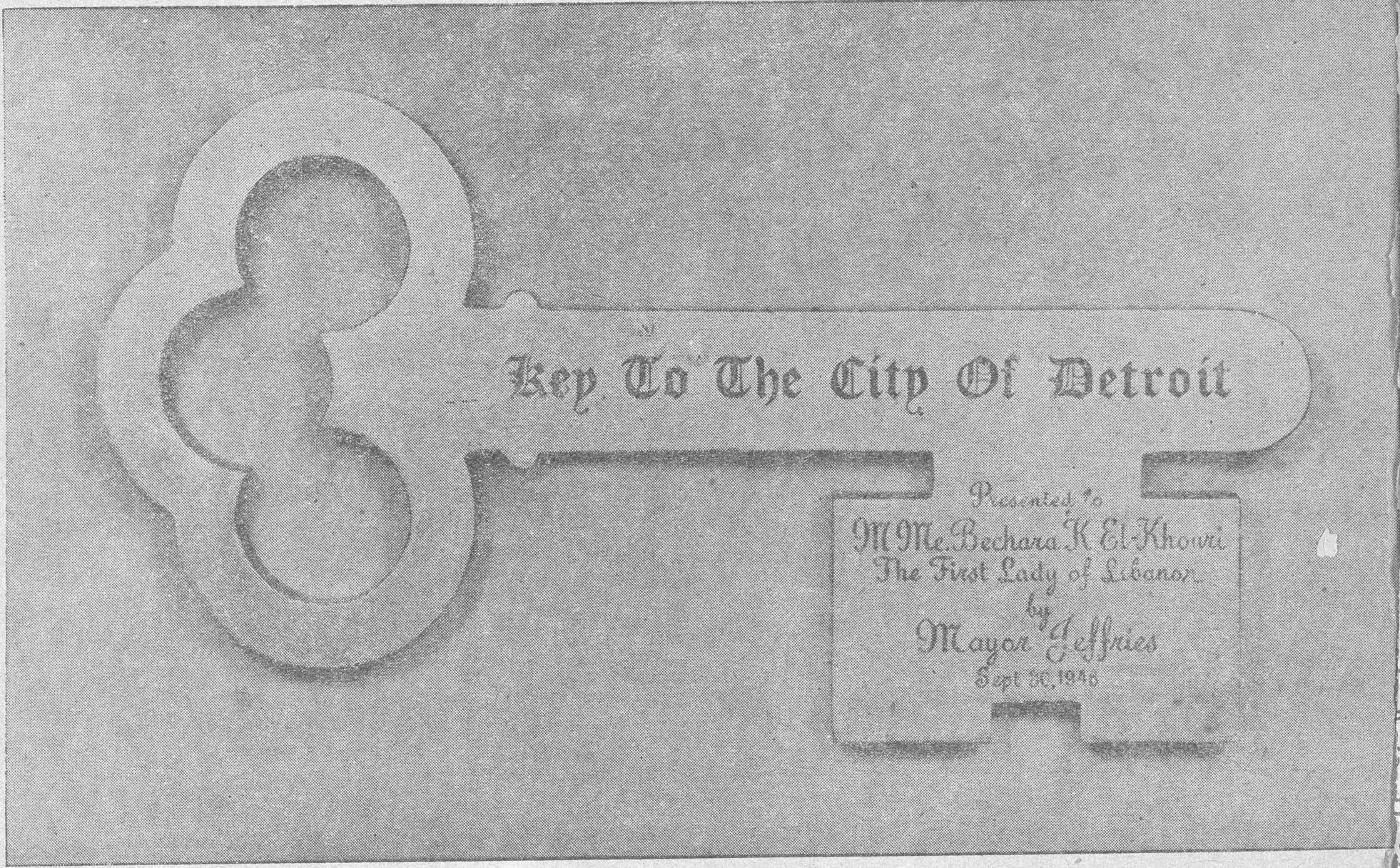
Key To The City Of Detroit
Presented to Mme Bechara K. El-Khoury
The First Lady of Lebanon
by Mayor Jeffries
Sept. 30, 1946