us bearing not, as it once did, the apples of death, in the days of Adam and Eve, but the apples of life, gleaming with light and everlasting green." This is a conjecture which, for all its subtlety, points to a theological belief that cannot rightly be taken as the explanation of this popular custom.
The holiday tree symbolizes, quite simply, the most delicate and beautiful of the qualities of the Christian religion — namely, the placing of religion within reach of the people, heads of families and children alike; for the gifts presented to them are not a reward for fitness or merit, but a token of the mutual affection of that day, since they believe it is the Child Jesus who brings them these gifts, and for this reason it is called among the children the gift of Christ. And since joy opens the heart to the entry of compassion and to sharing one's feeling with others, Christmas has become the feast of kindliness: the rich man visits the poor man and brings him gifts to gladden his heart and the hearts of his children.
The English took this custom from the Germans when Queen Victoria married the German Prince Albert, who was the first to set up a holiday tree at the royal court; then the English people took the custom from him, and it spread among the people with a speed that made them suppose it an ancient custom.
As for France, the holiday tree was not known there until Alsatian and German families moved in, and its spread was at first in the churches and schools. But the people did not imitate it and set it up in their homes until after the migration of Alsatian and Lorrainer communities, when Germany occupied Alsace and Lorraine.
This tree is not a matter of dogma. The basic idea of its meaning is that grace, peace, and joy belong to the little ones and the poor — a sign of what people owe one another by way of sharing in each other's joys and feelings.
From France and elsewhere, Christmas trees are sent out ready-decorated to all the families of missionaries and religious
missions in Greenland and the colonies of tropical Africa, to bring back to their minds and hearts the image of the far-off homeland.
As for Lebanon and Syria, this custom has been known since the coming of the foreign missionaries of their various denominations. But those who imitate them in it are, for the most part, certain well-to-do Christians.
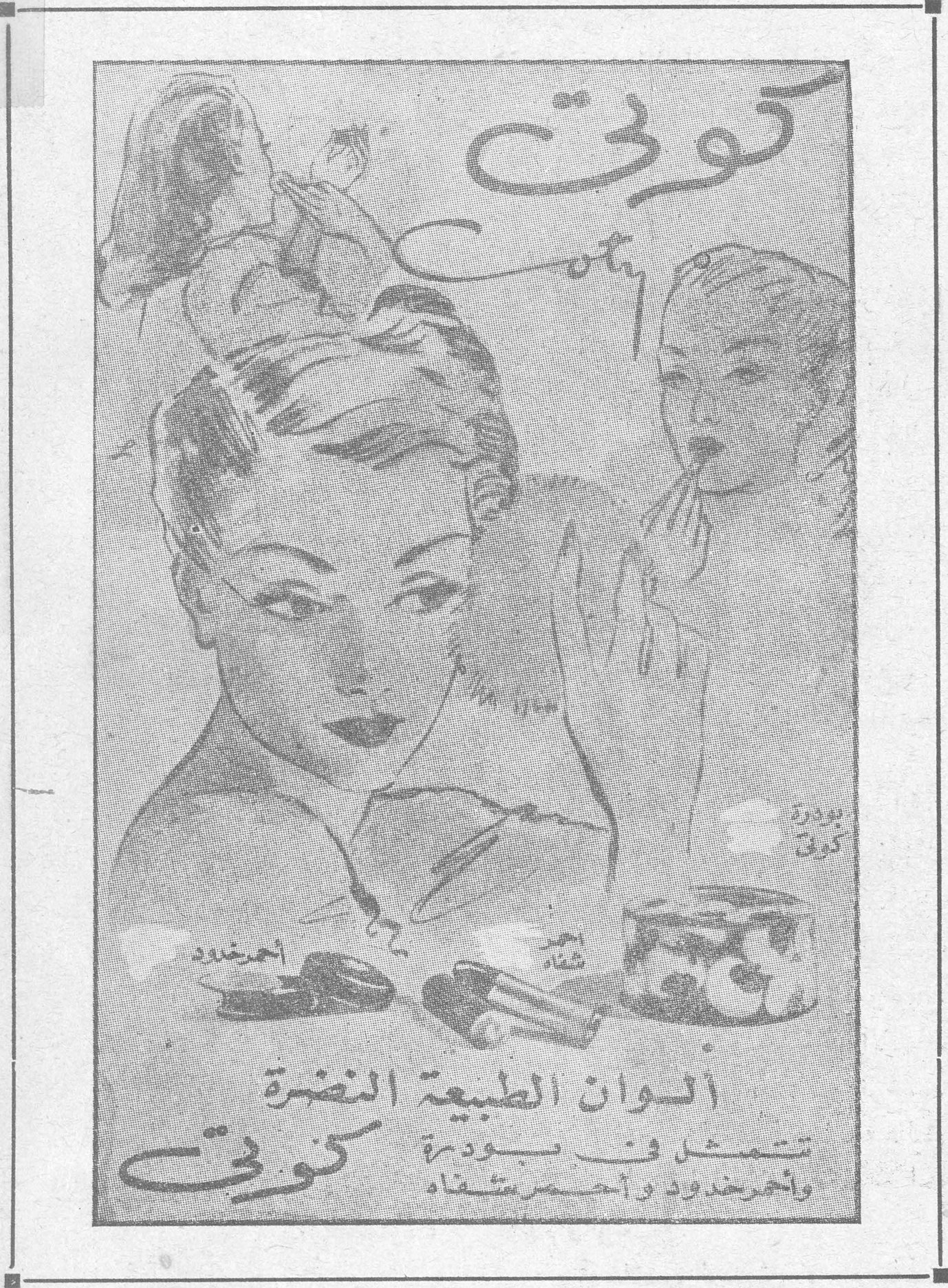
Coty
Coty powder
Rouge
The fresh colors of nature are embodied in Coty powder, rouge, and lipstick