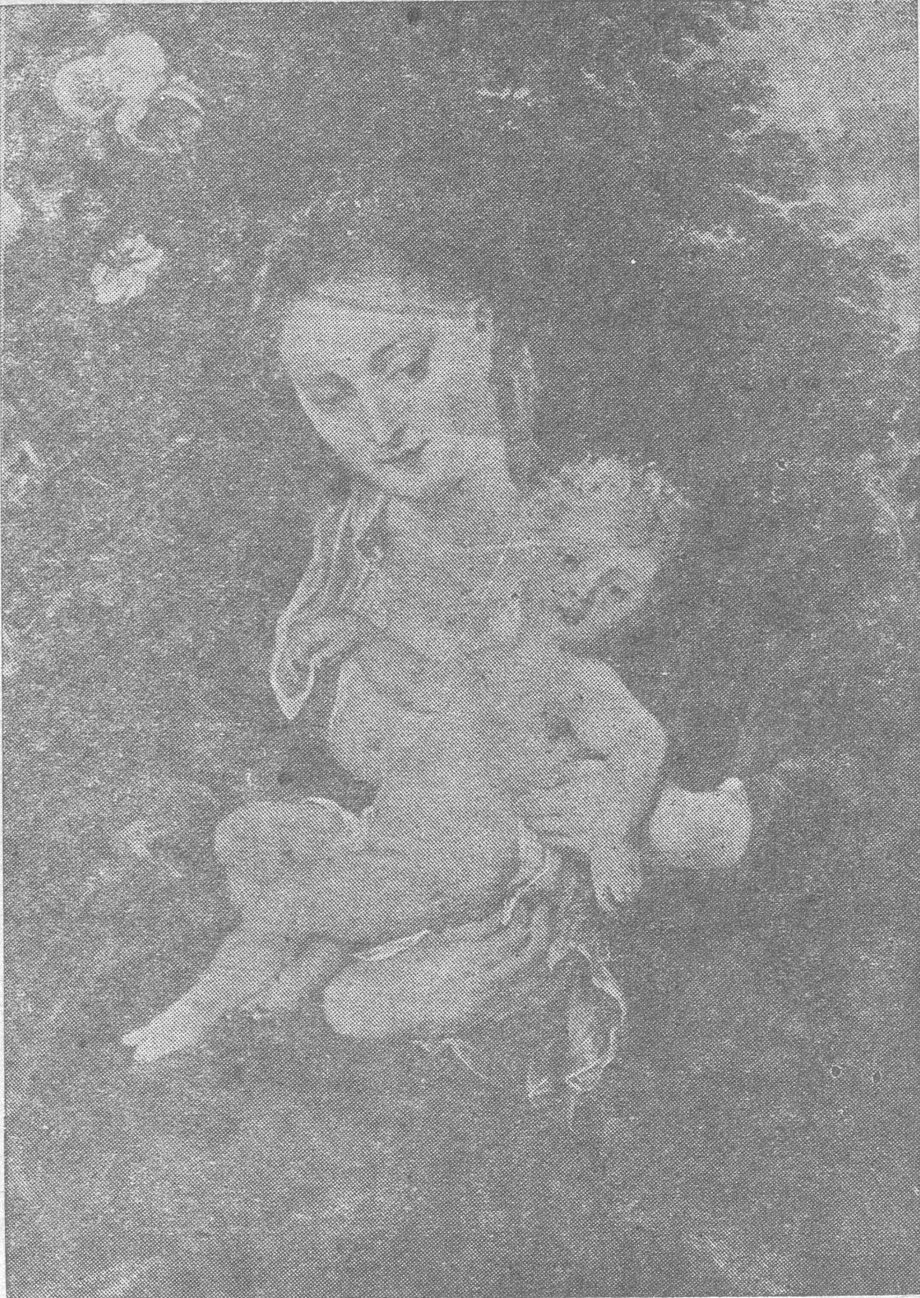

Welcome to the glorious feast of Christmas, coming once each year, bringing to the world the message of faith and love in an atmosphere drawn from the story of the holy Birth, and rich in beautiful varieties of tradition. The family gatherings around one table, the exchange of greetings and gifts, the joining in spiritual carols, the joy of the children, the holiday tree and "Papa Noël," and the cards the post carries, embellished with pictures and verses — all these are noble social customs which none denies save one whose feeling has turned to stone and whose soul is shackled in the fetters of matter.
Yet they are customs of recent date when measured against the history of the Church, to which belongs the first credit for preserving the doctrines of the Christian religion — doctrines whose influence upon art and literature has lasted down to our own age. And it is an established truth that art, in its development, has drawn inspiration from no subject greater or holier than the story of the Christ Child as it is given in the Gospels:
"So Joseph went up from Nazareth to Bethlehem, to be enrolled with Mary his espoused wife, who was with child; and while they were there her days were fulfilled that she should be delivered, and she brought forth her firstborn son, and swaddled him, and laid him in the manger, for there was no room for her in the house.
"And there were in that region shepherds keeping the watches of the night; and behold, the angel of the Lord stood before them, and the glory of the Lord shone round about them, and they were afraid. And the angel said to them: Fear not, for behold, I bring you good tidings of great joy which shall be to all the people. For unto you is born this day a Savior, who is Christ the Lord. And suddenly there appeared a multitude of the heavenly host, praising God and saying: Glory to God in the highest, and on earth peace, and good will toward men.
"And behold, Magi from the East came to Jerusalem, saying: Where is he that is born King of the Jews? For we have seen his star in the East, and have come to worship him. And the star went before them, until it came and stood over where the child was with his mother; and they fell down and worshiped, then opened their treasures and presented to him gifts — gold, frankincense, and myrrh.
"And after they had departed, behold, the angel of the Lord appeared to Joseph, saying: Arise, take the child and his mother, and flee into Egypt, for Herod intends to destroy the child. So he arose, and took the child and his mother by night, and departed into Egypt."
This is the great event that created for mankind an eternal heritage, from which they draw inspiration for goodness, for art, and for letters, and upon which they whet their talents, so that from them issue those immortal masterpieces that adorn the breast of civilization.
At the very first the Church entrusted to men of gifts, monks and others, the depicting of the lives of the Lord Christ and the saints for the purpose of worship; and so it continued, keeping this prerogative for twelve centuries, until it passed to the pioneers of art in Italy, foremost among them Cimabue, Giotto, Fra Angelico, and Filippo Lippi, with a number of other masters of the Italian school such as Botticelli, Bellini, and Mantegna; and then came the giants — Tintoretto, Titian, Raphael, Michelangelo, and Leonardo da Vinci. It became the custom that no artist of repute could stand forth unless he had treated one subject or more from the life of the Lord; and the purpose evolved from worship to pure art, each artist drawing inspiration from the essential element in the story of Jesus to cast it in a mold of his own imagination, under the influence of his surroundings and his time. Hence we see a difference in outward appearances, though the essence, which does not change, remains in accord.
However much disparity we find between one style and another, or between one costume and another, the marks of purity and awe in the face of the Virgin before the angel come to bring her the glad tidings, the marks of tenderness and contentment in the face of the mother enfolding her child, and the marks of pain and sacrifice in the face of the crucified Christ — these marks differ only in the measure of the talent granted the artist for bringing them out.
And often historical facts and temporal and natural circumstances are sacrificed for the sake of the eternal truths; otherwise, how could we accept from Filippo Lippi, for example, a purely Italian scene around the newborn in the grotto of Bethlehem; or from Lorenzo di Credi a strange posture for the child, lying upon the ground and speaking to the Magi; or from Rembrandt a cavern that is more like a Gothic