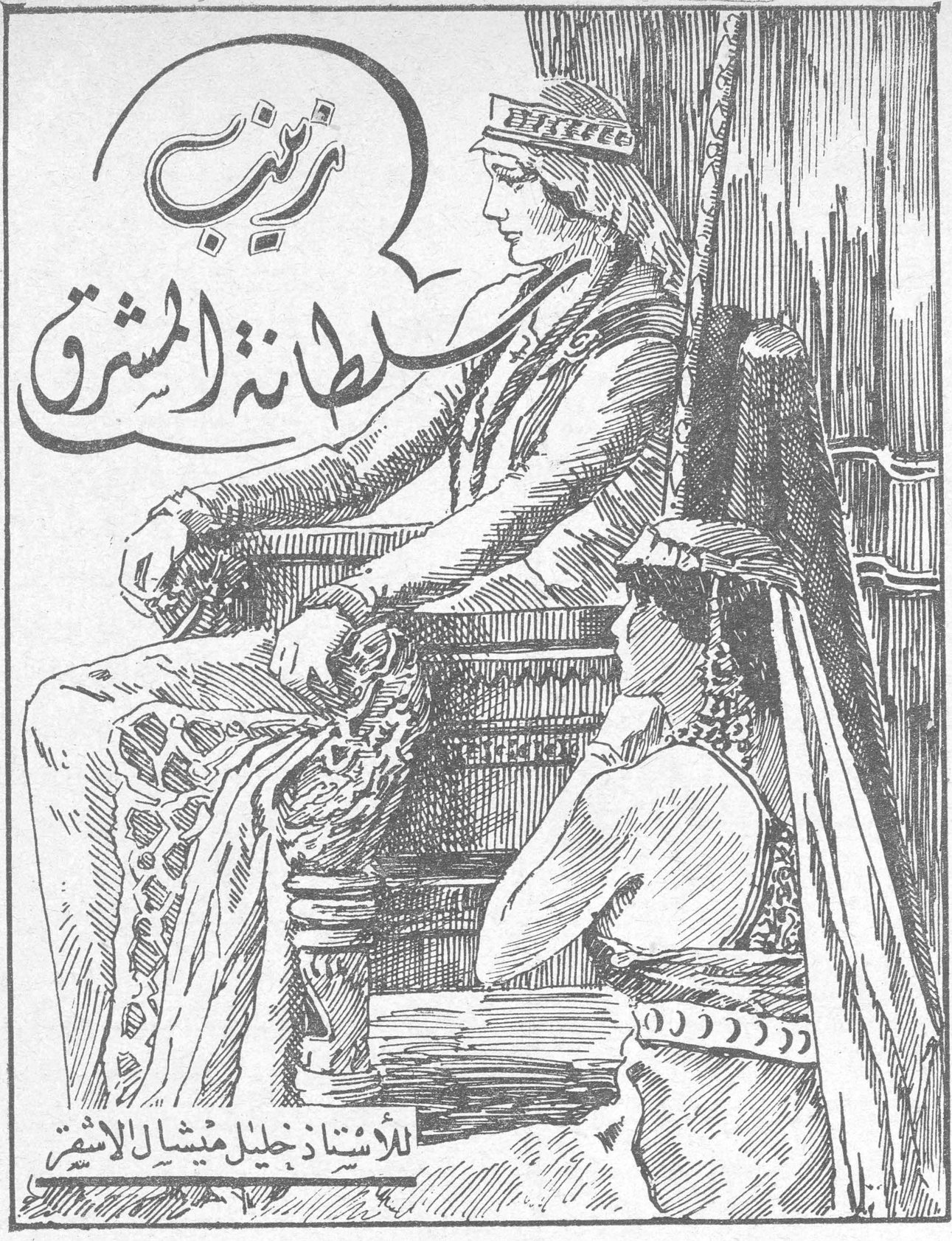
There is nothing strange in this title. Between her and an actual sultanate there stood only a passing glance from fortune, a smile from fate.
When the Caesar Aurelian attacked the armies of Palmyra and saw their might and courage, and the might and courage of Zenobia, he wrote to the Senate in Rome saying: "Some people may laugh at me for making war upon a woman; know, then, that when Zenobia fights, she is more of a man than any man."
Weeks later, Caesar's armies were perishing in vain around the city. So he thought of a way to conciliate Zenobia and summon her to surrender her capital, and he sent her this message:
"From Caesar Aurelian, king of the Roman world and sultan of the East, to Zenobia and her companions, greetings.
You ought to have done of your own accord what I now call upon you to do by this letter: to submit to the Romans and surrender to me. On this condition, and no other, will you obtain your safety and deserve your pardon. If you do so, the supreme Senate will permit you and your household to live in a city they will appoint for you. Hand over, then, to our treasury all that you possess of jewels, gold, silver, horses, and camels, and I pledge to you that I shall preserve for the Palmyrenes their rights."
And Zenobia answered:
From Zenobia, Sultana of the East, to Aurelian Augustus.
What you have sought of me in your letter, no one has ever dared demand of me by message. Have you forgotten that victory is won by courage, not by blackening pages?.. If the brigands of Syria overcame you though they stood alone, what will your state be when my allies join with me to fight you? You will doubtless bow before me and strip yourself of that pride which drove you to demand the impossible." —
An answer such as this, harsh in tone and strong in accent, bespeaks a courage and a self-assurance without parallel. Whence came
Zenobia's assurance? Who is this woman who confronted the Romans and very nearly overcame them... who is Zenobia, who gave her sons the highest preparation and taught them the Latin tongue, that they might one day be fit to mount the throne of Rome!..
All that the public knows of her is that she is Zenobia, Queen of Palmyra, or Zaynab al-Zabba', and no more!.. Yet the truth lies deeper than this naming.
The name Zenobia in the Aramaic language is "Bat Zabbine," meaning: the merchant's daughter. In this form it appears in the Palmyrene inscriptions.
As for the form "Zenobia," it is, in Waddington's opinion, the image of a Greek name which
the Easterners of Palmyra were accustomed to add to their Semitic names. Perhaps her name carries an allusion to the name of her father, "Zenobios," who was one of the notables of Palmyra.
But "Zenobia" would never consent to be reckoned "a merchant's daughter." She strove her utmost to conceal her origin, which drove the historians to invent suppositions that often stray very far indeed from the truth. Thus the date of her birth, and the place where she was born, are lost to us.
And it pleased Zenobia to trace her descent to Cleopatra, Semiramis, and Dido.
She would insist that Cleopatra was an ancestress of hers. Perhaps the name "Zenobia" itself