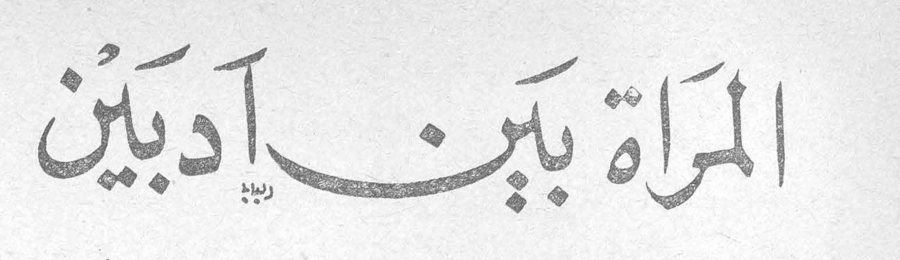
Search for woman and her influence, and you will find her mark in society and in literature. This mark of hers is a measure of a nation's advancement or its backwardness. Today's talk will treat her influence in the two literatures, Arabic and English. The strange thing is that the Arab woman begins her literary life high in station and great in standing, remains so for a time, and then moves toward decline, while the Englishwoman's life is at first dark, and then moves forward.
The Arab woman, after Islam had honored her with its glory, came to hold a lofty position, and this appears plainly in the great deeds that woman performed at the rise of Islam. That was an age filled with the names of excellent women who left their mark on the course of events and on literature. It is telling of her standing that great men, on occasions of honor, were called by the names of their daughters, such as Abu Salma and the son of Dhat al-Nitaqayn. Men would plunge into the thick of battle crying out the names of their sisters and their beloveds. There is verse that testifies to her rank and to the respect she enjoyed, as in the words of Dhu al-Rumma:
The pilgrimage is complete only when the mounts halt before Kharqa', her veil laid aside.
Her literary taste showed itself in poetry, criticism, and oratory. Do we not yearn for the poetry of al-Khansa', that pure, limpid spring gushing from a human heart to speak to every heart? Do we not take pride in the eloquence of Sukayna bint al-Husayn and her celebrated, overflowing speech — and many others besides? But what became of that beautiful vision? Those crowded gatherings? That literary life?
The Islamic realm expanded, races mingled within it, slave girls multiplied, luxury spread, and corruption crept through the whole of society; woman's worth sank, and the bond of the family weakened as the commands of religion were forgotten, and so they tightened the veil upon her! This veil which cut her off from the world of the living, robbing literature of its inspiration and society of its worth and spirit. And such was our condition: ascent, then decline.
The Englishwoman, by contrast, began at a perceptible degree of advancement. Chaucer pictured her in his tales rivaling men in their works; Shakespeare pictured her in his plays as possessed of no small ambition and skill. Then the people so cherished her that they accepted without hesitation the rule of Elizabeth as their queen while she was still in her youth. Her share of education then grew, and hardly had the eighteenth century greeted her with its newspapers, its literary movement, and its men who devoted themselves to bettering her condition and drawing her toward letters, than she greeted them in turn with her
eagerness and her activity, with her women's salons where she would gather with men of letters. Then general common education propelled her to share with man many of his political rights and his daily labors. And behold, literature grew great through her, and so did her influence upon man and society. As for production, the Arab woman and the Englishwoman are equal in falling short of man; yet the Englishwoman surpasses the Arab woman thanks to favorable circumstances that surrounded her history and of which the Arab woman was deprived in her best ages: the spread of general education, printing, and newspapers, and the existence of the art of the novel in the English language but not in the language of Dad.
The art of the novel is a great cause of the multiplication of the literature that woman herself produces, for the novel suits woman's nature, while poetry is more like man. In the novel, which studies social life and describes every motion and every stillness, woman finds the best field for expressing her inner stirrings and her observations. Nor must we forget that woman possesses a gentleness of soul and a delicacy of feeling that enable her to understand others. Beyond this, in the novel woman can express, through the tongue of another, the inclinations of her love and its phases, in a manner that would not be found seemly from her had she sent it forth as poetry. Thus hardly had the novel appeared, after the spread of education, than a company of great women novelists won fame in the last century, rivaling men — foremost among them Jane Austen, Charlotte Brontë, and Mrs. Gaskell. In the art of the novel lay the Englishwoman's best production, while the Arab woman excelled in poetry.
Did the two, one wonders, move through a broad literary field without the least enmity raised against them by man? Most likely they agree here too, for against each of them there arose a stubborn enemy who bore down upon her with cutting words. In the Arab woman's case, al-Ma'arri poured out his wrath upon woman, and his lot fell in the early days of the Arab woman's decline, when the weight of the veil pressed upon her most heavily, and so he found willing ears. As for Milton, though he set her at a rank beneath man, he was a single individual expressing personal ideas acquired from his own unhappy circumstances, and he did not influence his society.
Arabic literature knew a class of women unknown to English literature: the element of the slave girls, who excelled in letters, music, and song; men of letters would gather with them and celebrate them in amatory verse. Yet their influence was plain in the fall of woman's social standing.
The literature concerning the Arab woman may be confined to amatory verse, and to the praise and respect shown her in her first age. Such praise was among the noblest purposes of Arabic literature, one in which it stands alone apart from English literature. Of this kind are the words of Miskin al-Darimi:
What harm to my neighbor, while I dwell beside him, if his house should have no screen? I am blind whenever my neighbor's wife goes out, until the chamber hides her from view.
And the words of Abu Firas:
And I went off, dragging my saddle away from a field