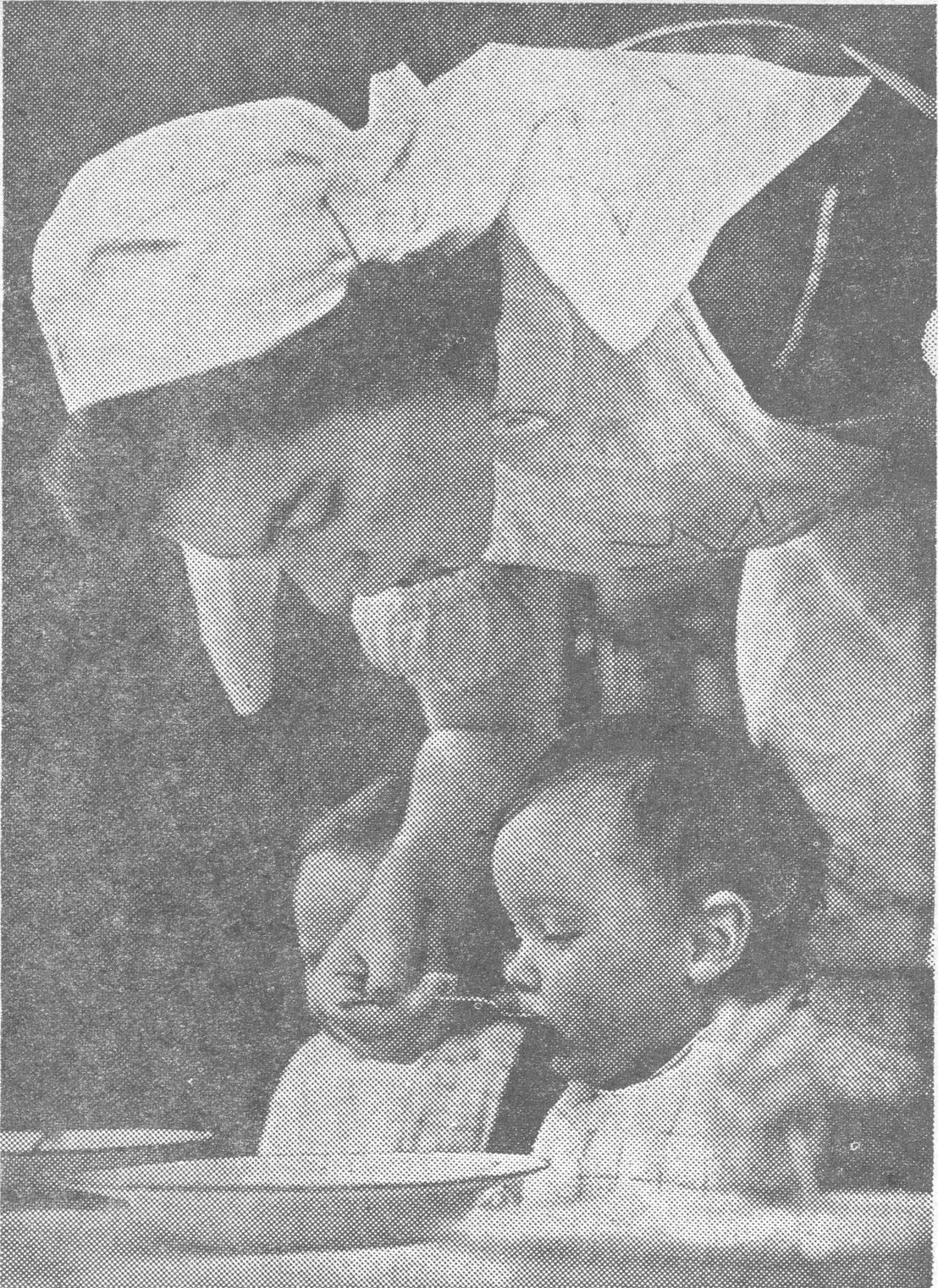

The Child's Food
Doctors believe that mother's milk is the best food for the child. The mother prepares her breasts for nursing the child by washing them with sterilized cotton or a sterilized cloth.
Until the milk flows in the mother's breasts, it is well for the child to nurse from both breasts at each feeding; and if the quantity of milk in a single breast is large, it is better that the child be given one breast at each feeding. If the child nurses from both breasts, the breast that came first at one feeding should come second at the next. And if it becomes clear that the mother's milk is not sufficient, or if it appears that the child is still hungry or poorly nourished and is
not gaining weight at the natural rate, the doctor will prescribe something to help in feeding him besides the mother's milk.
During each feeding the mother holds her child and raises him to her shoulder once or twice and pats his back, for this helps him bring up the air he has taken in while nursing. If the child falls asleep without having swallowed his food well, he may vomit. And if the child is fed at set times, he quickly grows used to nursing on schedule. Not all children grow hungry after equal intervals, but most of them feel hunger after four hours have passed.
Mothers should therefore begin to accustom their children to the following system: the child usually nurses at six and ten in the
morning, at two in the afternoon, at six and ten in the evening, and at two after midnight.
If the child wakes from his sleep and cries with hunger, asking to nurse at other than the appointed times, he may be in need of a change in his feeding schedule. In such a case it is well that the doctor be consulted.
Mothers should wake their children to nurse at these times, except at the time of the feeding at two after midnight; this feeding is given to most children only in the first three or four weeks after birth. The child may also do without the feeding at ten in the evening, and there is no need to wake him at that hour once he reaches the age of four or five months; when he reaches that age he generally sleeps on until morning. But if he wakes at night and cries with hunger, it is more fitting that he be nursed at ten in the evening for a further period.
Most children feed every four hours through the first year of their life; but when they reach the age of fourteen to eighteen months, mothers begin feeding them three times a day.
When the mother's milk is not sufficient for her child, the doctor may advise her to make use of cow's or goat's milk; and the milk must be boiled, then cooled, each time before the child is fed from it. It must be put at once into a sterilized vessel and kept in a cool place, and it is best that this be a refrigerator. If canned milk is used, it must be diluted with boiled water.
Yet children nursed by their mothers, and those fed from the bottle, are in need of a quantity of vitamins greater than