religion about with it — nay, he drew his very proof from it, on the day this immortal miracle was borne in procession between throat and palate — and then the (Hadith) went its rounds, and passed its hand over morals, over noble customs, and over the various walks of
daily life — even over dress and food — with an Arab color on which no foreign dust has settled.
Nor did the portion of the language — nay, the portion of the nationality — in the religion of Muhammad stop at this ample measure; it went beyond it to a measure ampler still: for behold, the tongue of our people joins this present life to the next; and behold, it is the language of felicity amid the clamor of bliss, for "Arabic is the language of the people of Paradise."
That, and the promised Paradise itself was spread out, in the "Book" and in the (Hadith), only according to the desire of the Arabs, in the likeness of their fancies and the yearning of their hearts: in it are the trees, and the rivers, and the clusters hanging near, and the green couches; no sun and no bitter cold, but unbroken clear weather, and bliss, and a great dominion... and so on to the end of that delectable tablet of Ridwan.
So Muhammad made this world over to the nationality of the Arabs, and the next world to their language. Then he feared lest, from behind the Message, they should split into a party believing in it and a party believing in another; so with "Whoso loves the Arabs has loved me" he bound fast where division was to be feared, and gathered together where scattering was to be feared! As though the condition, with him, were love for the Arabs, tenderness over them, and the taking up of their cause — not entry into their religion! Marvel, then, at a messenger whose whole care on earth was the command of God and the drawing of all creatures to Him, of every race — how he takes such pains for the sake of his nationality, and sows abroad such a sowing!
And behold our Arab peoples, on every horizon: whenever the muezzin looses his voice between heaven and earth, at the stirring of dawn in the dark, or at the sun's passage between its rising-place and its setting, they feel in that cry that "something" of their nationality is soaring in the air, pressing on its way from mountain pass to mountain pass... and they are filled
with the pride of solidarity for a religion sprung from among them, whose glad tidings ring out in their language, which a man of their own magnifies, and which one enters by the gate of their history!
One of those who passed long years in "Paris" told me — a Christian of ours, from (the Mountain), who studied medicine there and filled himself with the people's language, and their history, and their ways of give and take, in every least particular of intercourse, far more than he knows of our own things — he told me that once, as he was walking in the rue (Quatrefages), close by the "Mosque of Paris," his thoughts far away from this Lebanese land, suddenly a takbir rang out from the minaret and rose above the din of Paris. And our friend was seized with a sweet astonishment that filled his heart. He said: "I could not help but turn out of my way and enter the courtyard of the mosque, where I passed some part of an hour among those domes and arcades, as though, in my secret self, I were in Lebanon, gazing on their scenes and listening to their talk — and between me and them lay skies and deserts."
Thus did Muhammad gather to himself, by grace of the Arabic in his Message and the Arabism in his zeal, these Arab hearts of every religion — so that that friend of ours meets, beneath the minaret of the mosque in the land of exile — and he a son of Christianity, as you have seen — what he does not find beneath the dome of Christianity!! And that is because language stands above religion, and the solidarity of nation above the solidarity of sect, where inclinations are concerned and nature is left upon a loose rein!
Muhammad, then, belongs to the Arabs one and all: in the language of the "Book" and the (Hadith); in the zeal of the race and the fierce guarding of its noble dispositions; in a history of the conquest of kingdoms and the conquest of minds, radiant as the height of forenoon; and in morals upon which be the peace of God! As for the Muslims, they have no more of him than we — where profiting by him is concerned, and drawing upon him, and glorying in his mention — except Islam itself. And that is a surplus whose lack the Christians among the Arabs — I mean the purest of them in lineage and in letters — make good in their "Muhammadanism": they
ask of their hearts an ever greater love of Muhammad, and of their tongues and their pens an ever greater championing of his cause, until the two portions come near to standing equal!
Therefore the land of the Arabs is ablaze today with the glory of the one peerless Arab, and with love of him; and the echoes answer one another over the sand of the wastes and the growth of the mountains, on every shore and every gulf, from the rising of the sun in the blue of the East to its halting-place at forenoon on the borders of the clear sky... a love of "the son of Abdullah" in which white and black, settled and wandering, Muslim and Christian, are all alike; a pride in "the son of Abdullah," and a proud swaying of the shoulders over the nations, in his name!
And so, Ahmad — by my faith, the faith of "the son of Mary," and by the beams of his cross: we, in this quarter of the Arab people, look up to you from the windows of the church; our minds are in the "Gospel," and our eyes are on the "Quran"....
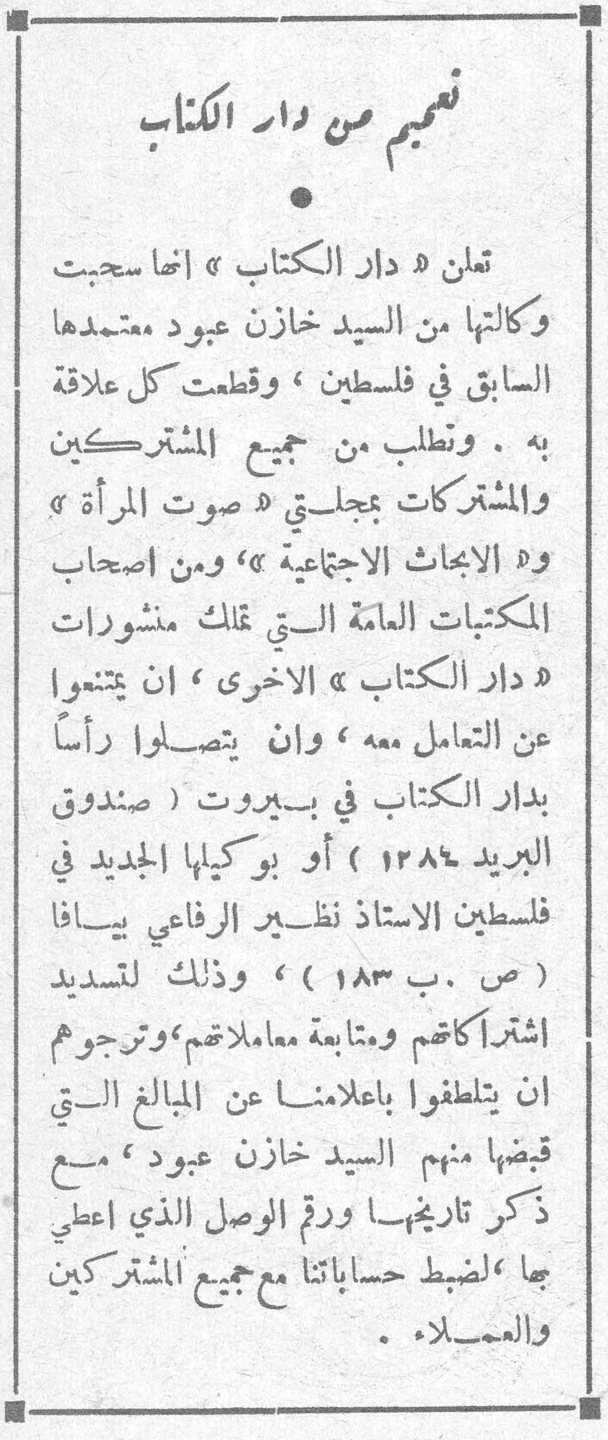
A Notice from Dar al-Kitab
Dar al-Kitab announces that it has withdrawn its agency from Mr. Khazen Abboud, its former representative in Palestine, and has severed all relations with him. It asks all subscribers, ladies and gentlemen, to the two magazines “The Woman's Voice” and “Social Research,” and the proprietors of the public bookshops that hold Dar al-Kitab's other publications, to refrain from dealing with him and to communicate directly with Dar al-Kitab in Beirut (P.O. Box 1284) or with its new agent in Palestine, Mr. Nazir al-Rifai, Jaffa (P.O. Box 183), in order to pay your subscriptions and carry on your transactions. It begs them to be so kind as to inform us of the sums Mr. Khazen Abboud has collected from them, stating their date and the number of the receipt given for them, so that we may settle our accounts with all subscribers and customers.