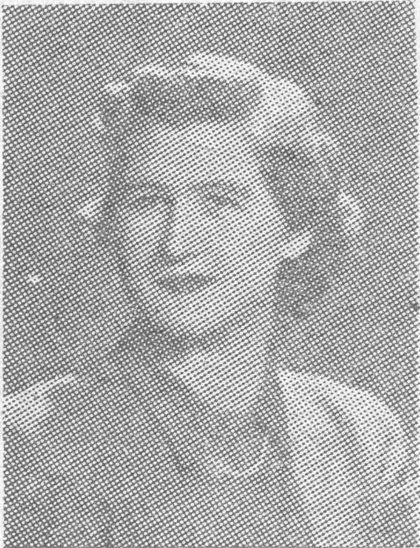
Miss Marian Elliott wrote this article especially for The Woman's Voice. Miss Elliott is an English woman of letters who works in the press section of the British Legation in Beirut.
In the middle of the last century a group of women resolved to begin the struggle to obtain the right of the vote for woman and the right to share in the government administration of the country. Among these women were Emily Davies, who after prodigious efforts succeeded in founding Girton College, the first home for women at Cambridge University, and Elizabeth Garrett, the first woman physician in England. One after another, women began to band together. At the opening of the present century feeling had grown so strong that they adopted a positive plan of struggle, which led them to stage noisy demonstrations and present petitions to Parliament. And when all these things availed nothing, they resorted to violence and force, to the destruction of property and the breaking of windows.
That state of affairs did not last long, however: the First World War came and put an end to it. Women turned their efforts to war activity at home and proved an outstanding capacity in their contribution to the general effort. Thus they took men's places in the factories, in agriculture, in the shops, in banking and in commerce, bearing their share of the burden of war. And although the emancipation of woman was delayed until then, the result was brilliant — truly brilliant — for woman in Britain proved to all, by her tangible deeds, an ability that entitled her to walk side by side with man in raising the level of the nation, and to share with him the burdens of rule and the administration of government.
Although that was only the beginning, it did away with the old theory which held that woman is capable of nothing but running her house and rearing her children, and it made of the two sexes persons equal in rights, with no barrier dividing them. In 1918 Parliament passed a bill allowing householders and their wives over the age of thirty to vote. The purpose behind fixing the age was to reduce the number of women voters, so that they should not become a majority. And ten years later, when Parliament had satisfied itself that no women's party could arise, it passed a bill by which woman was granted all the political rights enjoyed by man.
And yet the basic desire burning in the innermost depths of woman has never, at any time, gone beyond the possession of a home and children who will in the future be her aid against the assaults of time. The home is her kingdom; in it she extends her sway over everything, and no wish of hers is denied. And what use is a home if it is empty of the mother, as the song says. The home may be the man's den, but it is
the mother who lays its foundation. It is a great pride for the mother to bestow upon her home a shadow of the beauty of her own soul — cleaning it, adorning it, and securing in it for her children and her husband all that they need — so that happiness may abound in its corners and it may become an abiding paradise. These things are held to be essential in every home, if it is to be a home in the full sense of the word.
For all that, not every woman can realize her dream of marriage and a home. There are a great number of professions that demand efforts so great as to do away utterly with the disappointment a woman meets when she does not see fulfilled the dream that has accompanied her since childhood. Nursing is the most widespread profession among women in Britain, along with the care of the disabled and of the mentally and bodily ill. Other branches spring from that honorable profession, among them massage, X-ray photography, the training of the disabled for work, and others. Some choose social work, visiting the aged and the needy, or consecrate their lives to teaching or to the reform of juvenile offenders. There are besides, in addition to what we have mentioned, women physicians, women scientists, women lawyers, women engineers, women painters, etc.... Thus we see that woman has left no field without knocking at its door and succeeding in it greatly. Perhaps one of the causes of this extraordinary activity is that the number of women in Britain exceeds the number of men by two million souls.
The years of the recent war showed with all clarity and plainness the capability of the British woman. In the previous war the fair sex played a comparatively small part; but in the recent war everything changed. Every girl between the age of twenty and the age of forty-five was mobilized. They worked in agriculture to lighten the pressure of the naval blockade and to save space in the ships for military purposes; they took men's places in the factories; and most of them joined the land, sea, and air forces. There is no doubt that their performance of tasks which until then had been reserved for men opened the way for the rougher sex to join the fighting forces at the fronts and to win victory in the end.
The women of Britain have proved, by their efforts and their fruitful works, an outstanding capability in their contribution to the nation's effort; and by this means alone have they attained the goal for which they struggled so long — equality with man.