
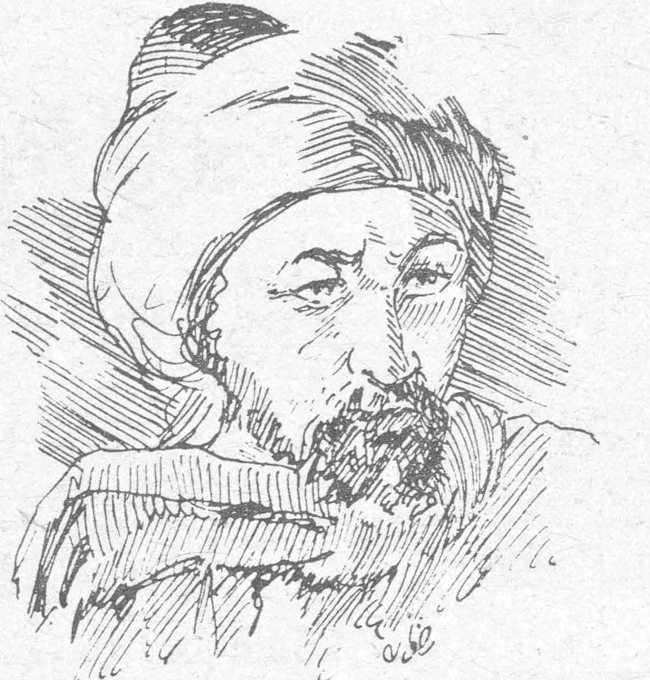
In this essay of mine I take up three points concerning Ishaq al-Mawsili: his literary and scholarly standing; his art of song and his command of it; and his likeness to his father and his walking in his footsteps.
Ishaq enjoyed a familiarity with the caliphs such as his father Ibrahim fell short of attaining. His scholarly and literary standing interceded for him, so that they preferred him above the rest of the poets and singers — so much so that he would come in to al-Ma'mun with the jurists, not with the singers. The singers would enter each carrying his lute; only Ishaq entered with no lute. His familiarity reached such a point that he was no longer content to come in to al-Ma'mun in his enclosure wearing a quilted robe and a taylasan, after the fashion of the jurists' dress; rather, one day — old age having taken full hold of him — he asked leave to enter the enclosure on Friday in a black durra'a and a black taylasan. Al-Ma'mun smiled and said to him: "Not all that at once, Ishaq..." — and bought it back from him for a hundred thousand dirhams, so that he should not grieve. Yet Ishaq often grieved. It happened once that he learned that al-Rashid would not permit him to enter his presence except in the company of Ibrahim, the nephew of Salama — the latter having contrived a scheme upon al-Rashid so as to laugh at Ishaq and humble him. So Ishaq went to al-Fadl ibn al-Rabi', complaining, weeping, threatening to abandon song and divorce it forever. No sooner did al-Rashid learn of this and grasp the trick of Salama's nephew than he said to al-Fadl: "Tell him: let him come whenever he pleases and keep apart from him; he need not come with him, and no honor to him." This Ibrahim, the nephew of Salama, was one of al-Rashid's
clients, and he envied Ishaq, so the two often quarreled and fell out. Ishaq once reviled and taunted him; whereupon he lay in wait for him as he was going along a road and struck him on the head with a rod tipped with a pick, and that was the cause of the weakening of his eyesight. When the news reached al-Rashid he swore that Ibrahim should never come into his presence; and though they pleaded long on his behalf, he swore he would not be reconciled with him until Ishaq was.
Al-Rashid's love for Ishaq went so far that he forbade him to sing for anyone but himself. He was jealous of him before other men, and would reproach him for sitting with al-Fadl and singing for him; and Ishaq would swear to him by the tomb of al-Mahdi that he had never sung for al-Fadl nor sat with him except for study and conversation, and al-Rashid would take comfort in his word and order that he be rewarded and treated generously. Once Ishaq and Ibrahim ibn al-Mahdi disagreed over some matter of melodies, of partition and division, and Ibn al-Mahdi said: "To whom shall I take you for judgment, when the people between us are donkeys!!"
And Ibrahim, who spoke these words, used to eat heartily with the singers until Ishaq appeared; then he would humor him and seek his favor, while Ishaq rebuked and opposed him. It was said: Ishaq was Ibrahim's bane, as everything has its bane. The stories are many of the place Ishaq held in the eyes of the caliphs and the princes. Al-Wathiq said one evening, having resolved upon a morning drinking-bout on the morrow: "Let none of the singers leave tonight." They all held back from opposing him — all but Ishaq, who said to him: "No, by your life, I will not stay the night!" And al-Wathiq could do no more than say to him: "Then by my life, will you not come early, Abu Muhammad?" All this while the singers sat by, bursting with rage. The morrow came, and there was Ishaq walking with Ahmad ibn Abi Du'ad, matching him in his dress and his black robes, his tall cap like his tall cap. No sooner did the singers see it than they rose up in fury against Ishaq, and Amrawayh said: "Look, you people! A khaynakar (Persian, meaning the clownish singer) goes in to the Caliph with the Chief Judge! Have you ever heard of luck more astonishing than this?" And Ishaq came forward and sat in the row of the boon companions, not stirring from it; only when al-Wathiq bade him sing did he step out a little, and a lute was brought, and he sang, then returned to the row of the companions. From all the foregoing it is clear that no one dared to touch him or to lower his dignity — or even dared to be slack in his presence. It was said: when the singers gathered without Ishaq among them, they sang carelessly, their minds elsewhere; but when Ishaq was present there was nothing but earnestness. They dwindled to nothing before him, becoming beside him less than the dust, melting before him as lead melts in the fire. Someone questioned Zurzur ibn Sa'id the singer, saying: "Tell me of Ishaq — how did he manage when he was present with you before the Caliph, he being cut off and failing, while your throats had not their like in the world?" He said: "By God, he would keep on, with his skill and his gentleness, his deliberateness and his grace, until we became beside him less than the dust." And Zurzur was asked another time: "Why do