company of al-Fayha's finest ladies felt with me,
the necessity of attending to our children — that the twentieth century, the age of science and light, was nearly half gone and we had not yet managed to establish a kindergarten for our children in which they might receive a sound upbringing by modern scientific methods. So we rose, all as one, to found the Children's Welfare Society.
That was in the year 1937, and not long after the society's founding the greater company of Tripoli's ladies joined it, until the number of members reached some 140, from the various sects and denominations, every one of them eager for the education of the child and the championing of his cause. The society's first concern, after its work had been suspended during the late war, was to establish a kindergarten on the model of the finest schools — for we believe with a firm faith that the best reform begins with the child. And we succeeded in obtaining a house for the kindergarten situated in the loveliest spot in the city of Tripoli.
As for the directress of the kindergarten, she is Miss Najah Kabbara. The kindergarten opened, for the first time in Tripoli, on the first of October 1945, and today it holds sixty pupils, boys and girls, ranging in age from three to seven. When I asked her about the running of the school and the means by which it works toward its goal, she said: The society is very well satisfied with the kindergarten's progress. What its supervisors care for above all is implanting virtuous character in the child and accustoming him to self-reliance — making him feel his own personality and trust in it. And I must mention that we lately took part in spreading the observance of Children's Day in Tripoli, hand in hand with the Child Welfare Committee in Beirut (one of the committees of the Lebanese Arab Women's Federation), and we strove by every means to make this day known to public opinion and to make it a national holiday throughout Lebanon. We collected about two thousand liras, which we have set aside to bring cheer to the poor children of Tripoli.
How often I thought, as I talked
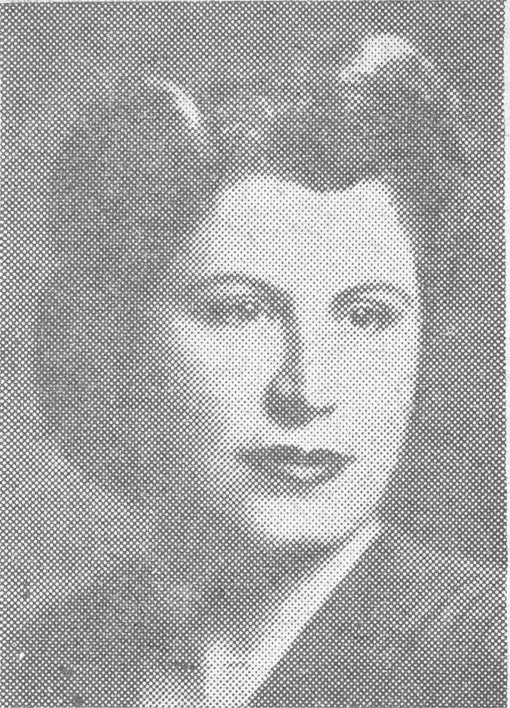
Mrs. Hortense Boulos Tamer
with this noble lady about her school and her orphanage, of the far greater company of our ladies who live pampered and luxurious in their palaces, far from the atmosphere of poverty and the poor, their ears closed to the cries of suffering humanity around them, as though they lived on Mars!!
Mrs. Hortense received me in her magnificent mansion and began to tell me of her charitable project, for which she spends the most precious things she has: her precious time, her energy, and her money. She said: The name of our project is the Mar Elias School and Orphanage. It is a fruit still tender, a little newborn of the Peace and Love Association, which has developed with time into a vocational school whose essential aim is to shelter orphan girls and to teach and educate them. We saw that societies pursuing many aims at once were numerous in the country; and out of our desire to attend to one portion of our daughters — who are, in my view, of all people the most deserving of mercy and compassion — we chose to confine our society's work to the orphan, for God enjoined her care, and the revealed scriptures commanded kindness toward her and the championing of her cause. Together with a company of the best of our ladies I spent tremendous efforts to bring this idea into being, and the Orthodox waqf administration placed a large building in the Monastery of Mar Elias at our disposal. We fitted it out as best we could, and now fifteen girls live in it, whom I gathered from circles so poor and destitute that no human being could imagine their existence!
— And how does the orphanage run?
With the utmost precision and order. There is a school and there is an orphanage. The school attends to teaching these little girls the two languages, Arabic and French — this takes place before noon. In the afternoon, the girls devote their efforts to household matters and handwork.
— And on what do you rely for the orphanage's finances?
On God, on various benefit entertainments, and on what generous souls freely give. News of the orphanage has traveled beyond the bounds of Beirut: there are those who see to provisioning the orphanage from Tripoli and Baalbek, and there are those far from us in the Mahjar who are seeing to it that the orphanage shall have its own building — foremost among them the two ladies Edma Yafet and Farida Malik Jaja. The future is ours.
The lady speaking to me fell silent. But the warmth of her talk and the strength of her faith had done their work in my soul. So I took my leave of her with congratulations, wishing this noble lady and her companions in their struggle all good and success.
The Lebanese Women's League held its monthly meeting in the hall of the Ahliah girls' school in Beirut, under the presidency of Mrs. Heneni Tarcha. At this meeting the reports of the various committees were read, from which appeared the extent of the commendable activity the League is carrying on in the service of Lebanese society.
After this administrative meeting was concluded, the members moved to the great assembly hall, where a fine company of gracious ladies and young ladies, and some of the country's men of thought, had gathered to hear the splendid, stirring address which the great orator, the Honorable Emir Raif Abillama, had been invited to deliver — an address interrupted repeatedly by applause, which found a far-reaching echo of approval.
May God take this League by the hand in its praiseworthy endeavors to raise the standard of woman and reform society.