Woman's favor is a lamp in the lives of the great... as though the lords of Olympus sent this protégée of theirs to none but the great, and as though the universe has never known a creature into whose depths this creating creature did not steal — one who thus never felt the warbling of a dawn or the hissing of a noonday.
Among the great for whom woman was a wine that intoxicates, and not a drug that destroys, is Edgar A. Poe. Poe is one of those poets known for the intensity of their attachment to woman and the dependence of their art upon her. How should he not be one of them — he who was forever enamored of beauty, sanctifying it and immortalizing it in his poetry? How not, when he was forever dreaming, and woman is dream more than waking, and whenever reality struck him, to her he returned? How not, when he believed that poetry has no goal but beauty, and beauty stripped of woman is an idea that never took flesh?
Poe loved woman because he needed her — this is the most important thing in the story of his relations with woman. All his life long he was like a small child, in need of someone to help him and hold him up. He was a minor who could not settle his affairs by himself, and had there not been women about him, tending him all his days, pitying him, inspiring him, and making him feel love and tenderness, he would not have lived the years he lived nor written what he wrote. The proof of that helplessness is that he never once dared to leave his house in the dark, and could not stay alone at night; so his wife's mother would stand guard, passing her hand again and again over his broad, smooth forehead while he strayed among his lost
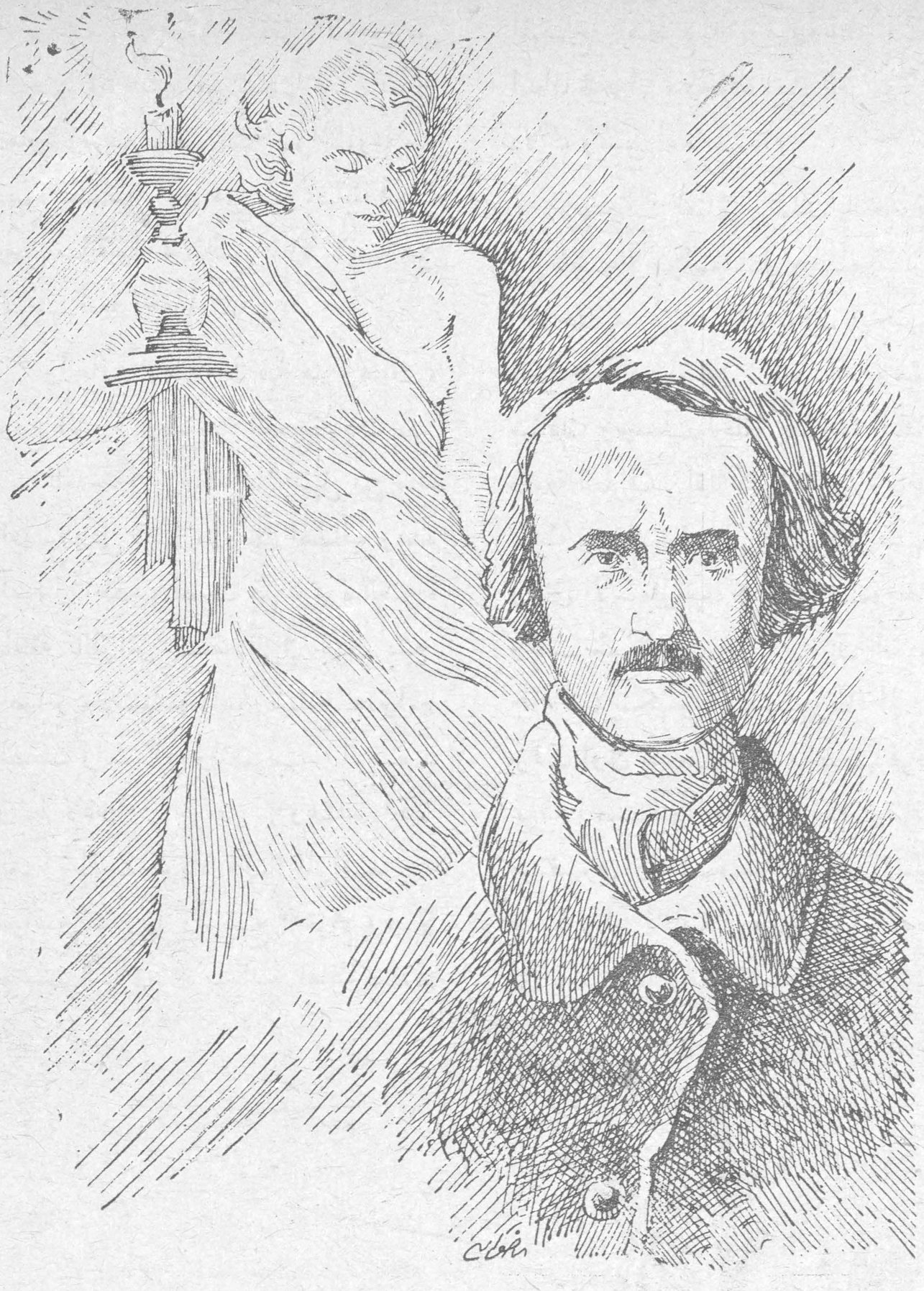
imaginings of the goddess of his dream — and if she drew her hand away, he would cry out to her like a child: don't go away!
Nor did Poe's need for woman spring only from his inability to manage his affairs by himself, but also from another factor of the soul: his loss of a mother's tenderness in childhood. His mother died when he was two years old, and he grew up not knowing the taste of that greatest of blessings, though knowing the worth of its taste; so his longing for it grew, his need of it deepened within him, and he came to search for it in every woman. Hence we do not wonder at his immense love for his wife's mother, and his love, all his days, for married women older than himself — indeed, at his attachment, when he was
fifteen, to the mother of a friend of his, in whose smile he glimpsed the tenderness of a mother; he mourned her loss until his death, and she affected the whole course of his thought and his poetry, and years after her death he wrote of her his sweetest piece, "To Helen." We do not wonder at this from him who held that when one angel whispers to his companion in heaven, they find, among all the burning words of love, no word holier than "Mother"!
The reader of the story of Poe's life will glimpse that he was a lover from his earliest youth, and that his tie to woman was not cut for a single day until his death. That was because of his need of her, as we have said, and because his love was distinguished by this: it was a