As for the question, it is truly a crying embarrassment for an artist who has vowed his heart to the beauty of absolute art — how, then, shall he fix it upon a single work of art?!
And then, art is a picture of life with all its beauty and ugliness, its gladness and grief, its happiness and misery; and when art reaches its summit in expressing any one of these, it is a masterpiece that occupies our heart and our mind forever.
For this reason it is impossible to divide art into parts and to prefer within it, for it is one cohesive whole whose aim is life; and in preferring within it we move in a vicious circle.
Holding fast to this creed, I present to the reader — upon whom I have intruded with this preamble, depriving him of the talk of art — a work by one of the giants of art: one who gave the world an undying revolution and bestowed upon it, out of his genius and his blood, an everlasting heritage that does not wear away — the prodigy of the generations, Michelangelo Buonarroti: architect, sculptor, and painter. He is the author of the dome of the church of St. Peter, that miracle of building; the creator of the statue of Moses, that miracle of art; and the painter of the Sistine Chapel, where stands the Day of Judgment, which will remain a symbol of human genius so long as humanity remains.
As I declared before, all the masterpieces are dear to me, beloved to my heart. Yet I shall speak, of necessity, about one of them, because, beyond its artistic beauty, it contains a kind of human art that pleases us and profits us in this age — and in the world to come, God willing.
Michelangelo was not an artist who fashioned phantasms and idols with no bearing on his age or his nation, in order to earn a few paltry dirhams and win a manufactured fame. He was a reformer and the bearer of a human message; therefore his art was great and sweeping — his own country grew too narrow for it, so he filled the
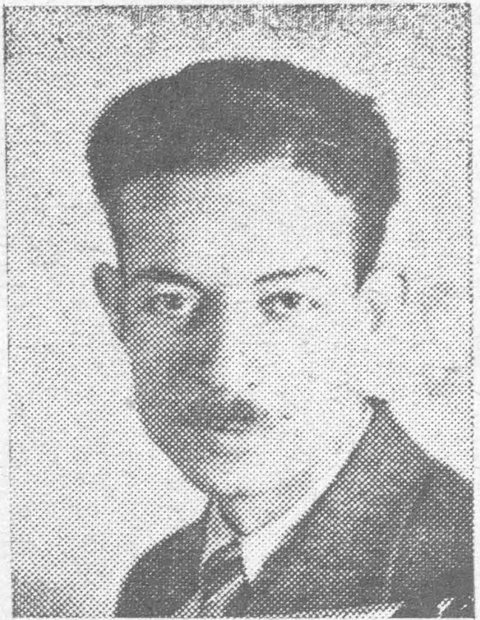
By the artist Moustafa Farroukh
world with it and imposed it upon the generations.
Michelangelo loved the human body as it was loved by the ancient Greek artists, who found in this body the gushing spring, for the beauty enfolded in its finest features and the wondrous harmony among its various attitudes. And if Greek art stopped at the representation of pure bodily beauty, Michelangelo added to it the expression of the human soul and the manifold feelings and hopes that stir within it. He devoted his art to learning its astonishing secrets, and put into it such anatomical art as rightly counts as a model to be followed by every aspirant. In this he is extraordinary in the life made manifest in the parts of bodies, extraordinary in representing simplicity and majesty, marvelous in the distribution of shadow and light, great in the variety of attitudes and dimensions, in reliefs and hollows, in balance and composition, in the power of expressing the idea moving within his soul — whether upon the colored canvas, or upon the mighty block of marble, or in the building that butts against the clouds. Michelangelo is great in all of these without hesitation: everything he produces is grand, all splendor and all majesty. His art was distinguished by movement, by power, and by revolt.
And here we choose — to use our dear magazine's phrase — one of his world masterpieces: the statue of Moses. A great mass of gleaming marble, five meters high, which only a moment before had been a piece of deaf stone; then the chisel of this genius passed over it and brought forth for men a living statue that speaks of humanity's feelings, its hopes and its pains. No wonder if a shudder of pride ran through Michelangelo when he beheld this rock standing before him, pulsing with life and poised to rise; he could not rein in his soul before this mighty creation, and he cried out from his depths a word that has become proverbial — after striking his statue with the hammer that trembled in his powerful hand, he shouted at it: "Speak, Moses!..."
Yes: the statue of Moses has spoken across the span of the generations, and has carried to humanity the essence of human thought and human feeling.
Whoever contemplates this treasure, and studies the skill and knowledge our artist deposited in it, sees all its parts as if they moved and breathed, came forward and trembled. The turn of the head toward the left, with that powerful mien, the sidelong glance, the great nose, and the compressed mouth with its jutting lower part, seems to call to revolt, to rouse to life, to give hope to the wronged and to threaten the wrongdoer. And his majesty is heightened by that twisting, tangled beard, which is a revolt in itself.
And whoever looks at the pose of the extended left arm, its muscles and veins standing out with force, sees it as if making ready for some grave deed. And how beautiful it is beside the movement of the folded right arm, which completes the harmony and adds to the sense of coiled readiness. And, to complete the meaning, in this hand he grasps the tablet of the Ten Commandments — to signify that the revolt he desires is a lawful revolt, springing from the right of man, not a destructive revolt of madness...