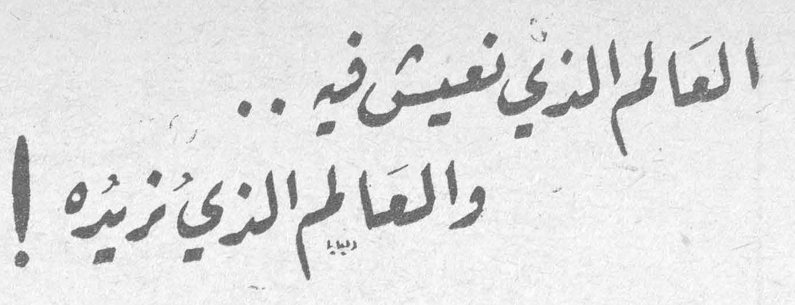
Last autumn a world women's congress was held in New York City, convened by a distinguished elite of American women headed by Mrs. Eleanor Roosevelt and Mrs. Alice McLean. Iraq was represented there, at the congress's invitation and by appointment of the government of His Majesty of Iraq, by the refined woman of letters Mrs. Maida al-Haydari Mahmoud. Lebanon was likewise represented by the distinguished pioneer of the renaissance, Miss Edma Bayoud.
The Woman's Voice had the honor of meeting her and speaking with her about this momentous congress, whose deliberations found a far-reaching echo in women's circles the world over.
She was on her way from America to Iraq when Mrs. Lily Badre was favored with a meeting with her. I found myself before an elegant lady about whom dignity, sweetness,
and intelligence radiated. Her talk with me about the congress was ample and engaging — how I wished I could convey it all to the readers of The Woman's Voice; but for lack of space, I have preferred to convey from it what concerns the descriptive side of the congress.
The gracious lady said:
The congress was arranged by Mrs. Alice McLean, one of the friends of Mrs. Eleanor Roosevelt, one of the prominent ladies of America, and president of the association of American women volunteers for aiding the American army during and after the Second World War. This lady had the thought that the world wants peace, and that woman has a great influence in the making of this peace. So she invited to meet with her nearly a hundred prominent women of America for an exchange of ideas to this end. These in their turn decided to invite the women of the world, and they named this congress or assembly "The World We Live In — The World We Want..."
As for the aim of this congress, it was to study the world's economic, political, social, and spiritual problems in the cause of the understanding that leads to the desired peace. In pursuance of this aim, invitations were sent to all the nations of the world, and fifty-four nations answered the call. The total came to three hundred persons. The participating members, however, numbered two hundred and fifty, representing different principles, socialist and democratic of their various kinds. The congress lasted twenty days: fifteen of them at Mrs. McLean's farm, eight of them for the congress's discussions, and the remaining days for studying American country life, for amusement, and for rest. The discussions were divided equally among the four following subjects: the political, the economic, the
social, and the spiritual. At the first meeting we decided unanimously: First — to adopt no resolution upon our discussions, for we felt that congresses are now many and resolutions more numerous still, but the carrying-out of them scant; better, then, to leave the profiting from the congress's principles to individual action.
Second — not to speak of national problems, because they breed tension among the various nations.
On the last day Mrs. Eleanor Roosevelt honored the congress and delivered an address welcoming us and recalling woman's importance in a lasting peace — for woman is a "mother" — and likewise the importance of knowing foreign languages for understanding among the different peoples. At last the congress came to an end, as everything must. We returned to New York, having learned that two days later we would gather in a general
assembly at the largest hotel in the world: the Waldorf Astoria.
This is a brief, comprehensive word on what befell us during the time the congress was in session. As for some of what we discussed and agreed upon, in summary it is this: First — the specter of fear that now dominates the world must be wiped away. Among the most important means of wiping away this specter is that the body of the United Nations should have a strong authority, so that it may be respected and obeyed by all nations.
Second — an international commission must be formed to know the secret of the atomic bomb, or else this secret must be made public; the use of this force, or of any weapon, must then be abolished until the
democratic order prevails in the full sense of the word — that is, until there are governments of the people and for the people, independent, free, bound by the sense of right.
Third — man in this world must have a standard of living that fits him to be an effective citizen in his society.
Fourth — we did not discuss the problems of woman, because the problem of woman was considered solved now that Western woman has taken her rights and become man's equal. We therefore discussed, in general terms, culture, health, and the like. Culture begins in childhood, for the growth of character; then in the stage of adolescence, for the growth of principles; then in maturity, when character and principles come together and are applied in life. All felt that every fanaticism is harmful to the child; we must therefore encourage lessons in social studies, so that the pupil may appreciate and respect the culture, governments, history, and religions of other nations, and so his mind may broaden. The pupil must be encouraged to know world events at whatever time, and thus be trained to use his own mind in solving life's problems of every kind. But before all else, he must be fed, must have a dwelling, and his material and moral life must be secured. Finally, we must teach him a comprehensive foreign language in addition to his own, that he may come to an understanding with the members of other nations.
Fifth — the affairs of mind and spirit are the road to happiness, and they are the lasting things. Religion is the worship of one God; and if we worship God and follow His guidance, we shall attain that longed-for happiness.
Miss Edma Bayoud
As for Miss Edma Bayoud, she received me at the Cooperation Club in Beirut, where she works with her