building of a sound and wholesome society — not of drugged women who know no meaning in life beyond adornment and affectation.
The women's movement in Lebanon gives glad tidings that this homeland is blessed with the good mother, the wise wife, and the capable, managing woman. In our mothers are radiant faces of goodness, fruitfulness, and blessing; and in them are dutiful, tender hearts holding a warmth that strengthens our faith and gives life a meaning in our eyes.
And in our society there is the wife who has known how to melt into her husband in a life of love, sacrifice, and devotion, for the sake of building a family over which the angels of happiness and the banners of peace hover.
And in our educated women, who have been given the chance to sip some measure of learning, there is that which moves us, the daughters of today, to lift our heads in love of the daughters of our sex, in pride of them and of their influence in their righteous works — works which the homeland will immortalize for them, and for which the new generation will thank them.
Of all these women we stand in need, my lord Man; and all of them must be taught the higher learning, so that the Arab woman may return to her first estate and teach the whole world the meaning of true love and true peace!..
Q. — What should the brush used for cleaning the teeth be like?
A. — The bristles of a brush are of three kinds: very stiff, moderately stiff, or soft. The stiff kind is used for gums that hold firmly on the teeth; the moderately stiff for gums liable to weakness; and the soft for weak gums. In these cases it is advisable to go back to the dentist for his opinion in determining the kind of brush suited to the gums, because it very often happens that the brush is unsuited to the condition of the gums, and harm comes of it without its user knowing of that harm — so that the result turns out the opposite of what is wanted.
Many people use a finger of their hand to clean their teeth, and this is a useless method and very harmful to the gums, for using the finger horizontally weakens the gums and produces in them notches that disfigure their appearance. These notches make a comfortable home for microbes; many diseases arise in them, and a foul odor in the mouth. The finger may be used in the mouth in one case only, namely: when the gums are weak there is no harm in using the finger, after taking the dentist's opinion, for massage — vertically, on the lower jaw — that is, by placing the finger at the base of the gums and massaging them vertically from below upward and back again, and that only after the finger has been thoroughly cleansed. This helps to strengthen the gums, if it is done according to the rules just stated.
Q. — How is the brush used to clean the teeth?
A. — We have already said what the brush for cleaning the teeth should be like, and its kinds. For the brush to yield the desired result, its user must open his mouth and begin the cleaning in the following manner: the brush is placed at the base of the
gums on the lower jaw and drawn upward, vertically, without returning vertically downward; and the reverse on the upper jaw, from above downward — that is, you place the brush at the top of the gums in the upper jaw and bring it down vertically, pressing on it as much as possible. This operation is difficult at the start, but with time the hand grows practiced at it and it becomes easy to perform; for the most important thing in cleaning the teeth is using the brush according to the rules. This method gives the gums strength and cleans out what is within them of the remnants of food and the like — since what is meant by cleaning is the removal of whatever has lodged between the gums and the teeth, and their strengthening. Thus we obtain what is wanted: the preservation of the gums, the cleaning of the teeth, and the keeping of their natural whiteness and luster. Using the brush horizontally is very harmful, for by this method the gums are weakened, the gum flesh that lies between each tooth and the next is lost, and the tissue between gum and tooth is weakened, while the debris lying between the edge of the gum and the tooth is pushed in; and this is what causes inflammations and an unnatural redness in the gums, from which arise pyorrhea and its kindred diseases.
I have heard many people say: "What have we to do with cleaning the teeth and caring for them, and buying toothbrushes and toothpastes and the like? Look at the teeth of the Bedouin who dwell in the desert — of a dazzling whiteness, though they use neither brush nor pastes, and know no dentist and have no need of one." This is a most engaging inquiry, and we shall give it its due in a coming issue.
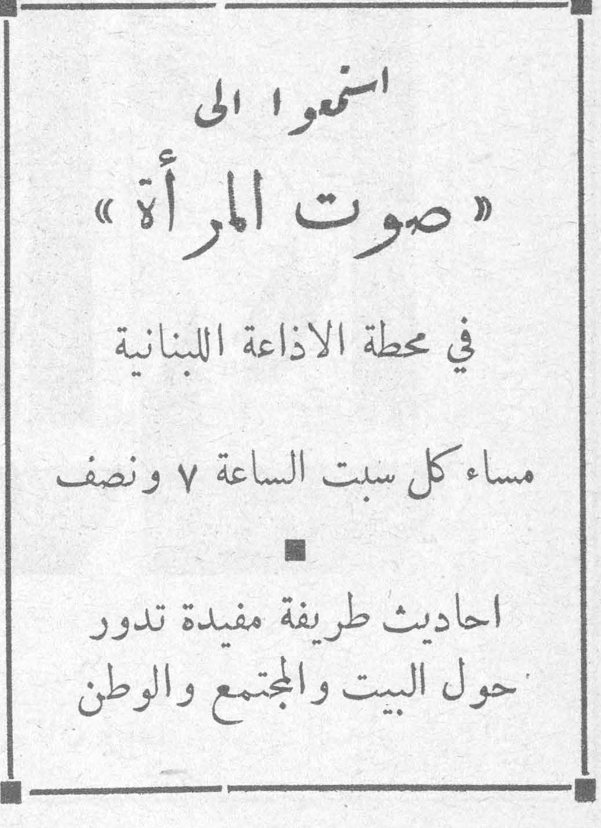
Listen to
"The Woman's Voice"
on Radio Lebanon
every Saturday evening at half past seven
Delightful and useful talks on the home, society, and the homeland