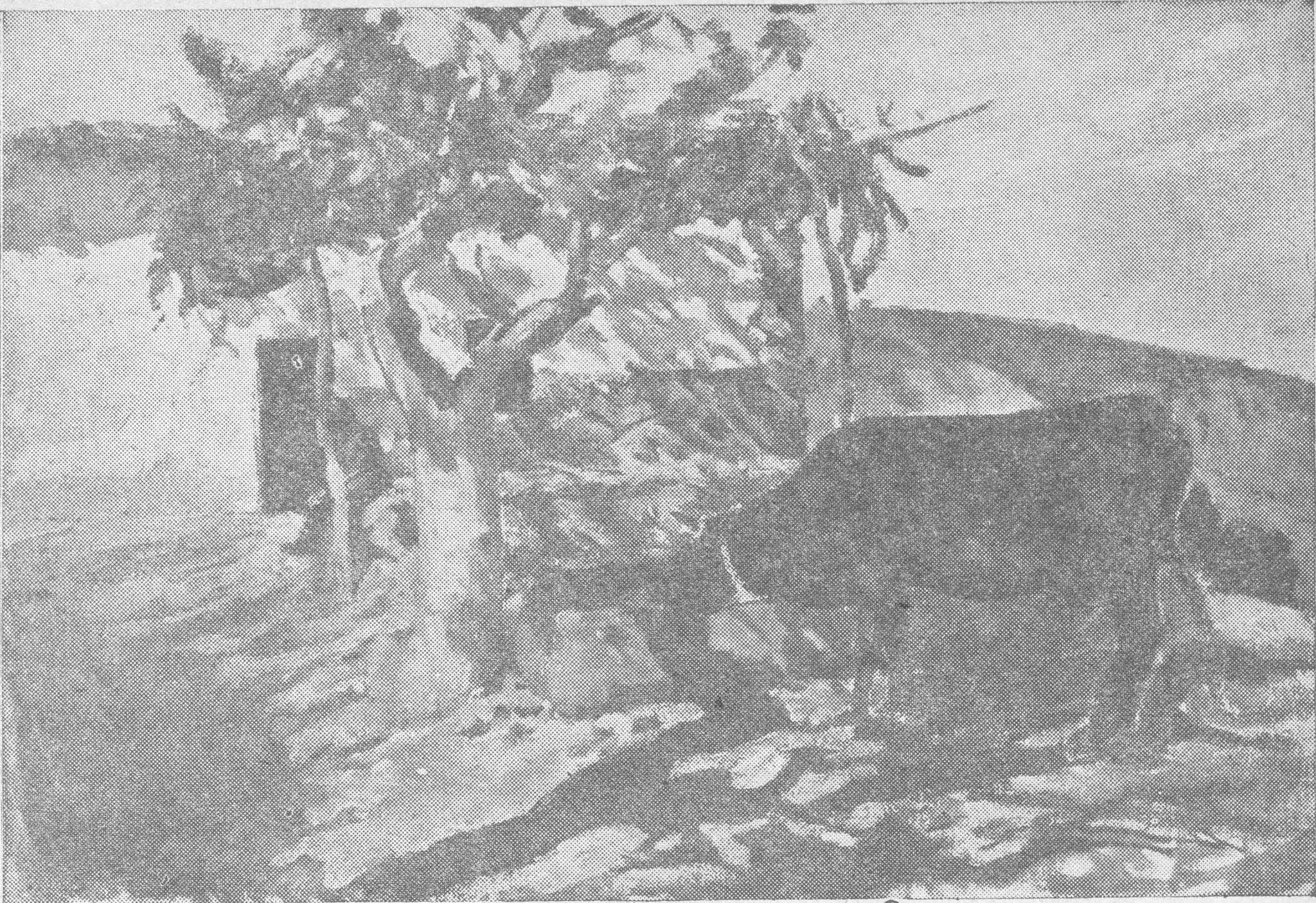
The Cow: by Saliba Douaihy
it show us the important distinguishing qualities in things, those which can stir in us a pure artistic emotion." So says Albert Barnes in his book, which is taught at the Louvre museum. It is the best word to speak before we begin to talk of the Lebanese artists and their exhibition.
If we begin with the dead artists, we find their paintings representing an art over which time has eaten and drunk, an art which today is without doubt numbered among the dead. It is strange that these artists, who journeyed to Italy and to Europe to receive the fine arts — sculpture and painting — never once came into contact with that band of rebellious Western artists who were then contending with the world to create a frank and pure art. Stranger still, they returned to us bearing a Western art which the Westerners themselves were trying to cast off and demolish. It would be well for these paintings to be kept in a special permanent place to which the researcher may return if he wants a reference for the history of art in Lebanon — and not to be exhibited again year after year.
But I except from this collection two paintings or more that are worthy of appreciation. One of them is by the brush of Gibran (no. 127), an oil painting of a young girl seated, her chin taken in her right hand, looking at you with her dreamy, wandering eyes as though she were visiting another world, or as though the painter had wearied her, so that she fell to thinking and thinking until thought lost her in a world of fancy of the kind handed down from Gibran. The painter succeeded in neglecting most parts of the picture, which lent the face a special freshness of color and a manifest clarity of expression; thus the painting acquired a definite point of focus. The painting holds a depth of feeling and delicate,
harmonious colors, as though the artist had loved his sitter and shared her fancy and her feeling.
Gibran's paintings are distinguished by their maturity and the harmony of their colors, and by subject matter which in its execution resembles the art of sculpture more than the art of painting — perhaps the result of his direct contact with Rodin and his serious interest in Blake's drawings, his subjects and his poems.
I except also some of the paintings of Makarov Fadel, which contain an attempt at liberation from the fetters of the schoolmasters — an attempt, and no more. He has a self-portrait, beautiful in execution, sincere in its expression and vitality, which makes you feel this young man's effort to slip the yoke of the classicists and their fetters.
The paintings of Khalil Saleeby are distinguished by precision of style and richness of color, but they lack a great deal in force of feeling and personality, and in the recording of the model's inner life. We do not see, for example, in the portrait of Ameen Rihani the power of thought and rebellion of soul for which the philosopher of Freike, the friend of Faisal, was famous; nor in his heads that life which appears so clearly in Farroukh's paintings. And the feeling in the portrait of his wife is very slight indeed when measured against the artists who painted the same subject — the likes of Roberts and Rembrandt, for example. (Some may object to comparing these men with our own artists, but it is the only means of appraising and evaluating art.) I do not say that Saleeby's paintings are devoid of feeling and vitality, but rather that they are weak in that respect; they doubtless surpass some of the exhibited paintings in that same vitality, and differ from certain others. I have been told that there are paintings finer and stronger than these by the same artist; for